
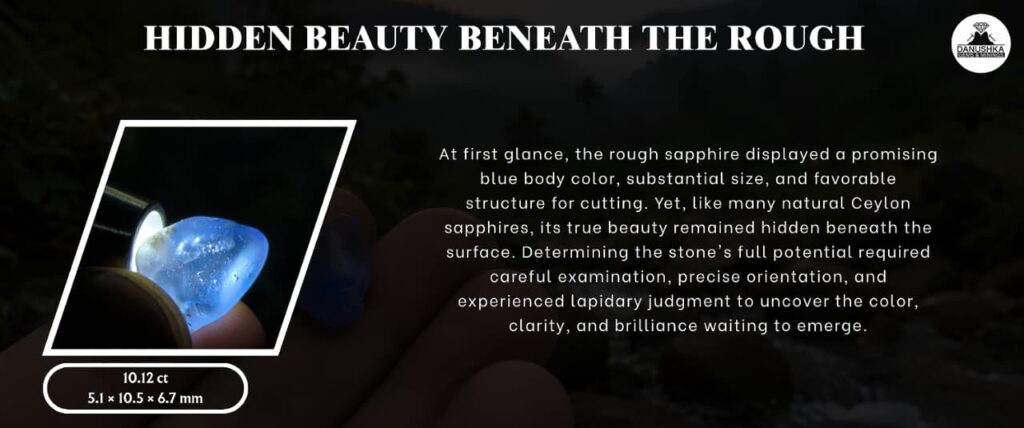
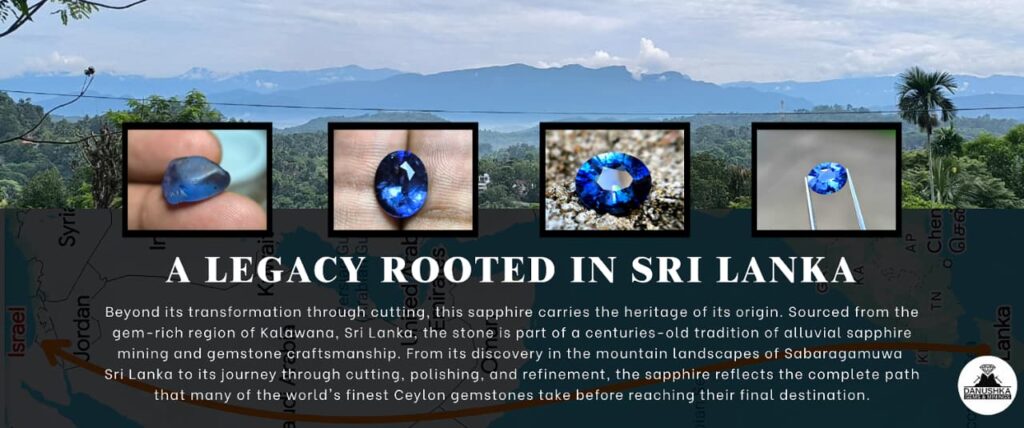
Every gemstone has its own journey, but some stones carry more than a simple rough-to-finished story. This Ceylon natural blue sapphire began as a 10.12 ct facet grade rough stone measuring 15.1 × 10.5 × 6.7 mm, sourced by Danushka Gems & Minings from Kalawana village around mining in Sri Lanka. The rough was found during an evening gem hunting visit in the beautiful mountain area of Kalawana, one of Sri Lanka’s well-known gem-bearing regions connected to alluvial sapphire deposits and traditional gemstone trading.
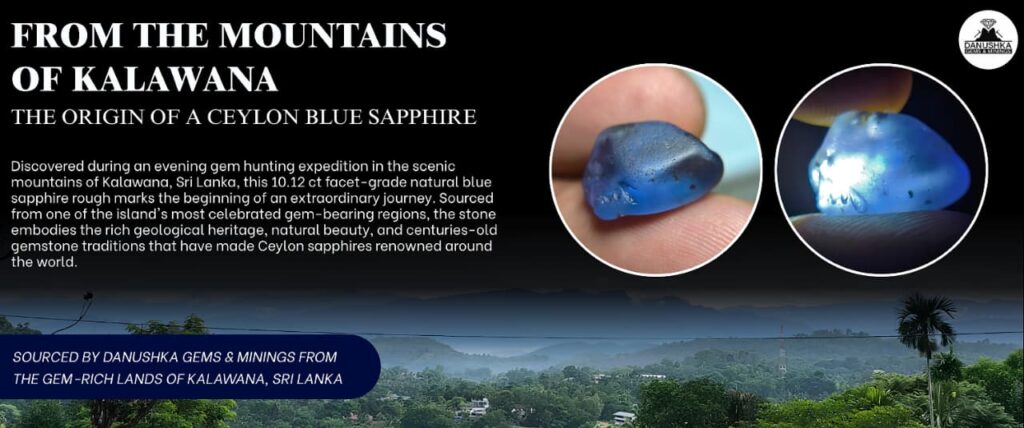
In rough form, the stone showed a promising blue body color with enough size, depth, and structure for cutting consideration. Like many natural sapphires from Sri Lanka, the rough did not immediately show its full finished beauty from the outside. A rough sapphire often hides its strongest color, clarity potential, and final brilliance until it is correctly studied, oriented, pre-formed, and faceted. This is why practical source experience and lapidary judgment are very important in rough gemstone buying and cutting.
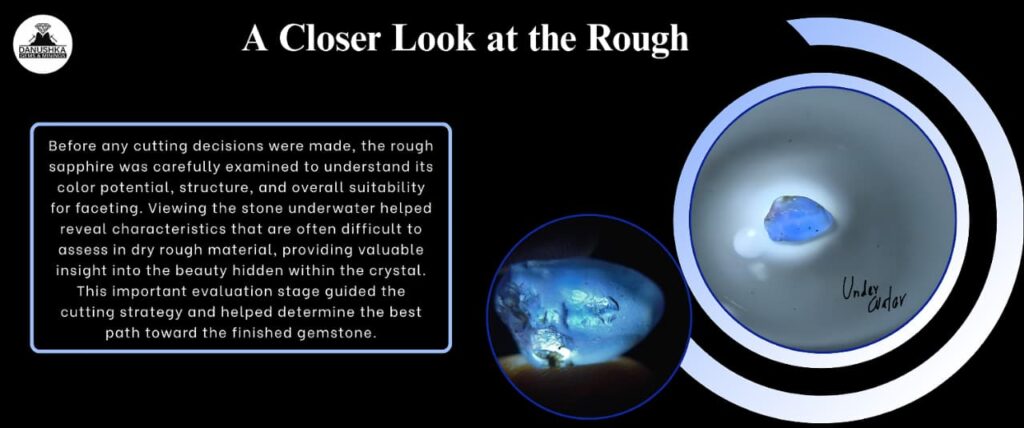
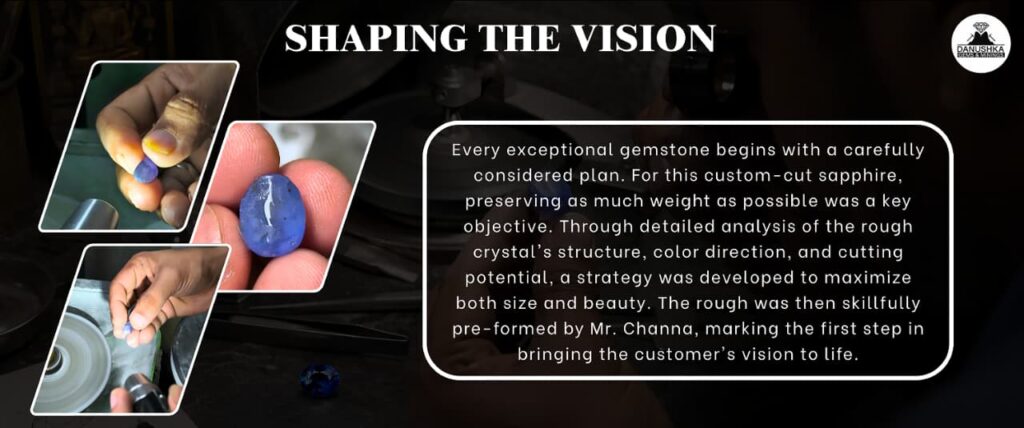
This sapphire was selected for a custom cutting project according to the customer’s request. The first priority was higher weight retention, meaning the cutter had to try to save as much carat weight as possible while still creating a usable faceted gemstone. The rough was carefully checked before cutting, considering the shape, depth, color direction, inclusions, and possible face-up result. After inspection, the stone was pre-formed by Mr. Channa, preparing the rough into a suitable shape for faceting.
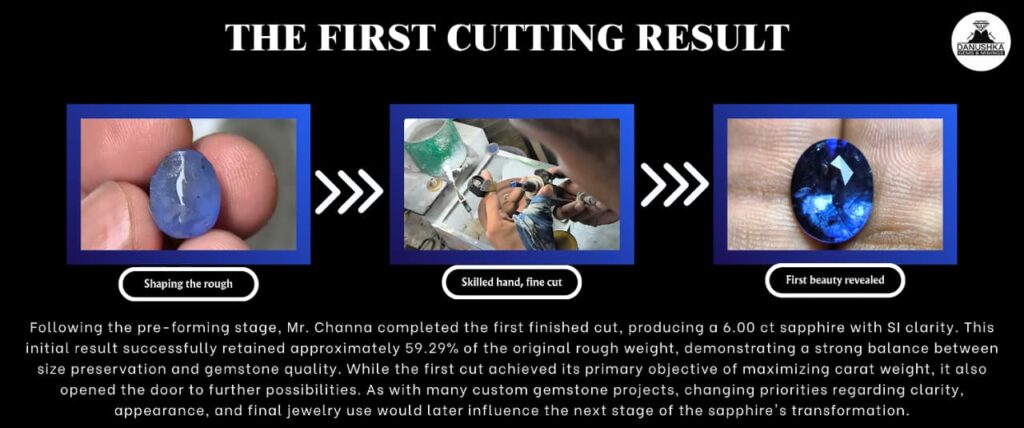
The first finished cut was completed by Mr. Channa, resulting in a 6.00 ct sapphire with SI clarity. From the original 10.12 ct rough, this first stage saved approximately 59.29% of the original weight. The cutting loss at this stage was 4.12 ct, or around 40.71%. This was a strong weight-saving result, especially because the first aim was to retain higher carat weight. However, gemstone cutting is not always finished with the first result. Sometimes the customer’s requirement changes after seeing the first cut, especially when clarity, jewelry use, or final beauty becomes more important than only weight.
After reviewing the first finished stone, the customer requested better clarity. To improve the visual clarity and overall appearance, the sapphire was recut with guidance from an expert recutter, Mr. Praveen. This second cutting stage reduced the stone from 6.00 ct to 4.50 ct, improving the clarity level from SI to VS. This means 1.50 ct was removed during the recut, which equals 25% of the 6.00 ct first finished stone. Compared with the original 10.12 ct rough, the 4.50 ct stage represented approximately 44.47% total weight recovery.
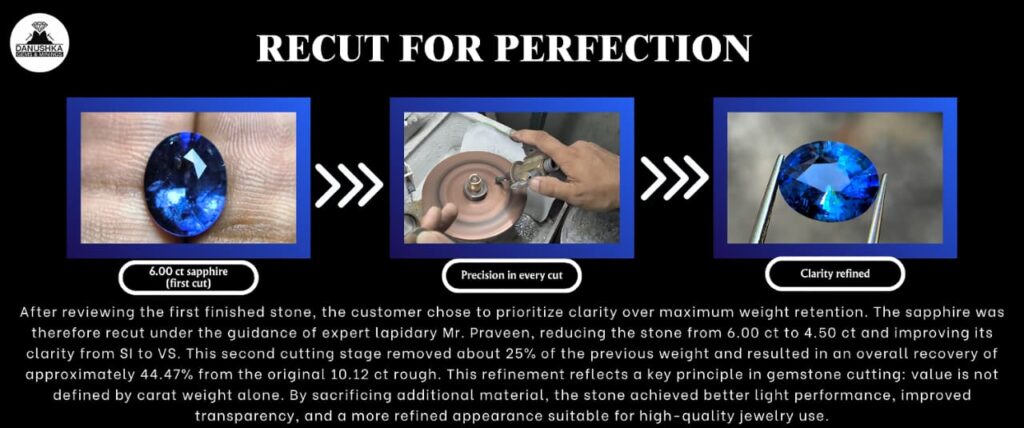
This stage shows an important reality in sapphire cutting: higher weight is not always the final goal. A heavier stone can look valuable by carat weight, but if the clarity, shape, or light performance does not match the customer’s needs, further cutting may be necessary. In this case, removing extra material helped improve the visual clarity and gave the stone a cleaner appearance suitable for more serious jewelry consideration.
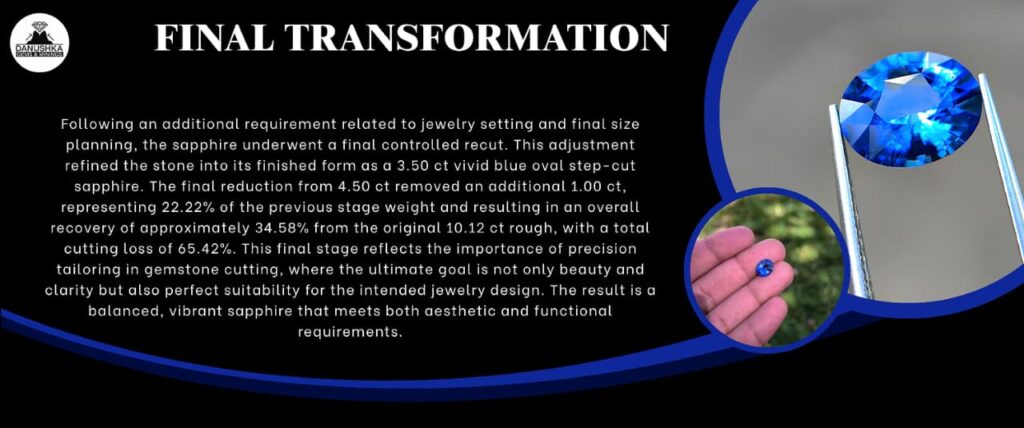
Later, the customer had an additional special requirement connected to jewelry attachment and final size planning. Because of this, the sapphire went through another controlled recut. The stone was finally finished as a 3.50 ct vivid blue oval step-cut sapphire. From the 4.50 ct stage to the final 3.50 ct result, another 1.00 ct was removed, which equals 22.22% of the 4.50 ct stone. Compared with the original 10.12 ct rough, the final 3.50 ct sapphire represents approximately 34.58% total weight recovery, with a total cutting loss of 6.62 ct, or around 65.42%.
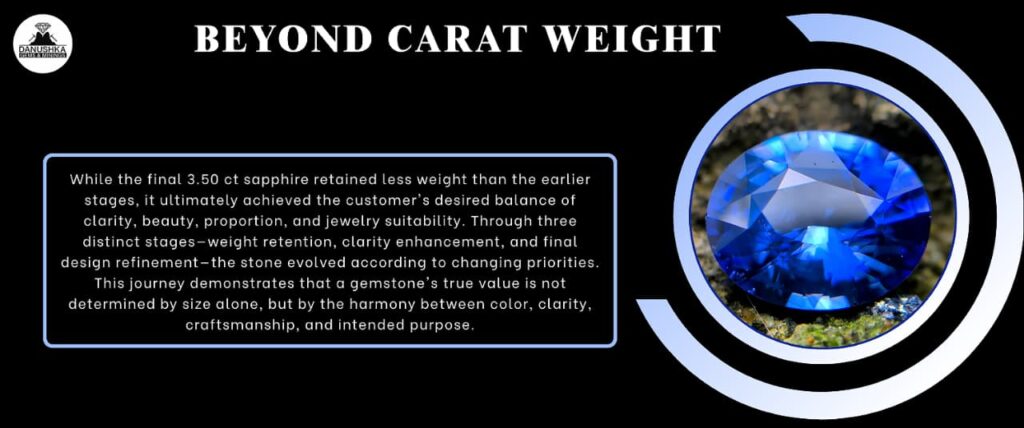
Although the final recovery percentage may look lower than the first 6.00 ct stage, the final result achieved a more refined purpose. The stone moved through three important stages: first, weight priority; second, clarity improvement; and third, jewelry-size and design requirement. This type of journey shows that gemstone value is not only about the highest possible weight. It is also about the correct balance between beauty, clarity, color, proportion, customer requirement, and final use.
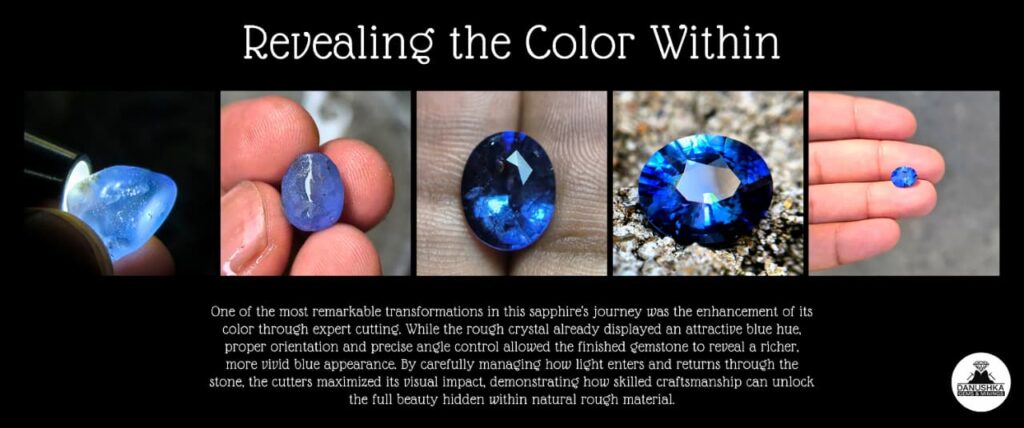
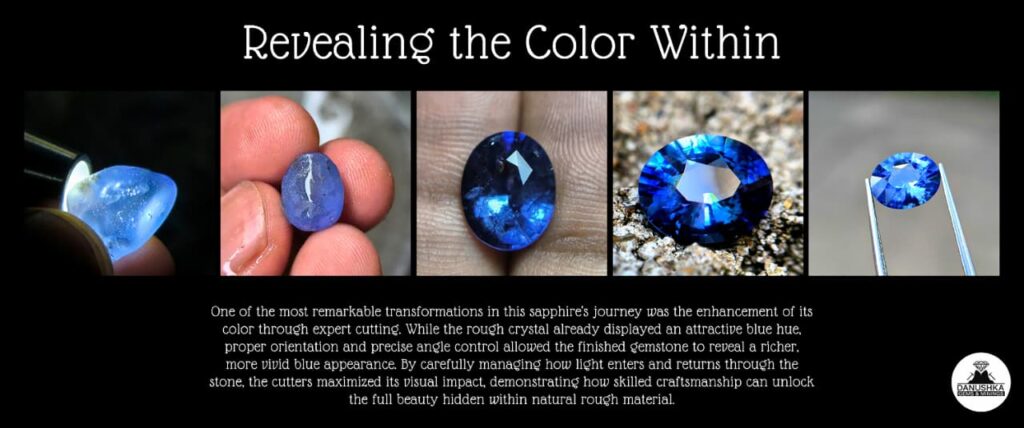
One of the most special parts of this sapphire journey is the color improvement after cutting. In rough form, the blue color was already attractive, but after proper orientation and correct angle cutting, the finished stone displayed a richer and stronger vivid blue appearance. This happens because the cutter controls how light enters, reflects, and returns from the stone. If the angles are not suitable, a sapphire may look too dark, too shallow, windowed, or less lively. With the right cutting direction and angle control, the same natural rough material can show a more intense and beautiful face-up color.
The final oval step cut gave the stone a clean, elegant, and practical appearance. Oval shapes are popular in fine jewelry because they offer good spread, balanced outline, and classic beauty. The step-cut style also gives the sapphire a calm, structured reflection pattern, allowing the vivid blue color to appear with depth and character. For a natural Ceylon blue sapphire, this kind of finished result shows how careful cutting can reveal the true quality hidden inside the rough.
Kalawana village around mining in Sri Lanka adds another meaningful layer to this stone’s identity. Sri Lanka has been known for sapphires for centuries, and areas around Kalawana are connected with the island’s long alluvial gem tradition. Stones from these regions are often recovered through local mining networks, then studied, traded, cut, polished, and prepared for international buyers. This sapphire followed that real path from a mountain-area source visit to practical lapidary work and finally into a customer-focused finished gemstone.
At Danushka Gems & Minings, this project represents the real work behind source-connected gemstone supply. The process did not stop at buying and selling a rough stone. It included field sourcing, rough inspection, pre-forming, first cutting, customer feedback, expert recutting, clarity improvement, final size adjustment, and finishing the stone according to jewelry needs. This is the practical side of gemstone business, where each decision affects weight, beauty, value, and final purpose.
From 10.12 ct rough to 6.00 ct first cut, then to 4.50 ct with improved clarity, and finally to a 3.50 ct vivid blue oval step-cut sapphire, this gemstone shows a different kind of journey. It is not only a transformation from rough to polished. It is a story of changing priorities, skilled cutting decisions, customer requirements, and the hidden potential of Ceylon sapphire revealed through experience.
FAQ
1. What was the original weight of this blue sapphire rough?
The original Ceylon blue sapphire rough weighed 10.12 ct and measured 15.1 × 10.5 × 6.7 mm.
2. Where was the rough sapphire sourced from?
The stone was sourced by Danushka Gems & Minings from Kalawana village around mining in Sri Lanka, during an evening gem hunting visit in the mountain area.
3. What was the first finished weight?
The first cut finished stone weighed 6.00 ct with SI clarity, saving approximately 59.29% of the original rough weight.
4. Why was the stone recut after the first finish?
The customer wanted better clarity, so the stone was recut to improve the visual appearance and clarity level.
5. What was the second finished weight?
After recutting, the sapphire became 4.50 ct with VS clarity.
6. What was the final finished weight?
The final gemstone was finished as a 3.50 ct vivid blue oval step-cut sapphire.
7. What was the total recovery from rough to final stone?
The final 3.50 ct stone represents approximately 34.58% recovery from the original 10.12 ct rough.
8. Why did the color look richer after cutting?
The final color appeared richer because correct orientation, cutting angles, and polishing helped improve light return and face-up blue color.
9. Who worked on the cutting process?
The stone was pre-formed and first cut by Mr. Channa, and the recut process was handled with expert support from Mr. Praveen.
10. What makes this sapphire journey special?
This stone went through different stages of customer requirement, from weight priority to clarity improvement and final jewelry-size planning, showing how professional cutting decisions shape the final gemstone.