
Introduction
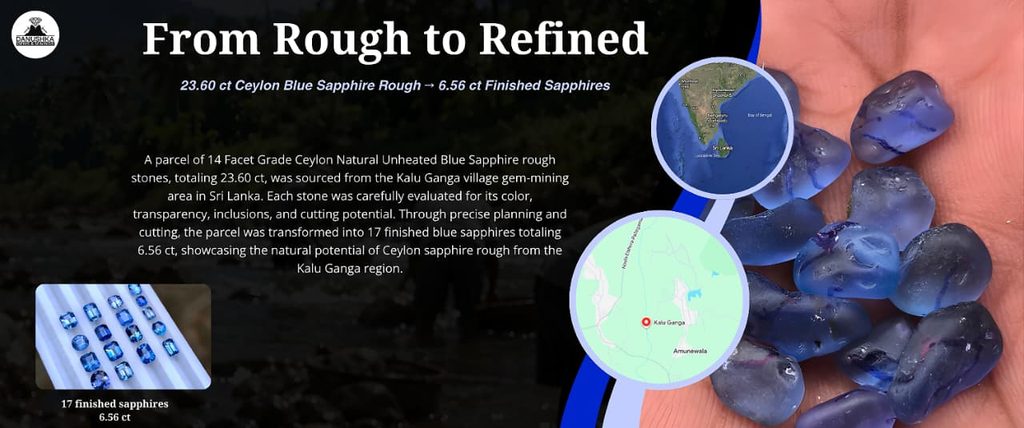
This gemstone journey began with a Facet Grade Ceylon Natural Unheated Blue Sapphire rough parcel, consisting of 14 individual stones with a total weight of 23.60 ct. The rough pieces ranged from approximately 2.35 ct to 1.00 ct each and were sourced from Kalu Ganga village around mining in Sri Lanka.
At Danushka Gems & Minings, rough sapphire parcels like this are not evaluated only by total carat weight. Every stone must be studied individually for its blue color, transparency, depth, natural surface, inclusions, feather positions, cutting direction, and usable clean areas.
This parcel was purchased by our customer from Australia. The goal was not simply to preserve the maximum possible rough weight. The priority was to transform the material into a practical collection of cleaner finished Ceylon sapphires while respecting the natural limitations of each rough stone.
The result was a finished parcel of 17 blue sapphires totaling 6.56 ct, with individual finished weights of approximately 0.50 ct to 0.15 ct and sizes ranging from approximately 5.5 mm to 3 mm.
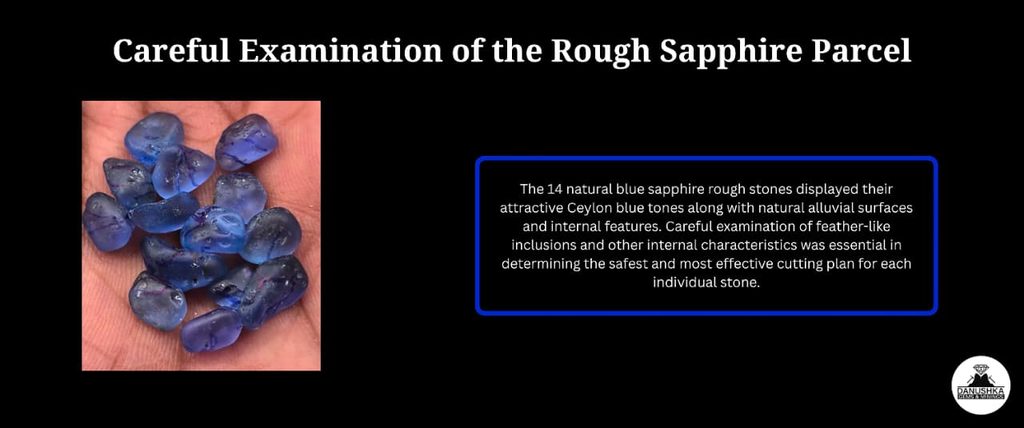
The original parcel contained 14 natural blue sapphire rough stones.
The rough showed a range of attractive Ceylon blue tones together with natural alluvial surfaces and internal features.
One of the most important considerations was the presence of feather-like inclusions and other natural internal areas. These features had to be studied carefully because cutting directly through the wrong section could affect the final clarity, durability, appearance, or usable yield.
For this reason, the cutting plan was based on each stone individually rather than applying one standard shape to the whole parcel.
Careful Examination Before Cutting
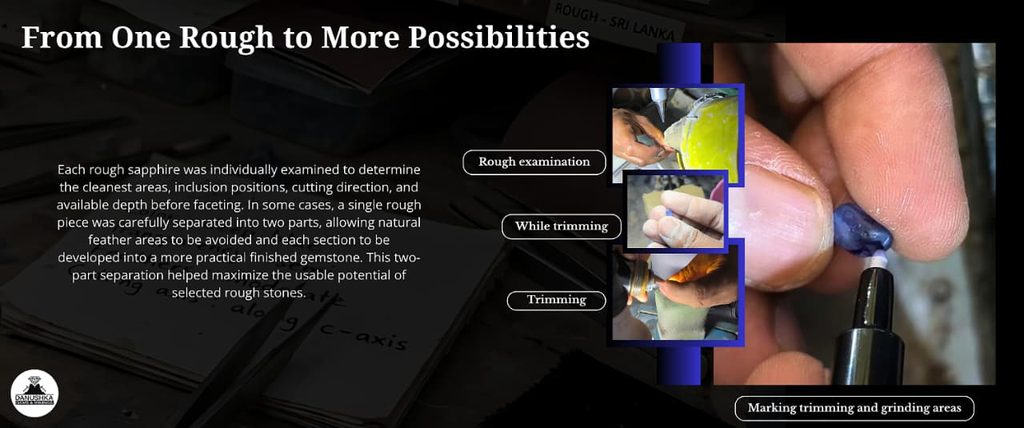
Before faceting, the rough pieces were carefully inspected to identify the most usable areas.
The cutter and Danushka Gems & Minings considered several practical factors:
Where is the cleanest transparent area?
Where are the feather inclusions positioned?
Which direction gives the strongest blue face-up color?
How much depth is available?
Can an inclusion be removed without sacrificing too much clean material?
Would separating one rough piece create two more useful finished stones?
These decisions are especially important with smaller sapphire rough because even a small adjustment can significantly change the finished weight and dimensions.
Some unnecessary or inclusion-affected areas were trimmed away. In several cases, one original rough piece was separated into more than one usable section.
That is why the original 14-piece rough parcel eventually became 17 finished sapphires.
In simple funny metaphor for trimming, some of the stones “made babies” during cutting. 😁 But technically, the decision was made because dividing certain pieces allowed us to work around natural feather areas and obtain more practical finished gemstones.
Why Weight Recovery Was Not the Only Priority
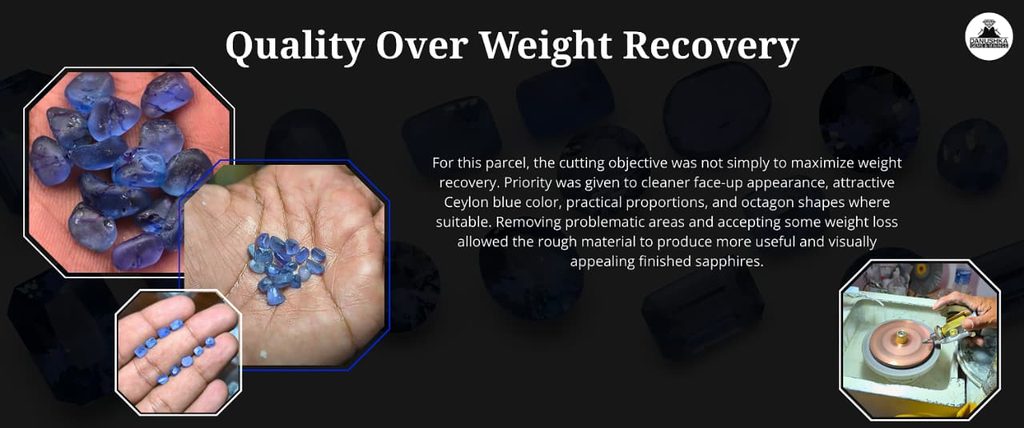
With rough gemstones, high weight recovery is desirable, but it is not always the most important goal.
If a cutter keeps too much unnecessary material simply to preserve carat weight, the finished stone may retain visible feathers, weak symmetry, poor proportions, unattractive orientation, or areas that reduce the overall face-up appearance.
For this parcel, the better approach was to prioritize:
cleaner face-up appearance and priority for octagon shapes, attractive blue color, usable proportions, removal of problematic areas, and practical finished gemstones.
This naturally resulted in a lower percentage recovery, but it produced a more useful collection.
Finished Blue Sapphire Parcel
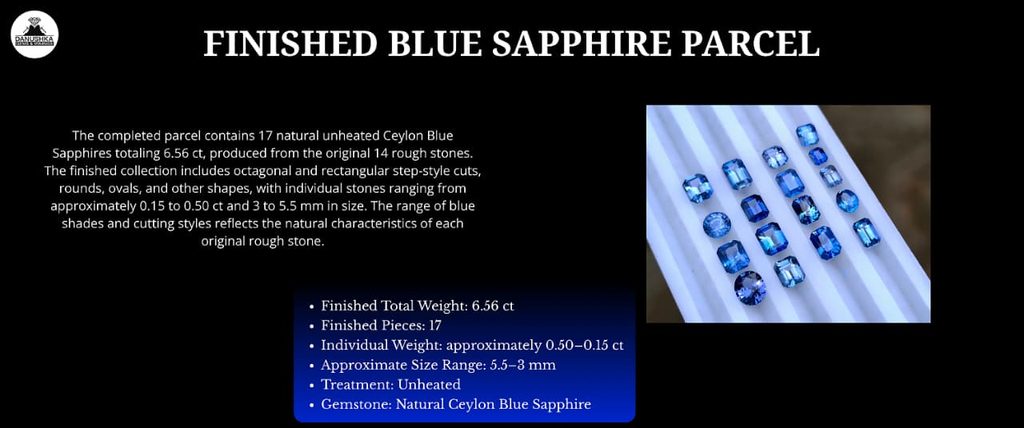
After trimming, separation, faceting, and polishing, the original 14 rough stones became a finished collection of 17 natural unheated Ceylon Blue Sapphires.
The finished parcel contains a mixture of shapes and cutting styles, including octagonal and rectangular step-style cuts, rounds, ovals, and other shapes selected according to the structure of each original rough piece.
Rather than forcing every stone into identical dimensions, the cutters worked with the natural material.
Finished Result
Finished Total Weight: 6.56 ct
Finished Pieces: 17
Individual Weight: approximately 0.50–0.15 ct
Approximate Size Range: 5.5–3 mm
Treatment: Unheated
Gemstone: Natural Ceylon Blue Sapphire
The collection now shows a range of blue shades and finished sizes suitable for different jewelry, collection, or dealer requirements.
Before and After Cutting Mathematics
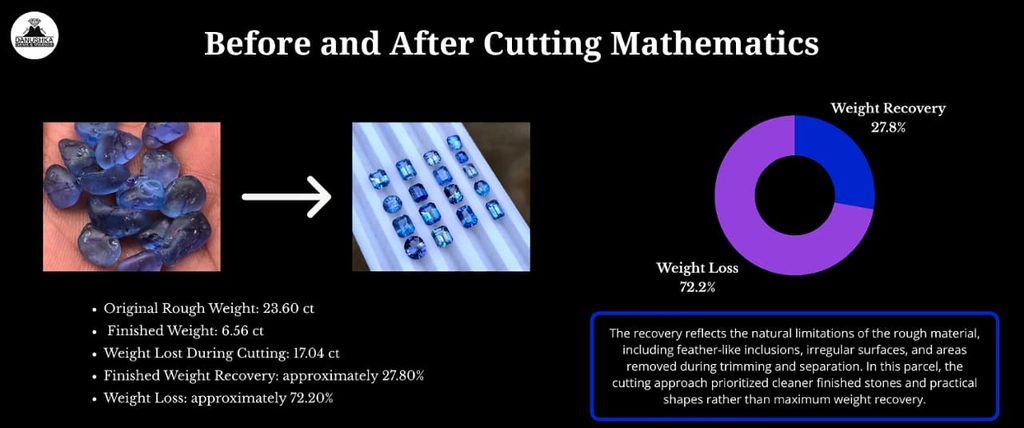
The complete cutting result gives a realistic example of how much rough weight may be sacrificed when inclusion removal and cleaner finished stones are prioritized.
Original Rough Weight: 23.60 ct
Finished Weight: 6.56 ct
Weight Lost During Cutting: 17.04 ct
Finished Weight Recovery: approximately 27.80%
Weight Loss: approximately 72.20%
A 27.80% cutting recovery is not a high recovery percentage, and we do not describe it as such.
However, percentage alone does not explain the quality of a cutting result.
The original rough included natural feather-like inclusions, irregular alluvial shapes, surface material, and areas that needed to be removed. Some pieces were also separated into multiple smaller stones to avoid undesirable internal features.
For this particular parcel, the objective was quality and shape-focused recovery rather than maximum-weight recovery.
From Sri Lankan Source to an Australian Customer
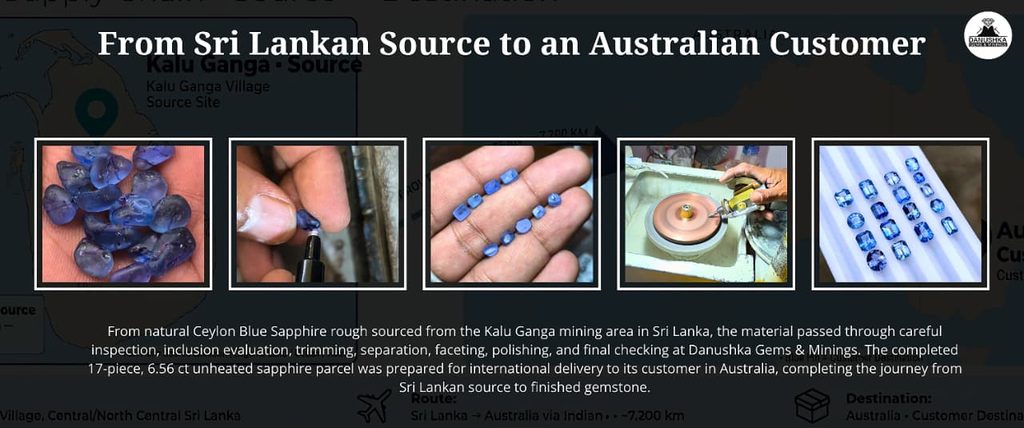
The journey began with natural sapphire rough sourced from Kalu Ganga village around mining North central province in Sri Lanka.
From there, the material passed through the complete Danushka Gems & Minings process: rough sourcing, inspection, cutting discussion, inclusion evaluation, trimming, separation, faceting, polishing, final checking, and preparation for international delivery.
The buyer in Australia originally selected the material as rough and followed the transformation into the finished collection.
The finished 17-piece, 6.56 ct Ceylon Blue Sapphire parcel is now ready for shipping to Australia, completing another source-to-finished gemstone journey.
This is what we mean when we talk about a gemstone journey from the source to your hand.
A Practical View of Rough Sapphire Buying
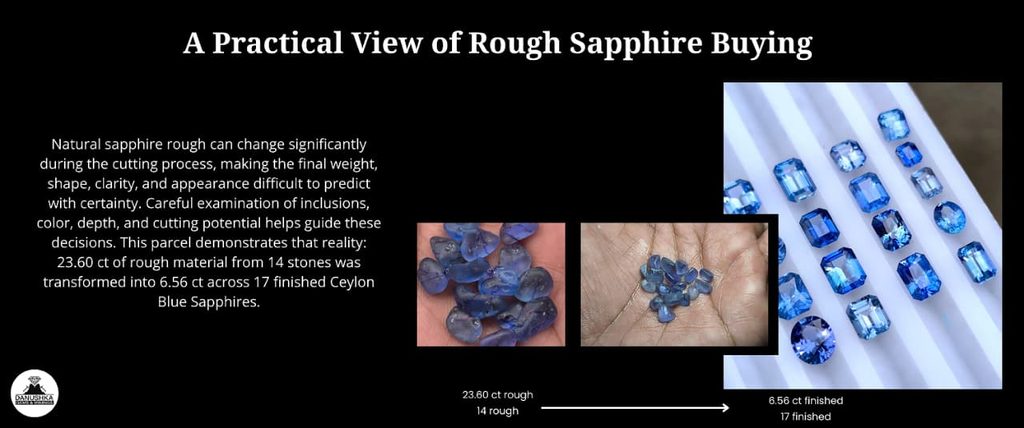
Buying sapphire rough is very different from purchasing an already finished gemstone.
With a finished sapphire, the buyer can immediately see the final carat weight, dimensions, clarity, shape, color, and brilliance.
With natural rough, these details can only be estimated.
Hidden inclusions may appear during grinding. Feather positions can change the cutting direction. Color may behave differently after reducing depth. One rough stone may become two finished gems, while another may lose considerable weight to obtain one clean result.
That uncertainty is part of working with natural gemstones.
At Danushka Gems & Minings, our approach is to explain these realities clearly and work with the natural material rather than promising unrealistic finished results.
This Ceylon Blue Sapphire parcel is a practical example: 23.60 ct of natural rough became 6.56 ct of finished sapphires, with 14 original pieces becoming 17 individual finished gemstones.
The numbers tell one part of the story. The finished collection tells the rest.
FAQ – Ceylon Blue Sapphire Rough to Finished Parcel
1. What was the original weight of the blue sapphire rough parcel?
The original parcel weighed 23.60 ct in total.
2. How many rough sapphires were in the parcel?
The parcel originally contained 14 individual rough stones.
3. Where were these sapphires sourced from?
They were sourced from Kalu Ganga village around mining in Sri Lanka.
4. Were these Ceylon Blue Sapphires heated?
No. The sapphires are represented as natural and unheated.
5. How many finished sapphires were produced?
The cutting process produced 17 individual finished blue sapphires.
6. Why did 14 rough stones become 17 finished stones?
Some rough pieces were divided into separate usable sections to work around feather-like inclusions and obtain cleaner finished gemstones.
7. What is the total finished weight?
The finished collection weighs 6.56 ct.
8. What are the individual finished weights?
The finished sapphires range from approximately 0.50 ct to 0.15 ct each.
9. What is the finished size range?
The stones measure approximately 5.5 mm down to 3 mm, depending on the individual cut and rough structure.
10. What was the cutting recovery percentage?
The finished weight recovery was approximately 27.80% from the original 23.60 ct rough parcel.
11. Why was the recovery relatively low?
The cutters prioritized removal of feather-affected and unnecessary areas, cleaner face-up appearance, color, usable proportions, and practical finished stones rather than maximum carat-weight retention.
12. Were all the sapphires cut into the same shape?
No. Different shapes were selected according to the natural structure and best usable area of each rough sapphire.
13. Who purchased this sapphire parcel?
The rough parcel was purchase from Australia, and the finished collection is now being prepared for shipment to Australia.
14. Can a cutter guarantee the finished weight before cutting sapphire rough?
No. A professional cutter can estimate potential, but exact finished weight, clarity, dimensions, and appearance cannot be guaranteed because natural rough can contain internal features that become clearer only during cutting.
15. What does Danushka Gems & Minings mean by “source to your hand”?
It describes our involvement from Sri Lankan gemstone sourcing and rough evaluation through cutting, polishing, final checking, and preparation for the international customer, creating a transparent journey from natural rough to finished gemstone.