
Some gemstone projects begin with a beautiful piece of rough. Others begin with a very specific challenge. This natural Ceylon blue sapphire had both.
The journey started with a 1.67 ct natural, unheated alluvial blue sapphire rough sourced from Kalawana village around mining in Sri Lanka. Danushka Gems & Minings sourced the stone directly during one of our regular source journeys through the mountain roads leading across the Rakwana and Pothupitiya areas toward Kalawana.
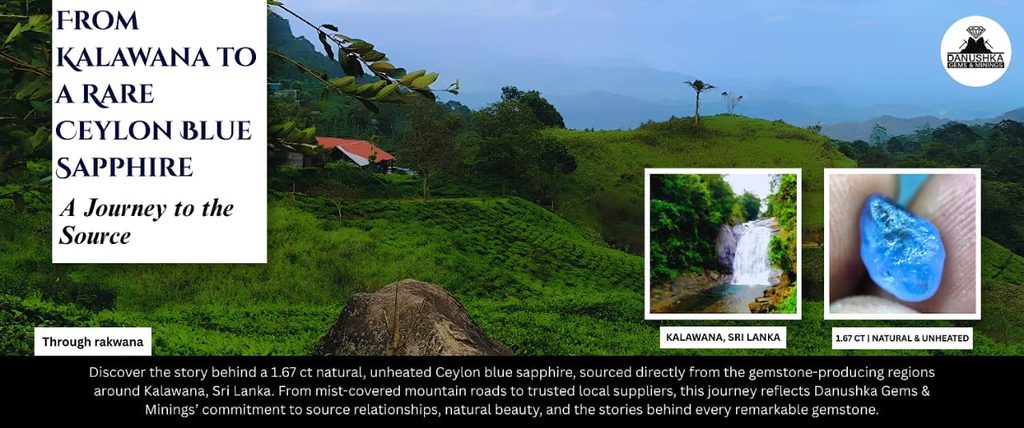
Reaching these source areas is part of the work itself. The road passes through mist-covered mountains, paddy fields, old villages and active gemstone-producing areas before reaching the people who actually handle material close to the source. During this journey, we met one of our long-time favourite suppliers, Mr. Ari, whom we casually call “Santa.” From his selection, this particular blue sapphire immediately caught our attention.
A Small Rough Stone with a Difficult Customer Requirement
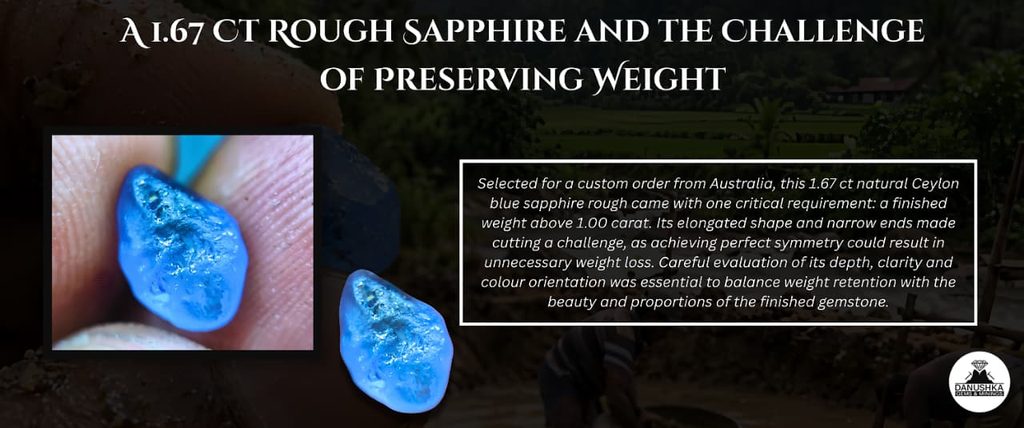
The stone was being considered for a custom requirement from Australia, and the customer’s priority was very clear: the finished sapphire needed to remain above 1.00 carat.
With a starting rough weight of only 1.67 ct, that was a serious cutting challenge.
In normal gemstone cutting, a cutter cannot simply calculate finished weight from rough weight using one fixed percentage. Every rough sapphire is different. Shape, depth, inclusions, surface damage, color orientation and the amount of material that must be removed to establish symmetry all affect the final result.
Fortunately, this rough had several advantages. It had been naturally rounded through alluvial movement, showed useful depth and appeared relatively clean internally. These were important positive factors for weight retention.
However, there was also a major limitation.
The rough was somewhat elongated, and the ends were narrower than the central width. If we tried to force the stone into a perfectly symmetrical standard oval, too much material could have been lost from those narrow ends. In a project where the customer specifically required a finished stone over one carat, sacrificing unnecessary weight simply for textbook symmetry would have worked against the main objective.
Examining Every Possible Option
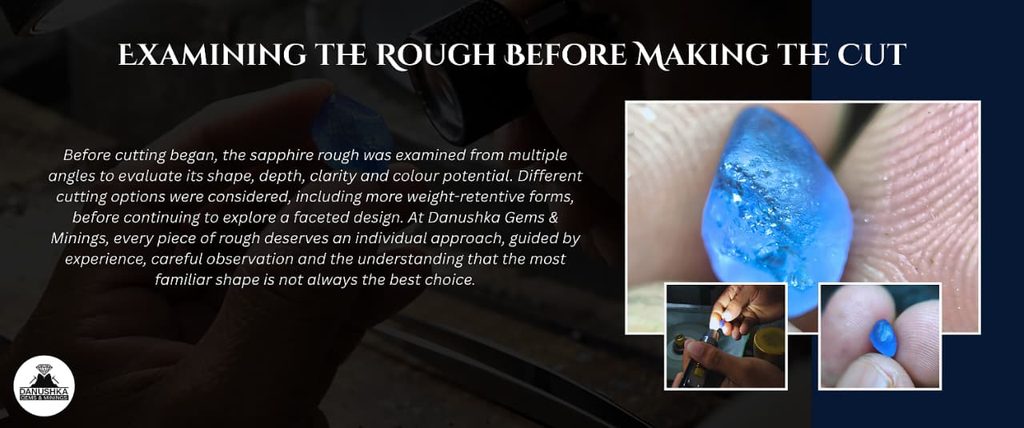
Before cutting, the rough was carefully examined from different directions.
We considered whether a cabochon or another weight-retentive form might be necessary if a standard faceted stone could not safely remain above one carat. However, because of the stone’s depth, clean areas and color potential, we continued exploring a faceted solution.
At Danushka Gems & Minings, this is one of the parts of gemstone work we enjoy most. We do not only look at stones after they arrive on a desk. We travel through mining areas, meet source people, study rough material, work with cutters and follow the transformation through polishing and certification.
Sometimes that means accepting that the most commercially familiar shape is not necessarily the best decision for a particular piece of rough.
Preforming Around the Natural Shape
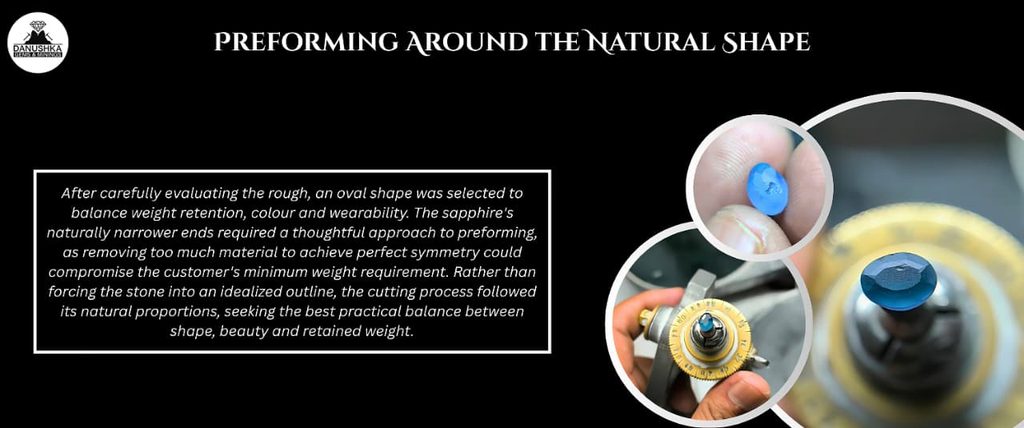
After studying the sapphire carefully, we began preforming according to the material that nature had given us rather than trying to make the rough fit an idealized outline.
An oval direction offered the best balance between preserving weight, retaining attractive color and producing a usable jewelry stone.
Because the ends of the rough were narrower than the center, the finished oval could not be pushed toward extreme geometric perfection without losing additional material. The cutting strategy therefore prioritized the customer’s requirement while still maintaining an attractive overall shape.
Gemstone cutting often requires this type of compromise.
Perfect symmetry, maximum weight, ideal color orientation, clarity and brilliance do not always point in exactly the same direction. A successful cut is sometimes about finding the best practical balance between all of them.
A Modified Pavilion for Better Balance
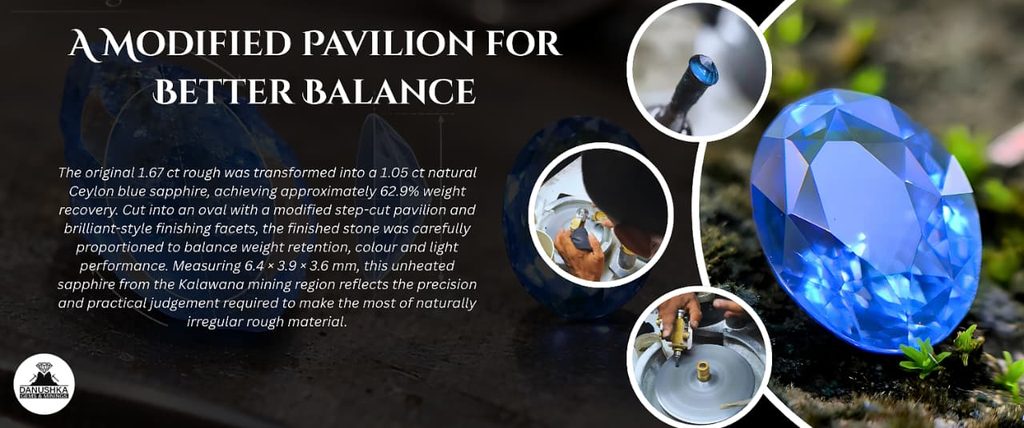
The finished sapphire was cut as an oval with a modified step-cut pavilion, with brilliant-style facets introduced into the final pavilion stage.
This combination allowed the cutter to work with the available depth and natural outline while improving internal light movement without unnecessarily sacrificing weight.
The result was:
Finished Weight: 1.05 ct
Measurements: 6.4 × 3.9 × 3.6 mm
Shape: Oval
Cut: Modified Step Cut with brilliant-style finishing facets on the pavilion
Treatment: Unheated
Origin: Kalawana village around mining in Sri Lanka
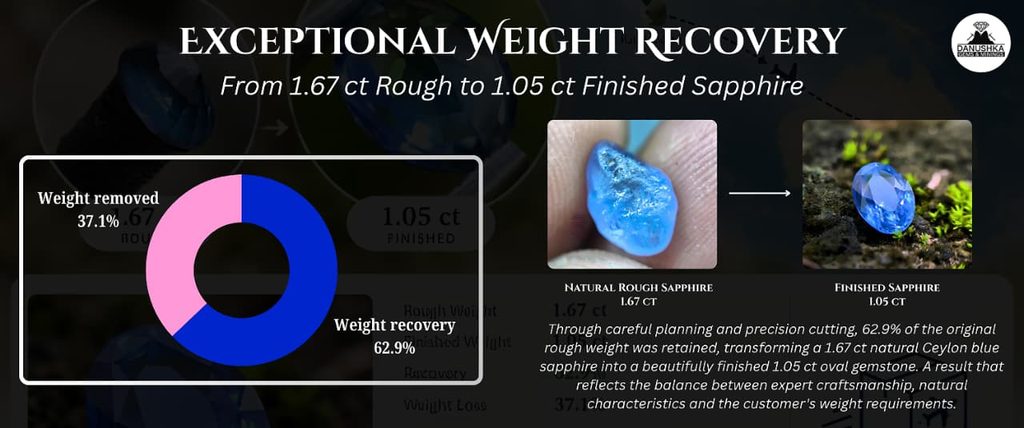
From the original 1.67 ct rough, the finished stone retained 1.05 ct, giving a weight recovery of approximately 62.9%.
For a small irregular sapphire rough where retaining more than one carat was the customer’s main requirement, this was a very strong practical recovery.
More Than Just Keeping Weight
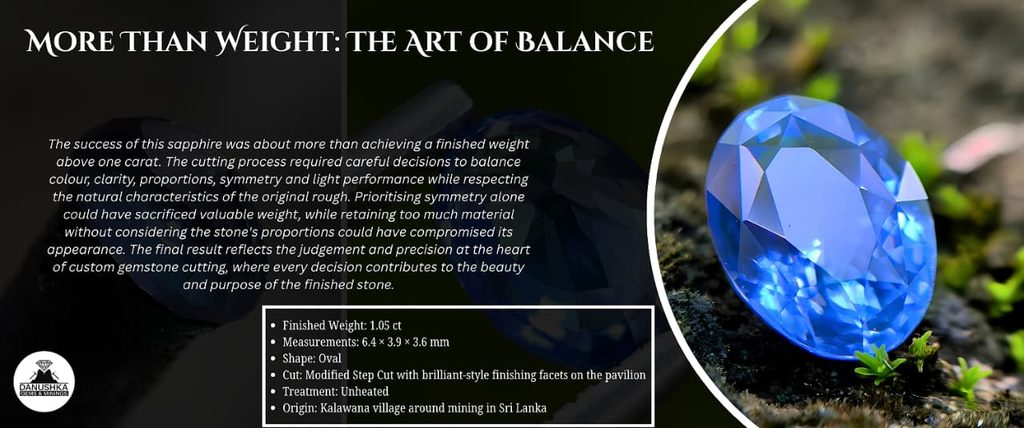
The final stone developed into a clean, attractive natural blue sapphire with a lively appearance.
But the importance of this project is not simply the final weight.
It demonstrates why gemstone cutting is a decision-making process rather than just material removal.
If we had chased perfect oval symmetry without considering the original rough, the final stone could easily have fallen below the customer’s required weight. If we had focused only on maximum retention without considering proportion and light behavior, the finished stone might not have shown its best appearance.
Instead, the process required balancing weight, color, clarity, depth, symmetry, brilliance and the customer’s intended use.
That balance is what custom lapidary work is really about.
Expert Cutting and Final Certification
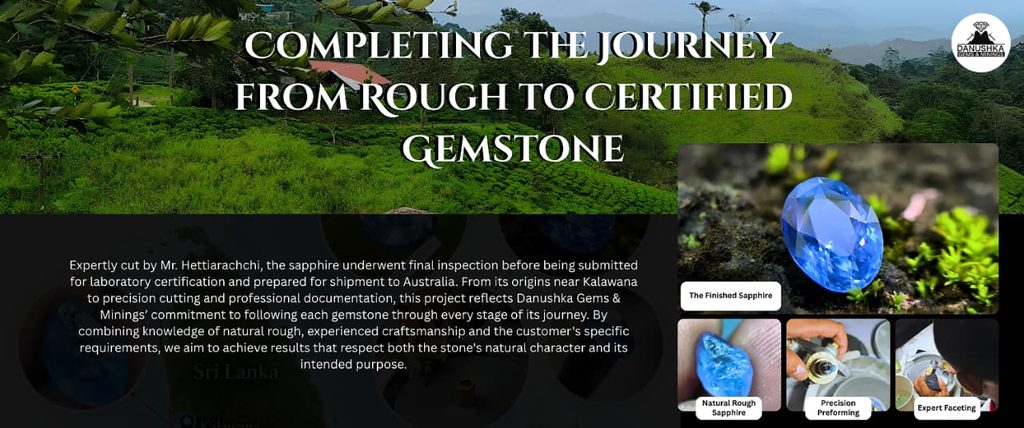
The sapphire was expertly cut by Mr. Hettiarachchi, whose experience was especially valuable in managing the narrow ends, preserving depth and keeping the finished weight above the customer’s target.
Following cutting and final inspection, the sapphire was sent for certification through a gem laboratory associated with a GIA Graduate Gemologist, providing the customer with professional identification and documentation before the stone was prepared for shipment to Australia.
From mountain roads and paddy fields around Kalawana, to careful rough examination, preforming, precision cutting and certification, this sapphire represents the complete source-to-finished journey that defines the work of Danushka Gems & Minings.
We work close to the source, but we also like to follow the stone further—to understand its structure, discuss the cutting strategy, solve difficult requirements and see what can realistically be achieved from natural rough.
Sometimes the best result is not the most mathematically perfect stone.
Sometimes the best result is the stone that successfully balances nature, craftsmanship and the customer’s real priority.
Frequently Asked Questions
1. What was the original weight of the blue sapphire rough?
The natural alluvial blue sapphire rough originally weighed 1.67 ct.
2. What was the finished weight?
The finished sapphire weighs 1.05 ct, successfully meeting the customer’s requirement for a stone above one carat.
3. What was the weight recovery?
The finished recovery was approximately 62.9% from the original rough.
4. Why was the finished oval not forced into perfect symmetry?
The original rough was elongated with narrower ends. Removing enough material to create a more standardized oval could have reduced the finished weight below the customer’s one-carat requirement.
5. What cutting style was used?
The sapphire was finished as an oval using a modified step-cut pavilion with brilliant-style facets added in the final pavilion section.
6. Was the sapphire heated?
No. The stone is presented as a natural unheated Ceylon blue sapphire.
7. Where did the sapphire come from?
It was sourced from Kalawana village around mining in Sri Lanka during a direct source journey by Danushka Gems & Minings.
8. Who cut the sapphire?
The stone was expertly cut by Mr. Hettiarachchi, with the cutting strategy focused on balancing weight retention, color, clarity and practical beauty for the customer’s final jewelry requirement.