
Some gemstone projects begin with a beautiful rough stone. Others begin with a customer’s idea long before the right stone is found. This project was the second type.
For a long time, one of our Japanese customers had been looking for a very light blue natural Ceylon sapphire with excellent transparency. He was not interested in a normal commercial oval, cushion, or standard brilliant cut. His idea was to create something more individual: a gemstone with a soft, artistic appearance, faceted on both sides and suitable for a unique jewelry design.
During one of our gem-hunting trips around Gangeyaya village around mining in Sri Lanka, we came across a sapphire that immediately reminded us of this request.
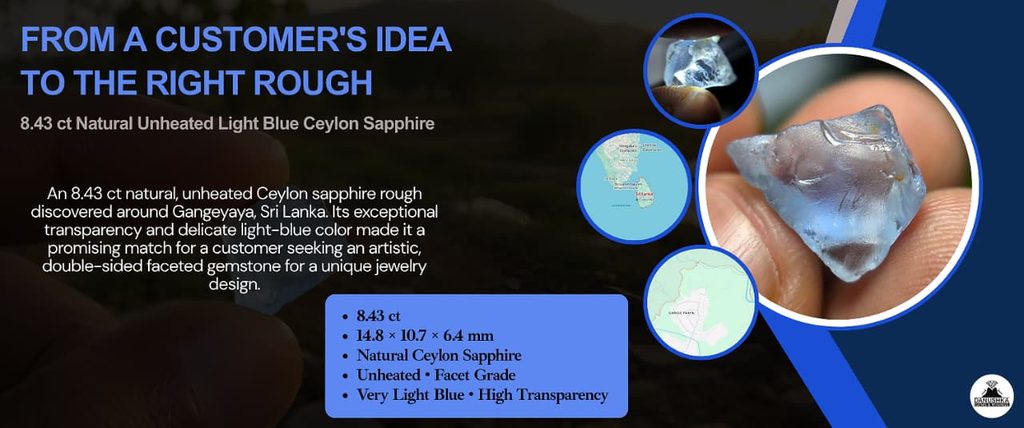
The rough weighed 8.43 ct and measured 14.8 × 10.7 × 6.4 mm. It was a Facet Grade Ceylon Natural Unheated Light Blue Sapphire rough with very good transparency. At first glance, the stone appeared almost colorless in some positions, but when examined carefully under transmitted light and in water, a delicate blue component became visible inside the material.
That subtle color was important. The customer wanted a very light sapphire, but we also wanted the finished gemstone to retain enough blue character that it would not simply appear colorless after cutting.
A Rough Shape That Changed the Original Cutting Idea
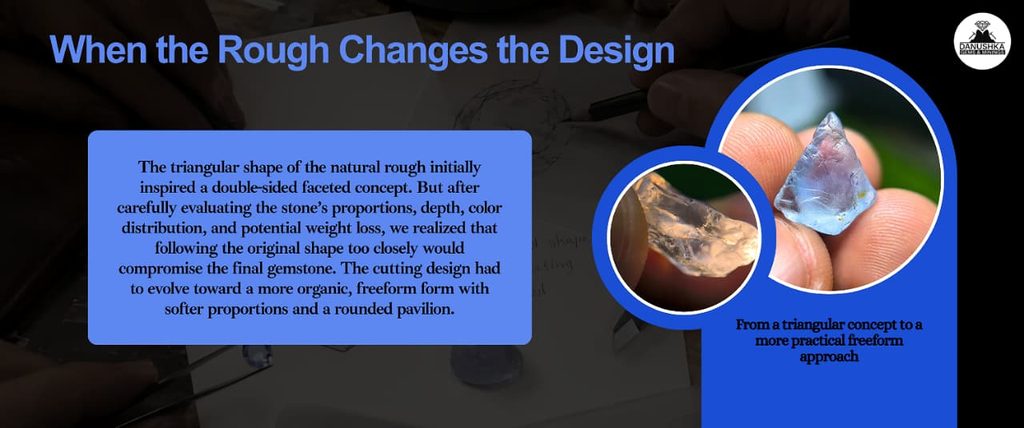
The natural rough had a noticeably triangular form.
Our first discussions therefore focused on keeping some relationship with that original shape. The customer liked the idea of a double-sided faceted triangular gemstone, but he did not want a conventional checkerboard cut or a typical rose cut. He wanted something irregular, artistic, and more organic.
We began thinking about a triangular freeform design with different facet arrangements on both sides.
The customer also had another important preference: the finished stone should have a softer, almost fruity and rounded appearance, rather than ending in a very sharp pavilion or aggressive culet.
That requirement changed the technical discussion considerably.
A gemstone can look attractive in a drawing, but the rough itself ultimately determines what is practical. Once the cutter examined the dimensions, depth, outline, color distribution, and expected weight loss, we realized that following the triangular shape too closely would create several compromises.
The design could lose a large amount of material, the double-sided proportions might become too flat, and the very light blue color might remain too weak when viewed face-up.
This is an important part of professional custom gemstone cutting: the first design is not always the final design.
From Triangular Concept to Rounded Oval Design
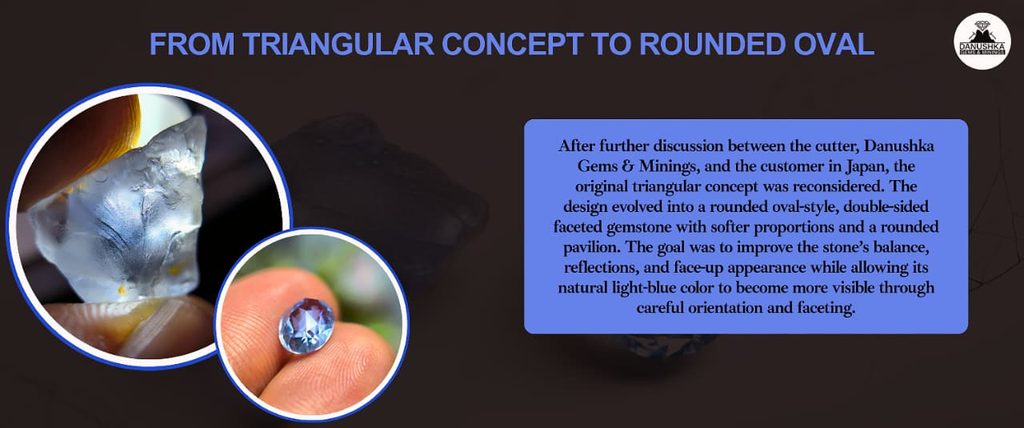
After further discussion between Danushka Gems & Minings, the cutter, and the customer in Japan, we decided to change direction.
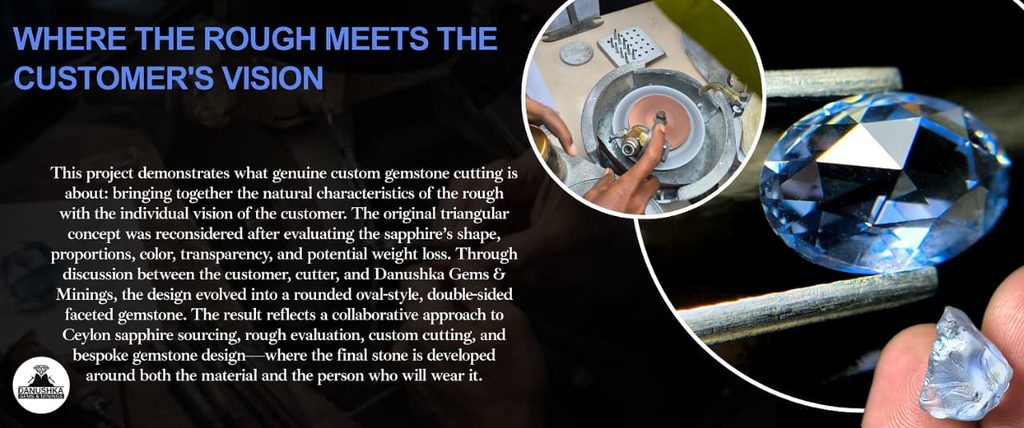
Instead of forcing the rough into a triangular artistic cut, we moved toward a rounded oval-style double-sided faceting design.
The objective became clearer: preserve the soft character the customer wanted, avoid a sharp culet, create attractive reflection from both sides, and orient the sapphire so that its natural light blue component would become more visible after cutting.
This was not about artificially changing the color. Cutting cannot create a new blue color inside a sapphire.
What cutting can do is change the way light travels through the existing material. Orientation, facet angles, depth, internal reflections, and the path of light through the colored areas can influence how strongly the natural color is perceived.
In rough form, this sapphire appeared extremely pale. After the orientation and finished faceting were established, the natural blue became much easier to see.
Double-Sided Faceting Instead of a Conventional Pavilion
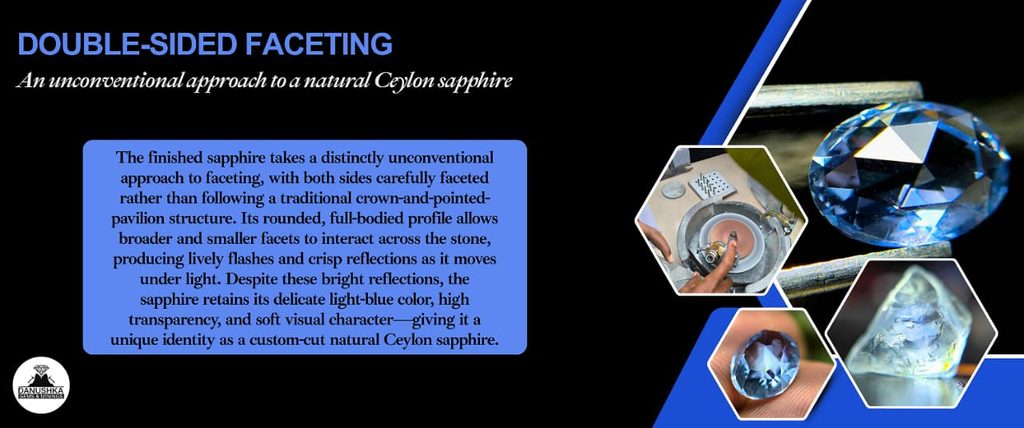
The finished sapphire was not designed with the usual idea of one dominant crown and one sharply pointed pavilion.
Instead, both sides were given a faceted appearance, creating a gemstone that can be appreciated from more than one direction.
The final design has a rounded, full-bodied profile with broader and smaller facets interacting across both sides. This creates lively flashes when the stone is moved under light while maintaining the soft visual character requested by the customer.
In certain lighting conditions, the finished sapphire produces very bright reflections that can appear almost diamond-like in their sharpness, although its identity and optical properties remain completely those of natural sapphire.
The blue itself remains delicate and light, exactly in keeping with the original requirement.
This is not a vivid or strongly saturated blue sapphire. Its appeal is the opposite: transparency, softness, subtle blue color, unusual faceting, and an individual custom-cut identity.
The Finished Result
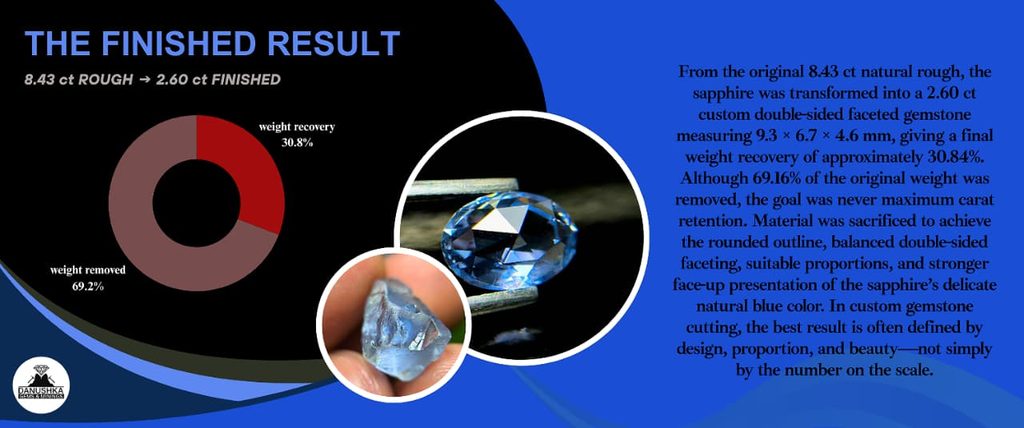
After cutting and polishing, the original 8.43 ct rough sapphire finished as a 2.60 ct custom double-sided faceted gemstone, measuring 9.3 × 6.7 × 4.6 mm.
The final recovery is approximately 30.84% of the original rough weight.
Approximately 5.83 ct, or 69.16%, was removed during planning, shaping, orientation, faceting, and polishing.
At first, that may appear like a high weight loss. But weight retention was not the main purpose of this project.
The customer wanted a particular visual identity.
To achieve that, the stone had to move away from its original triangular form. Material had to be removed to produce the rounded outline, eliminate unsuitable areas, create balanced double-sided faceting, maintain suitable thickness, and improve the face-up presentation of the very light blue color.
For custom gemstone cutting, a higher finished carat weight does not automatically mean a better result. Sometimes the correct outcome requires sacrificing weight to achieve the requested proportion, color presentation, symmetry, and artistic character.
Why This Project Represents Real Custom Gemstone Cutting
Custom cutting is more than choosing a shape from a catalog.
It begins with understanding the rough, understanding the customer, and then finding the point where those two realities meet.
In this project, the customer originally wanted a triangular, double-sided artistic cut. The rough also naturally suggested that direction. But after practical evaluation, we understood that another shape would give a better overall result.
We discussed the limitations rather than simply following the first idea.
The cutter explained what could happen to weight, proportion, color, and the finished profile. We then shared those considerations with the customer and adjusted the design together.
That collaboration produced the final light blue oval-style double-sided sapphire.
This type of work is one of the important areas of Danushka Gems & Minings: source-connected Ceylon sapphire sourcing, rough gemstone evaluation, custom sapphire cutting, bespoke gemstone design, and complete rough-to-finished gemstone journeys based on individual customer requirements.
From Gangeyaya to Japan
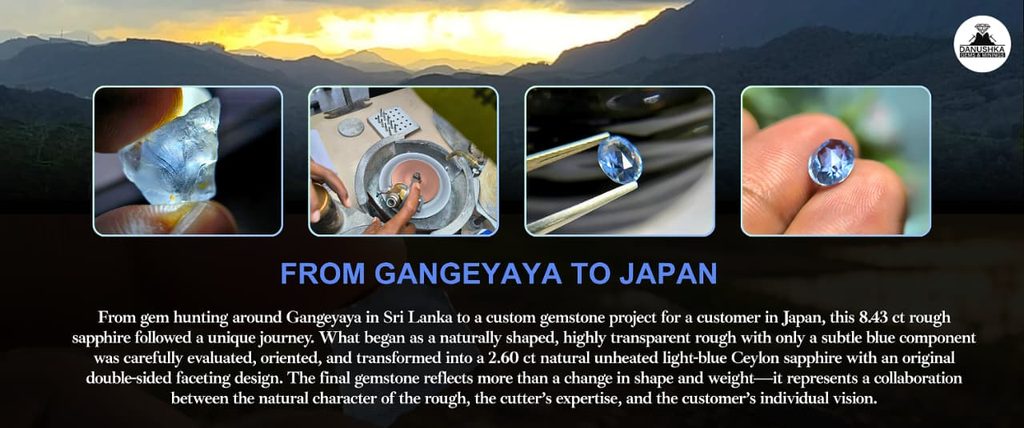
The story began during gem hunting around Gangeyaya village around mining in Sri Lanka.
At that stage, the sapphire was simply a naturally shaped 8.43 ct rough with excellent transparency and a small amount of blue hidden within its body.
But because we already understood what our Japanese customer had been searching for, the stone had a purpose almost immediately.
That direct relationship between sourcing and customer requirements is important to us.
Sometimes we travel to mining villages without knowing exactly what material we will find. A stone may appear unexpectedly, and because we already know the requirements of different buyers, jewelers, collectors, and cutters, we can recognize when a particular piece may suit a specific project.
This sapphire eventually became a 2.60 ct natural unheated light blue Ceylon sapphire with an original double-sided custom faceting design, prepared specifically around the customer’s preferences in Japan.
The final gemstone is very different from the original rough, but the journey between the two is what gives the piece its real character.
At Danushka Gems & Minings, we believe a custom-cut gemstone should not simply look unusual. The design should make sense for the rough, respect the natural material, respond to the customer’s request, and produce the best practical result possible from that individual stone.
That is the difference between simply cutting a gemstone and developing a gemstone together.
FAQ – Custom-Cut Light Blue Ceylon Sapphire
1. What was the original sapphire rough weight?
The original natural Ceylon sapphire rough weighed 8.43 ct and measured 14.8 × 10.7 × 6.4 mm.
was the original sapphire rough weight?
The original natural Ceylon sapphire rough weighed 8.43 ct and measured 14.8 × 10.7 × 6.4 mm.
2. Where was the sapphire sourced from?
It was sourced during gem hunting around Gangeyaya village around mining in Sri Lanka.
3. Was the sapphire heated?
No. The stone is presented as natural and unheated.
4. What was the original color?
The rough appeared extremely pale, almost colorless in some directions, with a subtle natural light blue component visible under careful lighting and observation.
5. Why was a triangular cut first considered?
The rough naturally had a triangular outline, and the Japanese customer originally wanted an unusual double-sided design rather than a standard commercial cut.
6. Why was the triangular design changed?
After cutter evaluation, the triangular design was expected to create excessive weight loss, Flat proportions than the customer wanted, and less effective presentation of the pale blue color.
7. What design was finally selected?
A rounded oval-style double-sided faceting design was selected, with a softer full-bodied appearance and no strongly pointed culet.
8. What is the final gemstone weight?
The finished sapphire weighs 2.60 ct.
9. What are the finished dimensions?
The finished gemstone measures 9.3 × 6.7 × 4.6 mm.
10. What was the weight recovery?
The final 2.60 ct gemstone represents approximately 30.84% recovery from the original 8.43 ct rough.
11. Why was so much weight removed?
The project prioritized custom shape, double-sided faceting, color presentation, balanced proportions, and the customer’s requested rounded character rather than maximum weight retention.
12. Did cutting make the sapphire blue?
No. The blue color already existed naturally in the rough. Cutting and orientation changed the way light traveled through the stone, making the existing light blue component more visible.
13. Is this a normal oval sapphire cut?
No. Although the outline became oval-like, the stone uses a custom double-sided facet arrangement rather than a conventional crown-and-pavilion commercial design.
14. Can Danushka Gems & Minings source rough gemstones for custom designs?
Yes. Danushka Gems & Minings works with source-connected natural gemstones in Sri Lanka and can evaluate suitable rough for custom gemstone cutting requirements, depending on available material.
15. Can a customer choose the rough before cutting?
Yes. For suitable projects, customers can discuss color, size, treatment preference, shape, design idea, and budget before a rough stone is selected and evaluated for custom cutting.