
A Scientific and Human Journey of a 10.12 ct Geuda Sapphire
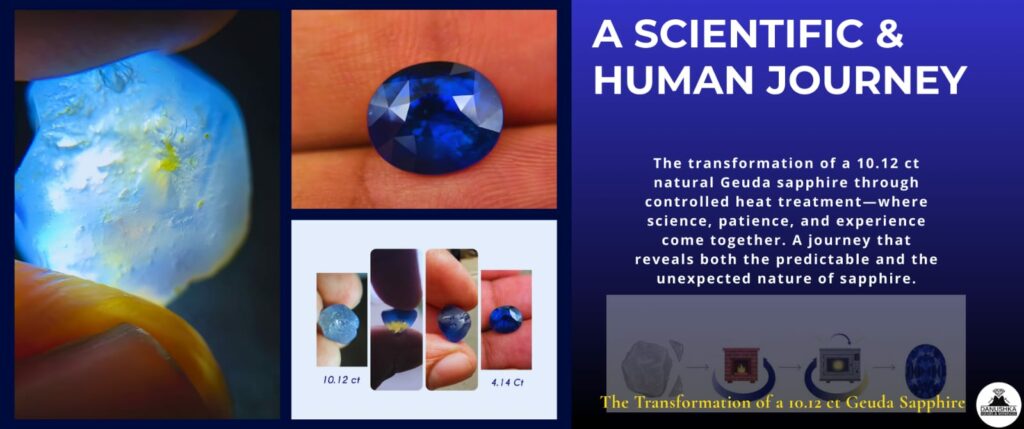
In the world of sapphire heat treatment, not every result follows a straight line. Some stones behave exactly as expected, while others reveal hidden characteristics that turn the process into a lesson—both scientifically and practically. This journey of a 10.12 ct natural Geuda sapphire is one such example: a story of patience, surprises, informed decisions, and respect for nature’s complexity.
The Beginning: Understanding the Rough
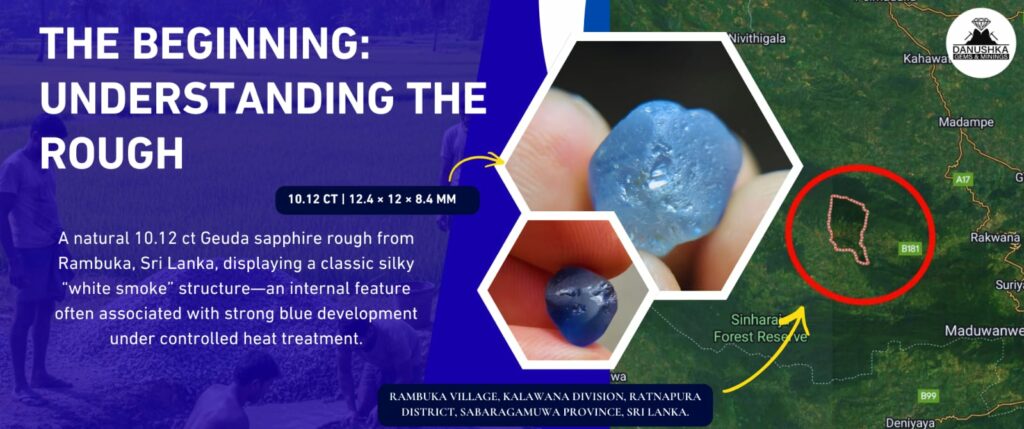
This sapphire began as a facet-grade natural Geuda sapphire rough weighing 10.12 carats, measuring 12.4 × 12 × 8.4 mm, sourced directly from Rambuka village around mining in Sri Lanka. The stone showed a classic silky milky internal structure, often described locally as white smoke. Such internal silk is widely recognized as a strong indicator of good heating potential for blue sapphire development.
At this stage, the stone was completely natural and unheated, with no artificial enhancements. Visual and microscopic observation suggested that, under the right heat conditions, the stone should transform into a royal blue sapphire. However, as every experienced gem handler knows, rough stones can still carry secrets beneath the surface.
Pre-Forming: Preparing the Stone for Heat
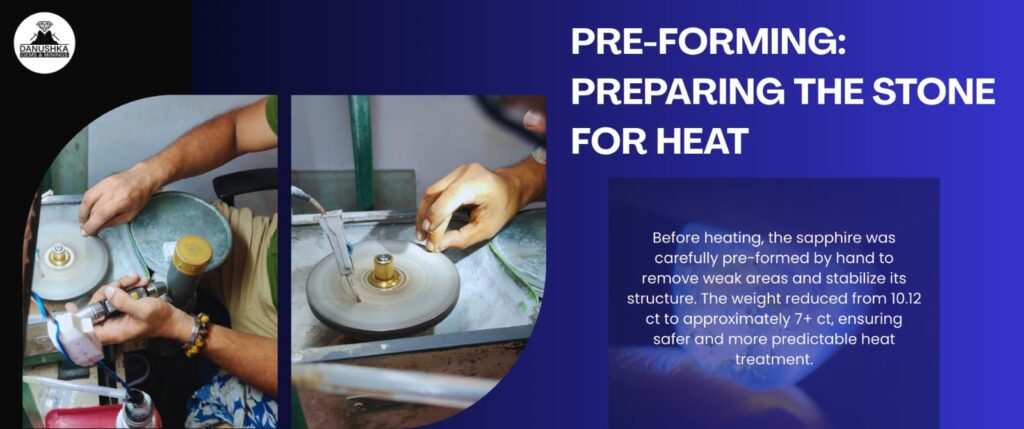
Before any heat treatment, the stone was carefully pre-formed by hand to stabilize it for firing. During this stage, surface cavities, weak areas, and unsuitable external features were removed. This step is critical—not for beauty, but for safety and predictability during heat treatment.
After pre-forming, the weight reduced from 10.12 ct to approximately 7+ ct. This step ensured that internal stress points were minimized and that heat could interact evenly with the stone’s internal structure. Pre-forming was carried out personally by the owner of Danushka Gems & Minings, ensuring full control and understanding of the stone before heating.
First Heat: Gas Furnace – The Expected Result
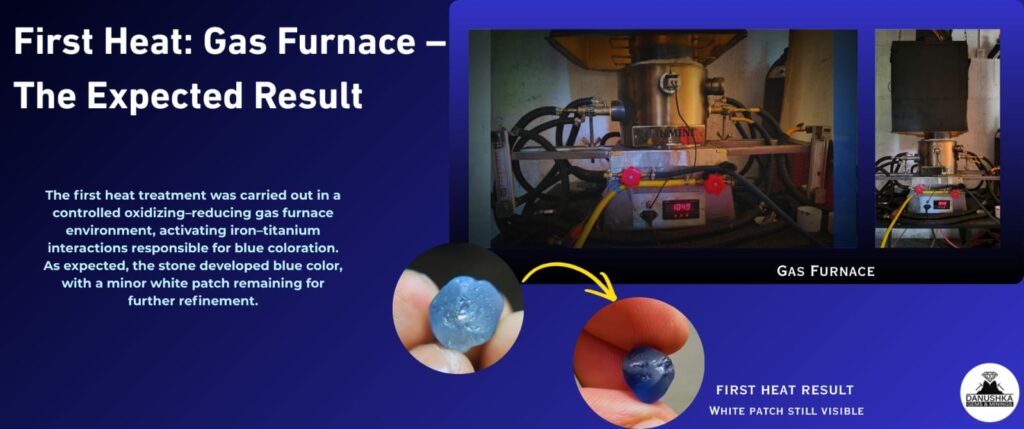
The first heat treatment was conducted in a gas furnace by a highly experienced local specialist commonly known as “Mr. Gas” (Gas Aiya). This stage involved an oxidizing–reducing environment designed to activate the iron and titanium interactions responsible for blue coloration.
As expected, the stone turned blue, confirming the initial assessment. However, a small white patch remained visible. This was not unusual and is commonly addressed with further heat refinement. At this point, the stone behaved exactly as predicted.
Second Heat: Electric Furnace – The Unexpected Surprise
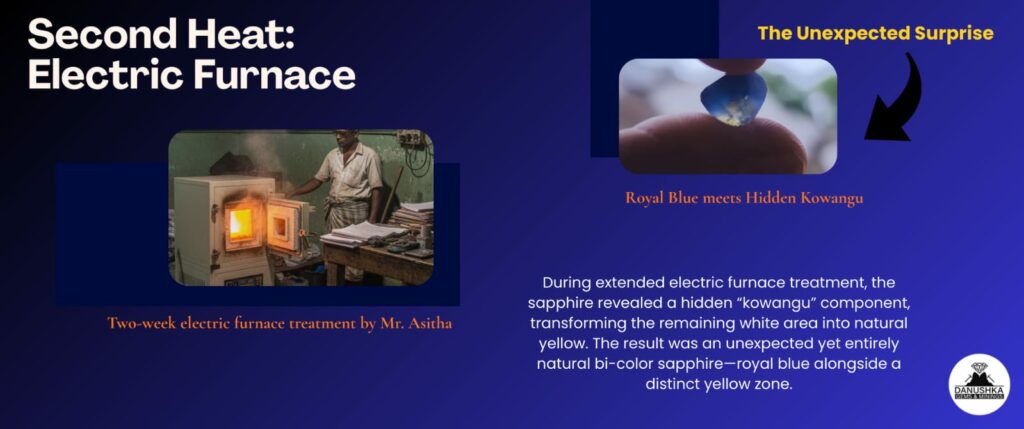
To enhance color uniformity and address the remaining white area, the stone was placed into an electric furnace for an extended treatment period of approximately two weeks, conducted by Mr. Asitha, a specialist in controlled electric heating.
This is where the journey took an unexpected turn.
Instead of simply deepening the blue, the previously white patch turned yellow. This transformation was not planned, nor anticipated. The reason became clear only after observation: the stone contained a hidden “kowangu” Geuda component that was not visually obvious before heating.
Kowangu Geuda is a known type in Sri Lanka that responds differently to heat, often developing yellow coloration under certain conditions. The key point here is that this reaction was permanent and natural, not an artificial effect. The stone had always carried this internal chemistry—it simply had not revealed itself earlier.
At this stage, the sapphire had become a bi-color sapphire, showing royal blue with a distinct yellow zone.
Appreciation vs. Market Reality
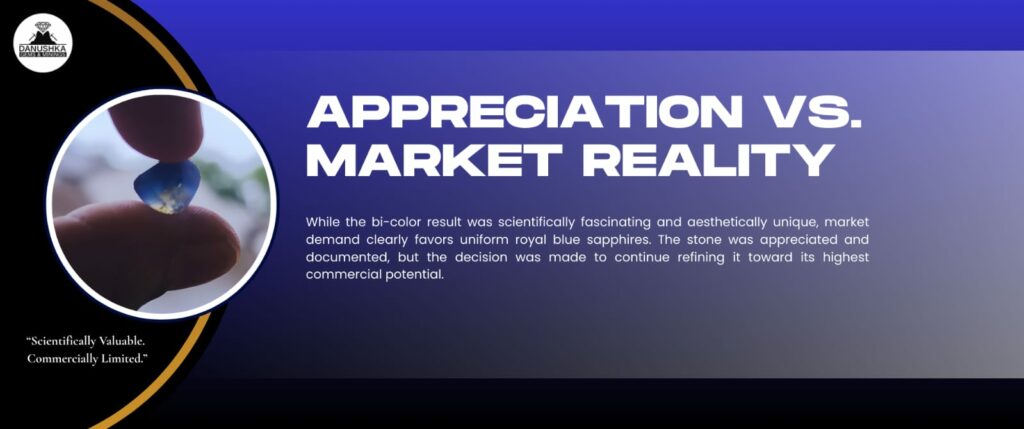
Scientifically and aesthetically, the bi-color result was fascinating. Bi-color sapphires are rare, and beautiful in their own way. From a research perspective, this outcome was valuable—it confirmed the presence of mixed Geuda characteristics within a single crystal and demonstrated how different furnace environments interact with internal chemistry.
However, from a market and valuation perspective, the situation was clear:
A uniform royal blue sapphire holds significantly higher demand and value than a bi-color stone of this type.
The bi-color result was appreciated, respected, and documented—but the decision was made to continue refining the stone toward its highest commercial and gemological potential.
Reverse Heat: Correcting the Yellow Hue
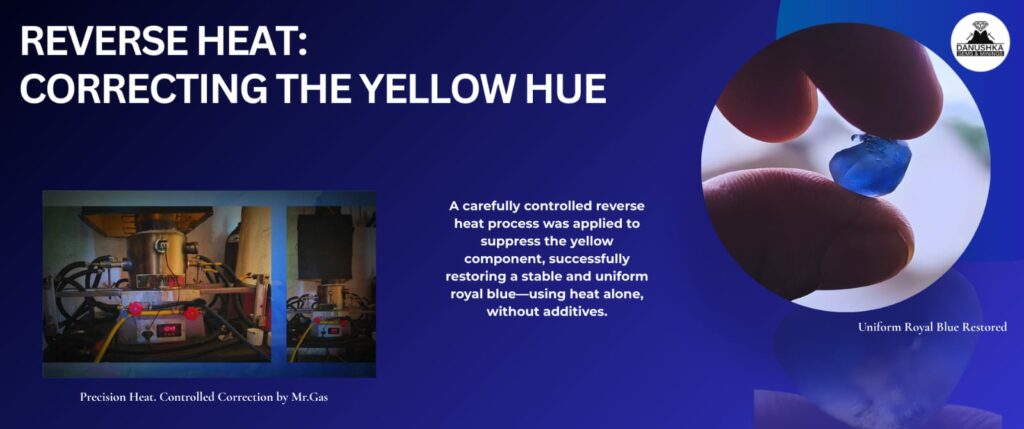
To remove the yellow component, the stone underwent a reverse heat process, again performed by Mr. Gas. This stage was carefully controlled to suppress the yellow coloration while preserving and strengthening the blue.
The result was successful:
The yellow hue was removed, and the stone returned to a stable, uniform royal blue. This confirmed that the yellow reaction, while permanent in formation, could still be managed and corrected through precise thermal control.
Importantly, no foreign elements or artificial additives were introduced at any stage. The entire transformation relied solely on heat interacting with the sapphire’s natural internal properties.
Final Cutting: Revealing the True Result
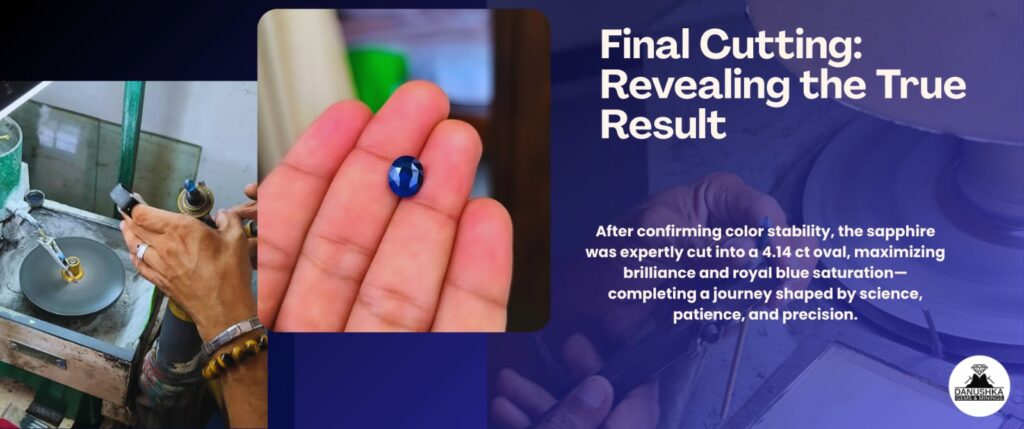
Once color stability was confirmed, the sapphire was handed over to Mr. Channa for cutting and polishing. Based on internal structure and color distribution, an oval shape was selected to maximize brilliance, depth, and color performance.
The final result was a 4.14 ct vivid royal blue sapphire, with excellent brilliance, strong saturation, and balanced proportions.
From 10.12 ct rough to 4.14 ct finished gem, this stone completed a long and complex journey—one shaped by knowledge, patience, and informed decision-making.
Why This Journey Matters
This sapphire is more than a finished gemstone. It is a case study in:
The unpredictability of natural Geuda sapphire
The scientific importance of furnace environments
The role of hidden internal chemistry
The balance between appreciation of rare results and market reality
Ethical enhancement without artificial intervention
Every stage of this journey—pre-forming, gas heat, electric heat, reverse heat, and cutting—was documented and understood. The result is a sapphire that carries not only beauty, but knowledge.
Final Thoughts
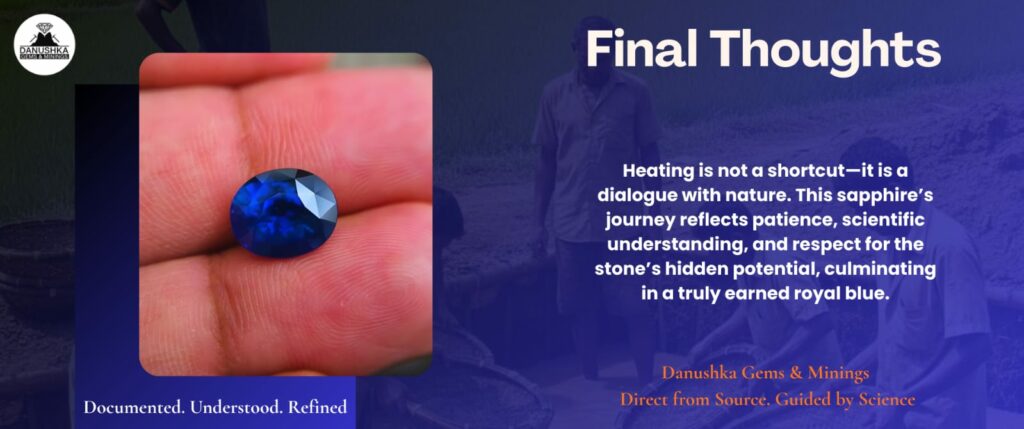
Nature does not always follow expectations, and that is where true gemology begins. This sapphire reminds us that heating is not a shortcut, but a dialogue with the stone. Sometimes it answers exactly as predicted. Sometimes it surprises us.
In this case, the surprise was welcomed, studied, respected—and then refined.
A journey of fun, science, experience, and value—ending in a sapphire that truly earned its royal blue.
If you are curious about the hidden potential inside Geuda sapphire rough, and would like to explore a similar journey of discovery, experimentation, and transformation, we welcome you to do so with us.
At Danushka Gems & Minings, we work directly from the source and approach heating with respect for both science and nature — documenting every step, embracing surprises, and guiding each stone toward its best possible outcome.
If you would like to join a real heating journey with your own Geuda rough, feel free to contact Danushka Gems & Minings.