
In the gemstone world, some stones are cut.
Others are understood.
This is the story of an 11.22 carat natural Chrysoberyl Cat’s Eye rough sourced directly from Ratnapura village around mining in Sri Lanka — and how careful observatin transformed what appeared to be one stone into two perfectly formed living eyes.
The Rough – Natural Structure with Hidden Decision
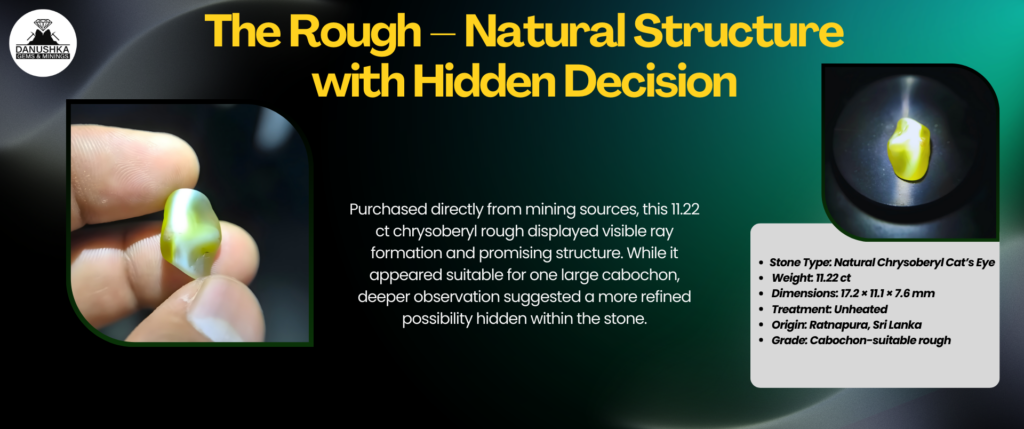
Stone Type: Natural Chrysoberyl Cat’s Eye Rough
Weight (Rough): 11.22 carats
Dimensions: 17.2 × 11.1 × 7.6 mm
Treatment: Unheated
Origin: Ratnapura, Sri Lanka
Type: Cabochon-grade rough suitable for chatoyancy
This rough was purchased directly from mining sources by Danushka Gems & Minings. As always, when our rough stones are not sold within a few weeks, we study them for cutting potential rather than letting material remain idle.
Chrysoberyl Cat’s Eye is not an ordinary gemstone. It is a phenomenon stone. Its value is not only in color or clarity — but in the sharpness, movement, and life of the “eye” (chatoyancy).
At first glance, this rough appeared suitable for cutting into one large stone. The body was strong. The structure looked promising. The ray was visible. The color was attractive yellowish-green.
But Cat’s Eye cutting is not about first glance. It is about deep observation.
The Critical Discovery – “Muhunu Deka” (Two Faces)
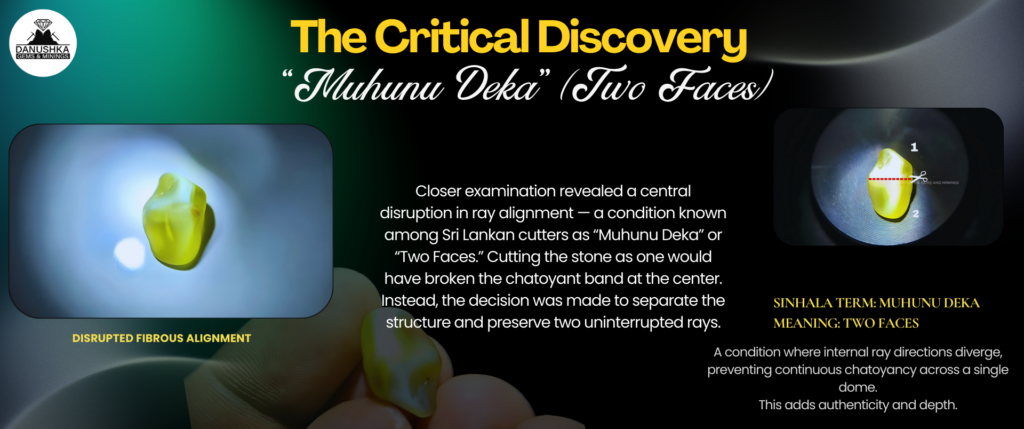
Upon closer inspection, a small central zone showed disruption in fibrous alignment. In Sinhala, cutters refer to this situation as “Muhunu Deka” — meaning “two faces.”
What does this mean?
The stone may look like one large single piece, but internally the ray direction is split. If cut as one stone, the chatoyancy would break at the center.
In Cat’s Eye and Star stones, the ray must flow continuously across the dome. Even a small misalignment can reduce sharpness.
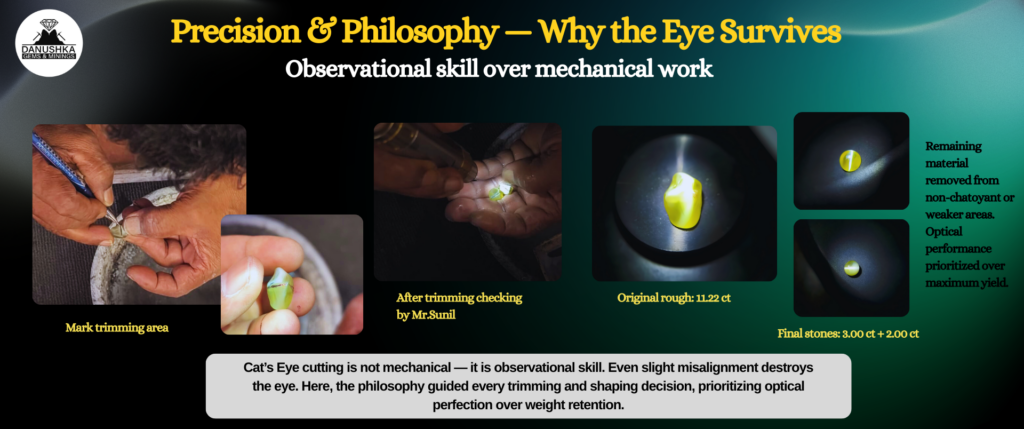
Instead of forcing one large stone, we made the decision to trim and create two separate stones from the broken ray area.
This is where art begins.
Traditional Cutting – Hanaporuwa Craftsmanship
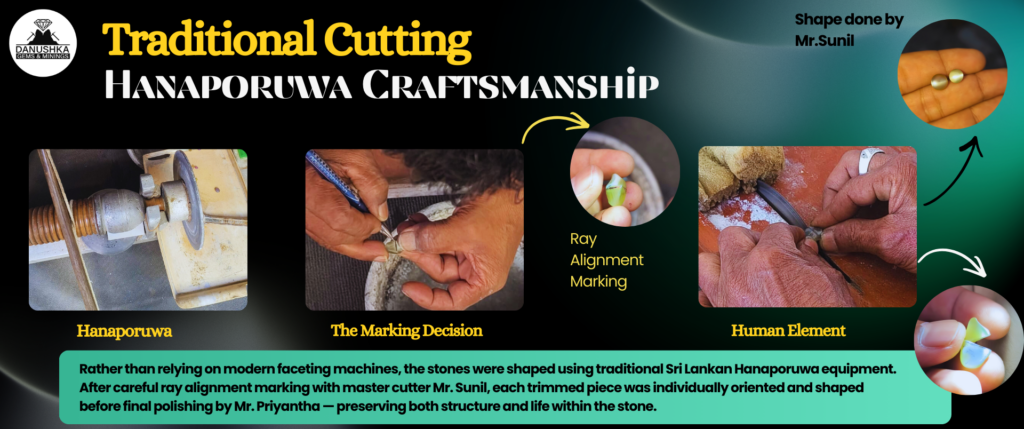
Cat’s Eye and Star Sapphires are not typically cut using modern faceting machines. They are shaped using traditional Sri Lankan equipment called a “Hanaporuwa.”
We first discussed the trimming strategy with traditional master cutter Mr. Sunil. The trim lines were marked carefully to preserve maximum ray alignment.
The stone was then taken for precision trimming in the local market area before returning to Mr. Sunil for shaping.
Each piece was oriented individually based on its internal fiber direction.
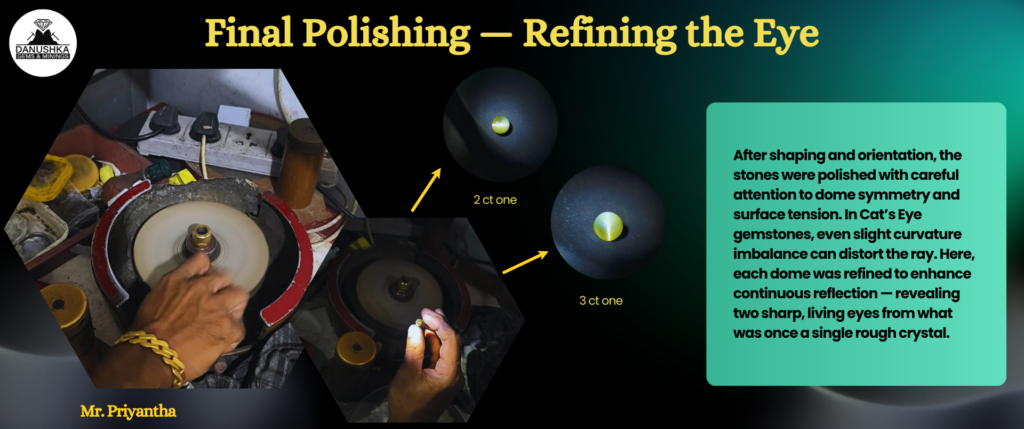
After shaping, the stones were handed to Mr. Priyantha for final polishing.
Polishing a Cat’s Eye is a delicate process. The dome must be smooth. The surface must be tension-free. The curvature must enhance the ray reflection without distortion.
The Final Result – Two Living Eyes
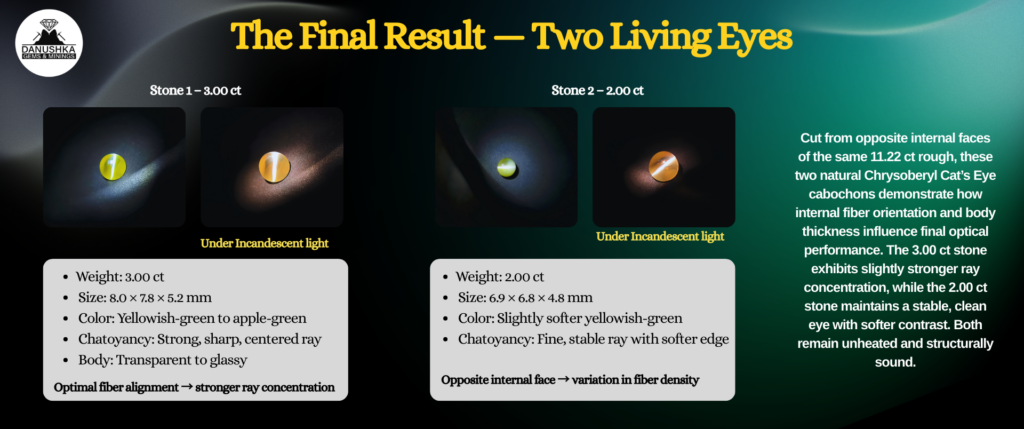
Stone 1:
Weight: 3.00 carats
Size: 8.0 × 7.8 × 5.2 mm
Color: Yellowish-green to apple-green
Chatoyancy: Strong, sharp, centered ray
Body: Transparent to glassy
This stone displays a strong, bright, well-centered eye. The ray moves smoothly across the dome and remains intact under directional light. The body is lively and transparent, enhancing the contrast of the white line.
Stone 2:
Weight: 2.00 carats
Size: 6.9 × 6.8 × 4.8 mm
Color: Slightly softer tone compared to the 3 ct
Chatoyancy: Fine and stable, slightly softer edge
Why is the second stone slightly different in color and ray sharpness?
Because it was cut from the opposite internal face of the original rough. The fiber orientation and body thickness vary between sections. Even when two stones originate from the same rough crystal, internal zoning affects final appearance.
The 3.00 ct stone shows slightly stronger ray concentration due to optimal fiber alignment.
The 2.00 ct stone still displays a clean and stable eye — but with slightly softer contrast.
Both are natural. Both are unheated. Both are structurally sound.
Why Cat’s Eye Stones Require Judgment
Cat’s Eye gemstones are different from faceted stones.
In faceting, brilliance comes from light reflection angles.
In chatoyancy stones, beauty comes from internal needle-like inclusions reflecting as a single line.
The cutter must:
Align the dome perpendicular to fiber direction
Maintain balanced curvature
Avoid flat spots
Preserve transparency
Protect structural integrity
One wrong orientation, and the eye disappears.
This is why Cat’s Eye cutting is not mechanical work — it is observational skill.
Weight Retention Insight
Original rough: 11.22 ct
Final stones: 3.00 ct + 2.00 ct
The remaining material was removed from non-chatoyant or structurally weaker areas.
Rather than prioritizing weight, we prioritized optical performance.
That is the philosophy behind our cutting decisions.
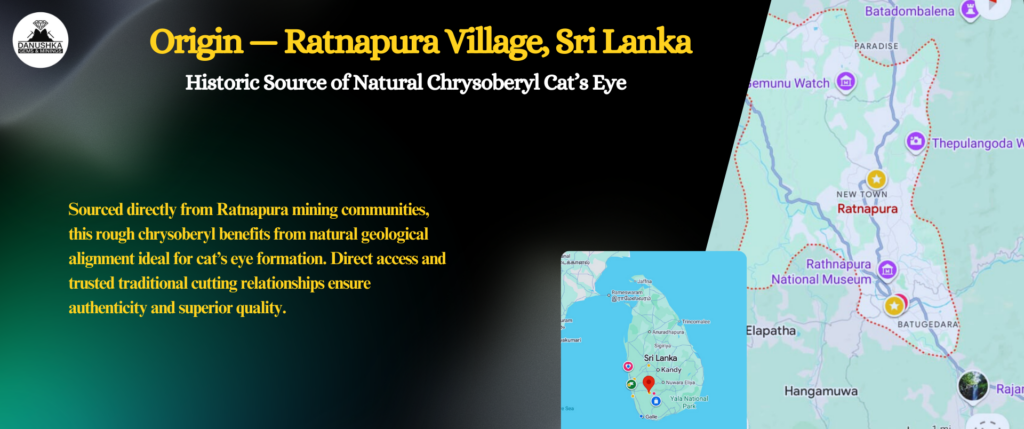
Origin – Ratnapura Village Around Mining in Sri Lanka
Ratnapura remains one of the world’s historic sources of Chrysoberyl Cat’s Eye. The geological environment produces stones with strong fibrous structure suitable for fine chatoyancy.
This rough was sourced directly from mining communities, not secondary markets.
At Danushka Gems & Minings, our strength lies in direct mining access and traditional cutting relationships.
Final Thoughts – Not Just Cutting, But Understanding
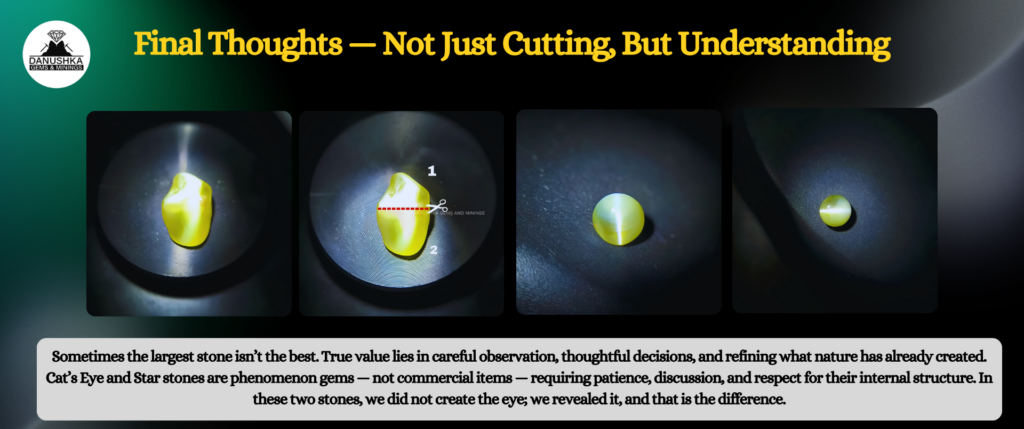
From 11.22 carats of natural rough to two refined living eyes — this journey reflects something important:
Sometimes the biggest stone is not the best stone.
Sometimes the best decision is to divide, refine, and perfect.
Cat’s Eye and Star stones are not commercial items. They are phenomenon gems. They require patience, discussion, and respect for internal structure.
In these two stones, we did not create the eye.
We revealed it.
And that is the difference.
Frequently Asked Questions (FAQ)
1. What is Chrysoberyl Cat’s Eye?
Chrysoberyl Cat’s Eye is a natural gemstone that displays a bright moving line of light across its surface, known as chatoyancy. This effect is caused by parallel fibrous inclusions inside the stone that reflect light as a sharp “eye.”
2. Is this Cat’s Eye natural or treated?
Both stones were cut from a natural, unheated chrysoberyl rough sourced from Ratnapura village around mining in Sri Lanka. No heat treatment was applied.
3. Why was one rough stone cut into two pieces?
The original rough showed a split internal fiber alignment, locally called “Muhunu Deka” (two faces). Cutting it as one stone would have broken the ray. Trimming into two pieces preserved stronger chatoyancy in each stone.
4. Why do the two stones look slightly different in color?
Even within the same rough crystal, internal zoning and fiber direction can vary. Each section of the stone reflects light differently, which affects ray sharpness and body color.
5. What makes a high-quality Cat’s Eye gemstone?
A fine Chrysoberyl Cat’s Eye should show:
A sharp, centered, well-defined eye
Strong contrast between the ray and body color
Smooth dome curvature
Good transparency
Stable movement of the eye under light