
Sri Lanka has long been known as one of the world’s most important gem-bearing regions. Among its many treasures, chrysoberyl crystals hold a special place — particularly the rare cyclic twin formations known as sixling crystals. These are not common gem-trade materials; they are crystallographic phenomena preserved in natural form.
At Danushka Gems & Minings, we have encountered such specimens from Nivithigala village around mining in Sri Lanka, as well as historically from Kolonna, Rakwana, Ratnapura, Pelmadulla, Embilipitiya, Deniyaya, Balangoda, and Hunuwala. However, even within these productive regions, well-preserved sixling crystals are not regularly seen. In practical mining reality, they may appear only occasionally — sometimes once a year in small numbers — making them highly interesting to mineral collectors.
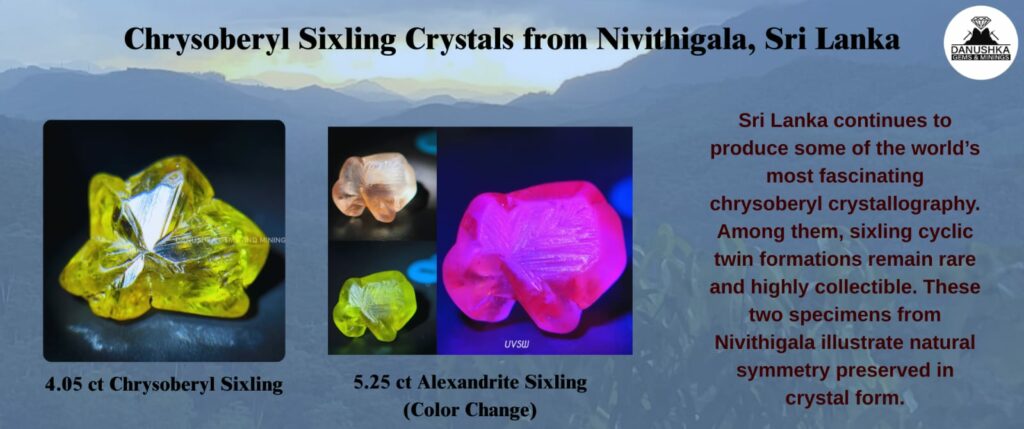
This article discusses two important specimens:
* 4.05 ct Natural Chrysoberyl Sixling Crystal
* 5.25 ct Natural Alexandrite Sixling Chrysoberyl Crystal (color change)
Both from Nivithigala.
Understanding Chrysoberyl: Chemistry and Crystal Structure
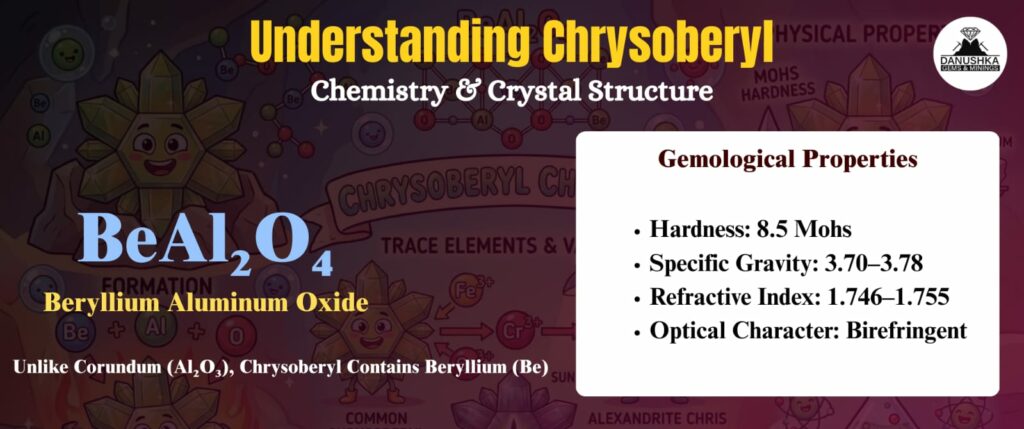
Chrysoberyl has the chemical formula:
BeAl₂O₄ (Beryllium Aluminum Oxide)
It crystallizes in the orthorhombic crystal system, despite often forming pseudo-hexagonal appearances due to cyclic twinning.
Key gemological properties:
Hardness: 8.5 on Mohs scale
Specific Gravity: ~3.70–3.78
Refractive Index: 1.746–1.755
Strong birefringence
Often distinct growth striations
Unlike corundum (Al₂O₃), chrysoberyl contains beryllium, which significantly affects crystal structure and physical behavior.
Sixling Formation – Crystallographic Significance
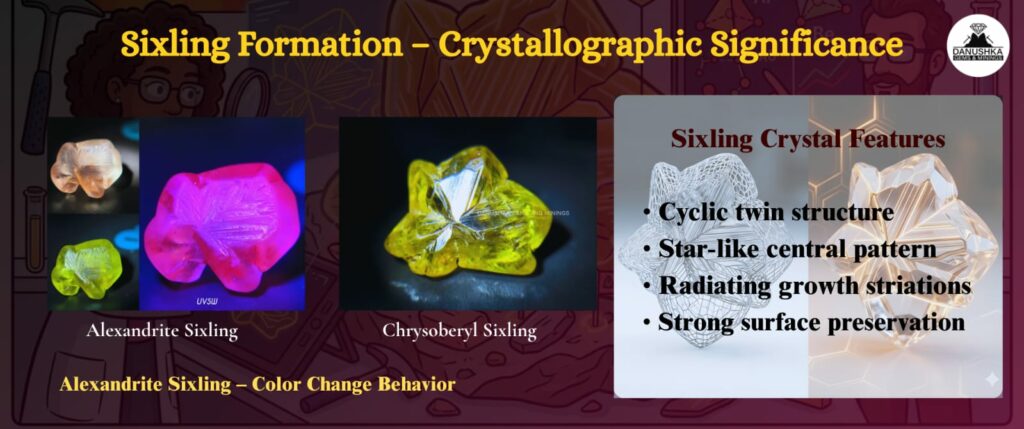
A “sixling” is a cyclic twin composed of multiple twin individuals arranged around a central axis. The result is a star-like pattern when viewed from certain angles.
In both of these Nivithigala specimens:
Clear cyclic twin architecture is visible
Central star-like intersection is evident
Growth striations radiate from the core outward
Surface preservation is strong
The striations are not random surface marks — they are growth-related twin-plane expressions formed during crystallization.
The center of both crystals clearly shows a symmetrical radiating pattern, which is typical in well-developed sixling specimens.
Specimen 1: 4.05 ct Natural Chrysoberyl Sixling Crystal
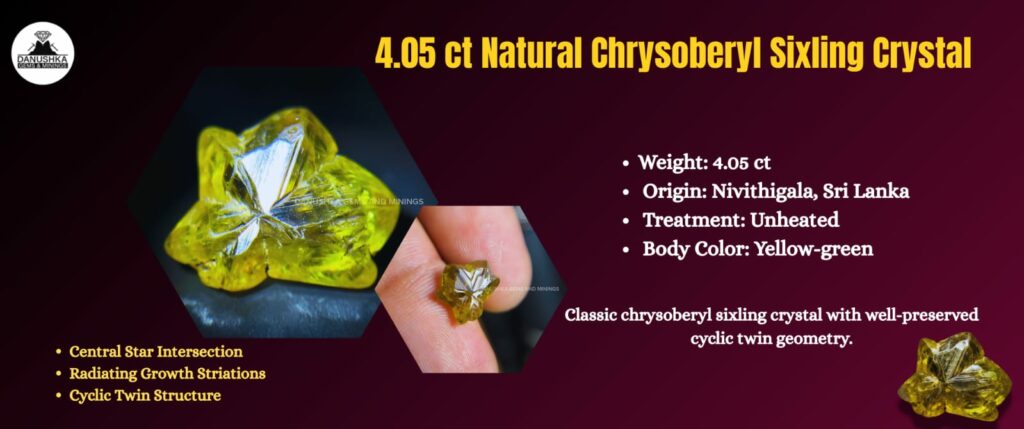
Origin: Nivithigala village around mining in Sri Lanka
Unheated
Classic yellow-green body color
This specimen represents chrysoberyl without color-change chemistry. The iron content likely influences the yellow-green body tone.
Observations:
Strong preserved striations
Compact cyclic twin geometry
Defined central star formation
Good structural thickness
From a mineral collector’s standpoint, this is a textbook cyclic twin example.
Specimen 2: 5.25 ct Natural Alexandrite Sixling Chrysoberyl
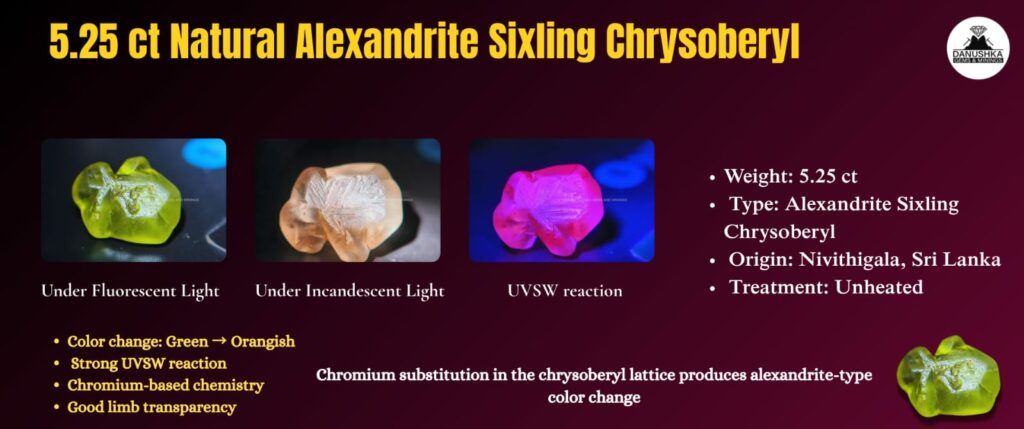
Origin: Nivithigala village around mining in Sri Lanka
Unheated
Green in fluorescent light
Orangish under incandescent light
Strong UVSW reaction
This crystal contains trace chromium substituting for aluminum within the lattice. Chromium is responsible for the alexandrite-type color change.
Gemological behavior:
Green in daylight or fluorescent light
Orangish in incandescent light
Strong long-wave UV reaction
Good transparency in limbs
Clear star-shaped striation center
The UVSW reaction indicates chromium presence and confirms its alexandrite-type chemistry rather than standard iron-dominant chrysoberyl.
This combination of cyclic twin structure + color change is less commonly encountered than standard yellow chrysoberyl sixlings.
Geological Context – Nivithigala and Sri Lankan Deposits
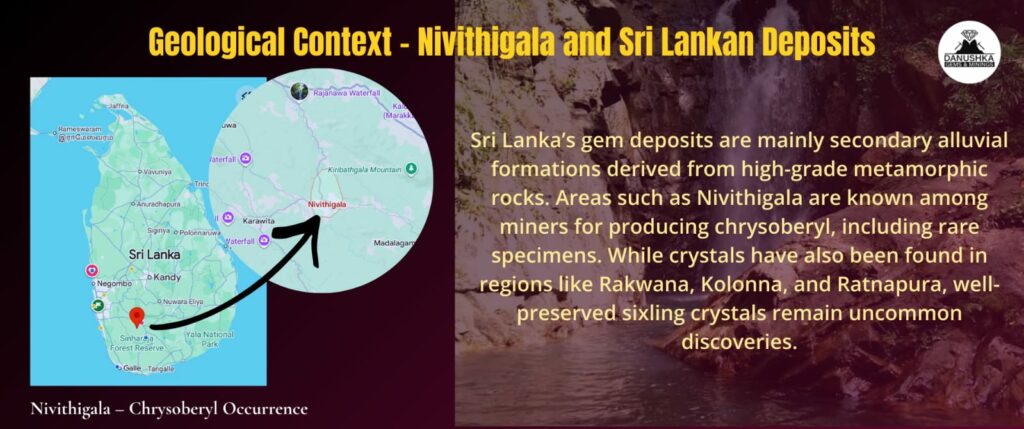
Sri Lanka’s gem fields are primarily secondary alluvial deposits derived from high-grade metamorphic source rocks.
Chrysoberyl in Sri Lanka forms within:
High-grade metamorphic terrains
Pegmatitic influences
Beryllium-bearing geological environments
Nivithigala is recognized among local miners as a productive area for chrysoberyl, including alexandrite occurrences.
While we have also encountered chrysoberyl crystals historically from:
Kolonna
Rakwana
Ratnapura
Pelmadulla
Embilipitiya
Deniyaya
Balangoda
Hunuwala
Sixling crystals of clean preserved quality are not frequent. They are occasional discoveries rather than regular production items.
We have also seen chrysoberyl sixlings in Madagascar, but again not in large quantities.
Striations – Comparative Observation
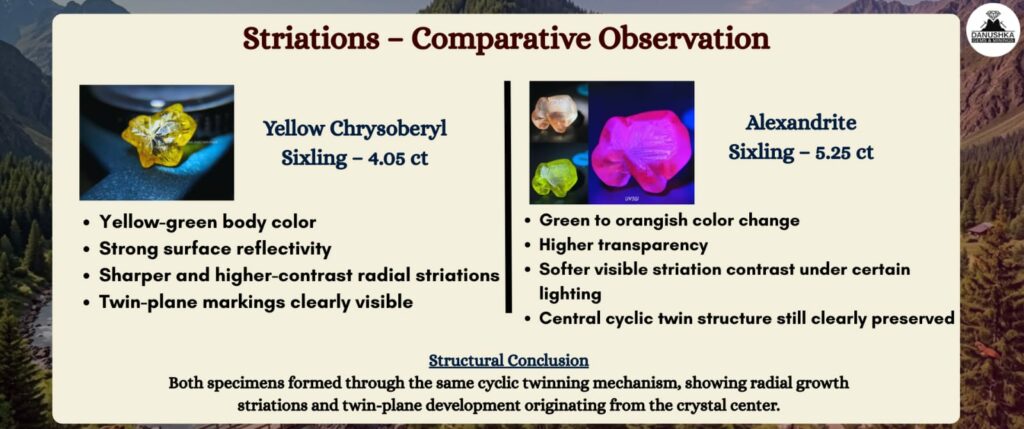
Both specimens show:
Radial growth striations from the center
Parallel twin-plane markings
Feather-like surface textures
The yellow specimen displays sharper, higher-contrast striations due to surface reflectivity.
The alexandrite specimen shows softer visual striation contrast under certain lighting due to higher transparency and color-change effect.
Structurally, both are formed by the same cyclic twinning mechanism.
Practical Market Perspective
From a gem-dealer standpoint:
These are not cutting rough.
They are collector specimens.
Cutting a sixling destroys its crystallographic value.
Collectors value:
Symmetry
Preservation
Growth marks
Optical behavior (in the alexandrite piece)
Locality
Because these appear only occasionally — sometimes once per year — they remain niche collector materials rather than commercial mass-market stones.
Why These Matter to Serious Collectors
They represent:
Structural crystallography
Geological formation history
Rare twin development
In the second case, optical phenomenon (color change + UV reaction)
For mineral collectors, this combination of structure + chemistry + locality is what creates long-term interest.
FAQ – Chrysoberyl Sixling Crystals
1. What is a chrysoberyl sixling crystal?
A sixling is a cyclic twin formation where multiple crystal segments grow symmetrically around a central axis, creating a star-like structure.
2. What causes color change in alexandrite chrysoberyl?
Trace chromium substituting into the crystal lattice causes the stone to appear green in daylight and orangish in incandescent light.
3. Are sixling crystals common in Sri Lanka?
No. While chrysoberyl is found in several Sri Lankan regions, well-preserved sixling crystals are not frequent discoveries.
4. Is UV reaction important in alexandrite?
Yes. Strong UVSW reaction supports chromium presence and helps confirm alexandrite-type chemistry.
5. Should sixling crystals be cut?
From a collector standpoint, no. Cutting removes the cyclic twin structure, which is the primary value of the specimen.