A Hidden Potential Inside Natural Rough
Every gemstone has a beginning, but not every beautiful gemstone starts with an impressive appearance.
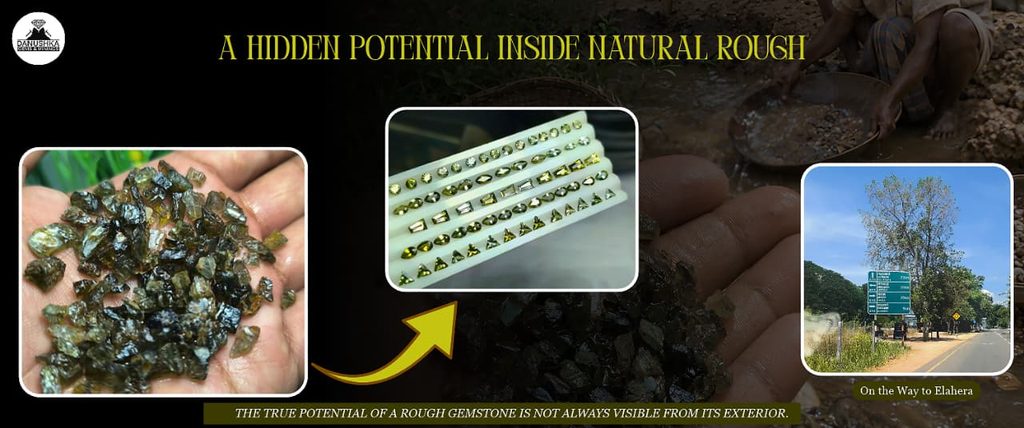
This journey began with 100 carats of natural unheated kornerupine rough from Elahera village around mining in Sri Lanka, North Central Province.
At first glance, the rough material was not particularly attractive. Its mixed olive-green, yellowish-green and brownish tones, irregular surfaces, and many of internal and external futures and varying transparency made it difficult to imagine the finished gemstones hidden inside.
But experience teaches us something important: the true potential of a rough gemstone is not always visible from its exterior.
At Danushka Gems & Minings, years of working around Sri Lankan mining villages have taught us to look beyond the first impression. Careful examination under different lighting conditions, attention to internal features and practical cutting knowledge can reveal possibilities that might otherwise be overlooked.
That was exactly how this kornerupine project began.
Elahera, Sri Lanka – Where the Story Started
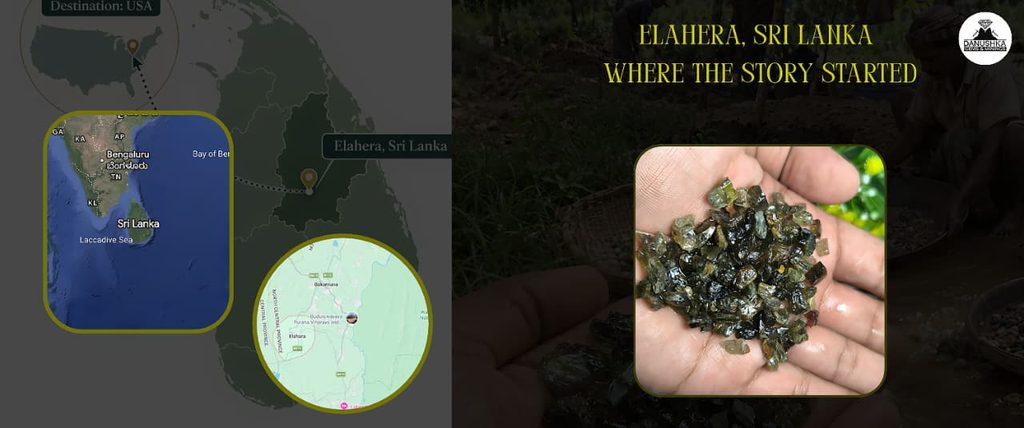
Elahera is part of Sri Lanka’s established gemstone-producing region in the North Central Province, associated with mineral-bearing deposits and a long history of gemstone recovery.
For us, the word “origin” means much more than a location printed on a gemstone certificate.
When we examine gemstones from a familiar source, we remember the people, the mining environment, the journeys through villages and the experience of discovering material close to where it was recovered.
This is what makes direct sourcing meaningful.
We understand the working conditions and the people involved in bringing these natural treasures to the surface. Purchasing directly from mining sources also helps direct money toward the miners and communities doing the physical work.
For this kornerupine project, the source and subsequent cutting journey are known to us. That traceability allows us to connect the finished gemstones with their original rough material and the people behind them.
Understanding Kornerupine – Gemology and Natural Characteristics
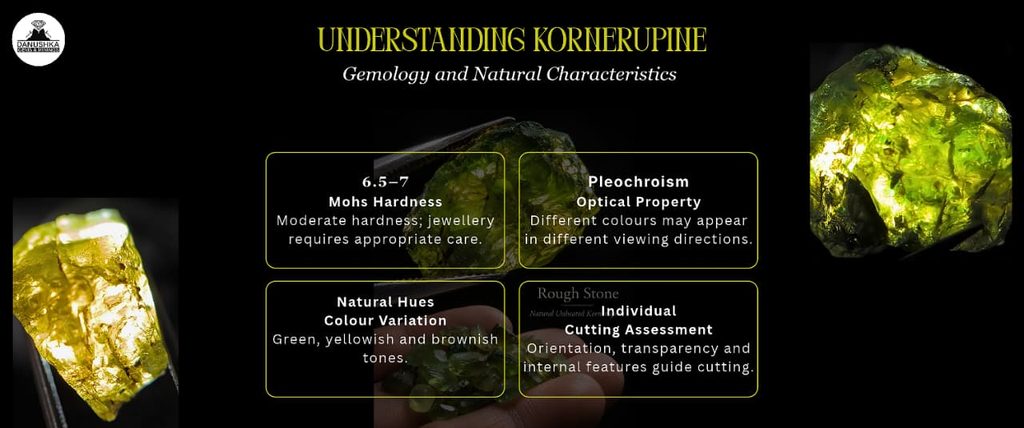
Kornerupine is a distinct mineral species belonging to the silicate group. It is generally described as a magnesium-aluminium silicate that may contain boron and iron, with an orthorhombic crystal structure.
Its typical Mohs hardness is approximately 6.5–7, making it suitable for carefully designed jewelry when handled appropriately.
One of kornerupine’s most interesting gemological characteristics is pleochroism.
This optical property allows a gemstone to display different color appearances when observed along different crystallographic directions. Kornerupine may show greenish, yellowish and brownish tones depending on its composition and orientation.
For gemstone cutters, pleochroism is an important consideration. Selecting the cutting direction can influence the dominant color visible in the finished gemstone.
Kornerupine can also show different levels of transparency and natural internal features.
These are general gemological characteristics of the species, rather than laboratory-confirmed measurements of this particular parcel.
Our Elahera material is presented as natural unheated kornerupine, with individual cutting decisions based on direct examination.
The First Examination – Finding the Usable Material
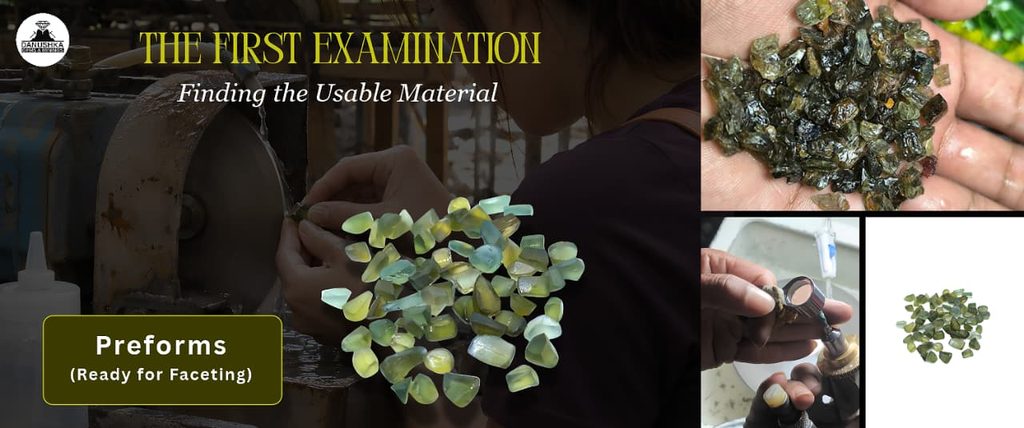
The original 100 ct parcel contained multiple rough pieces with different shapes, colors and internal appearances.
Rather than cutting immediately, we began by carefully examining the material and identifying potentially usable sections.
This is where experience becomes important.
Some rough pieces contained areas that needed to be removed before proper cutting could begin. Others offered smaller sections suitable for individual faceted gemstones.
Our objective was not simply to preserve the maximum possible weight.
We wanted to produce attractive, well-finished gemstones that could be useful to jewelry designers, collectors and professional buyers.
Even smaller pieces were carefully considered rather than automatically discarded.
The examination and preforming process gradually transformed the irregular rough material into a collection of shapes ready for faceting.
From Preforming to Professional Faceting
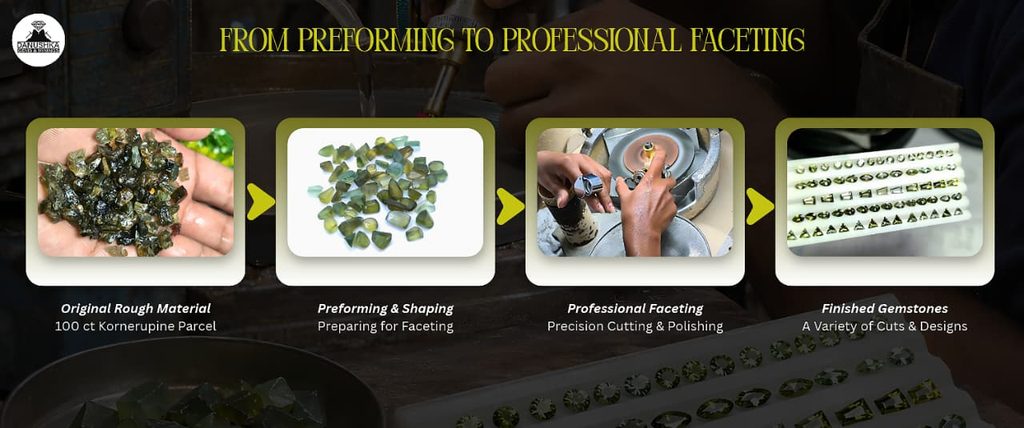
After the initial examination, unnecessary outer material was removed and suitable preforms were prepared.
Each preform required decisions about shape, color orientation, available depth and the amount of usable material.
The preformed stones were then sent for professional faceting and polishing.
Over the following weeks, the rough material gradually became a collection of finished kornerupine gemstones.
Instead of producing only one cutting style, we selected several designs to demonstrate the versatility of the material.
Some pieces were cut into closely matching sizes suitable for coordinated jewelry arrangements.
Other stones were finished individually according to their available shape and cutting potential.
The project shows how experienced examination, practical preforming and careful lapidary work can bring value to rough material that initially appears unpromising.
The Finished Collection – 65 Kornerupine Gemstones
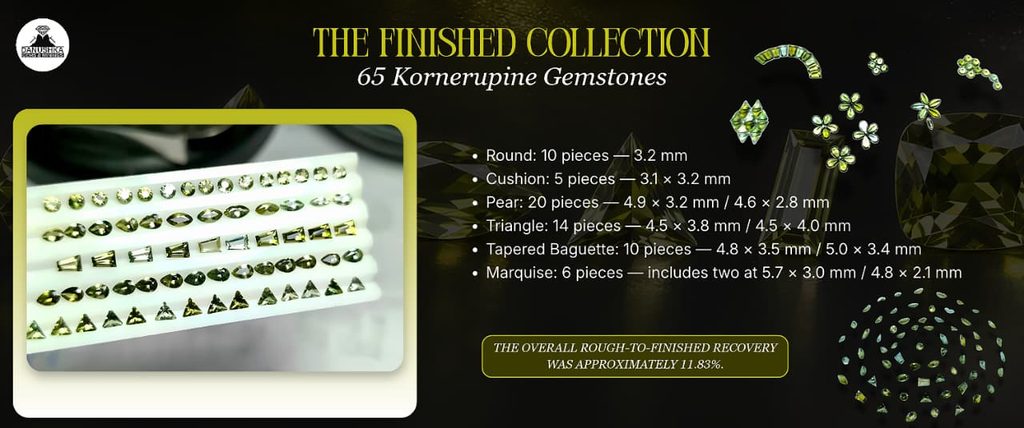
After completing the cutting and polishing process, the original 100 ct rough parcel produced 65 finished faceted kornerupine gemstones.
The collection includes six different cutting styles:
Finished Shape| Pieces| Approximate Measurements
Round| 10| 3.2 mm
Cushion| 5| 3.1 × 3.2 mm
Pear| 20| 4.9 × 3.2 mm / 4.6 × 2.8 mm
Triangle| 14| 4.5 × 3.8 mm / 4.5 × 4.0 mm
Tapered Baguette| 10| 4.8 × 3.5 mm / 5.0 × 3.4 mm
Marquise| 6| Includes two at 5.7 × 3.0 mm / 4.8 × 2.1 mm
The overall rough-to-finished recovery was approximately 11.83%.
This represents the actual outcome of this project, not a recovery percentage that can be guaranteed for other kornerupine rough.
The finished gemstones display variations of olive-green, yellowish-green and greyish-green appearances, with different cutting styles offering possibilities for rings, earrings and coordinated multi-stone jewelry.
From Sri Lanka to a Customer in the United States
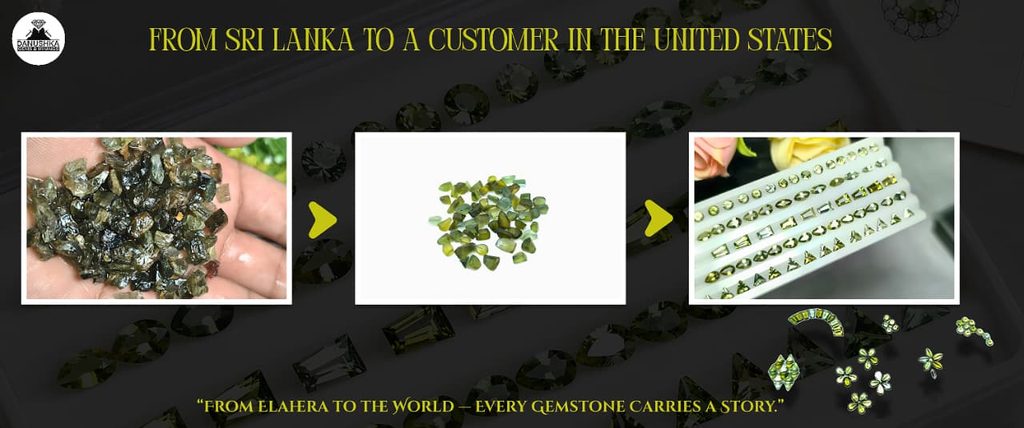
Shortly after completing the collection, a customer from the United States expressed interest in the finished gemstones.
The collection is now ready for shipment.
This is the moment when the entire journey comes together.
What began as rough material from Elahera’s gemstone-producing area has become a collection of 65 individually cut and polished gemstones, prepared for use far beyond the place where they originated.
For us, these gemstones carry more than their combined 11.83 carat weight.
They represent the people who mined the material, the experience of examining rough gemstones, the decisions made during preforming and the skills of the lapidaries who completed the cutting.
Every stage contributes to the finished result.
The Danushka Gems & Minings Philosophy
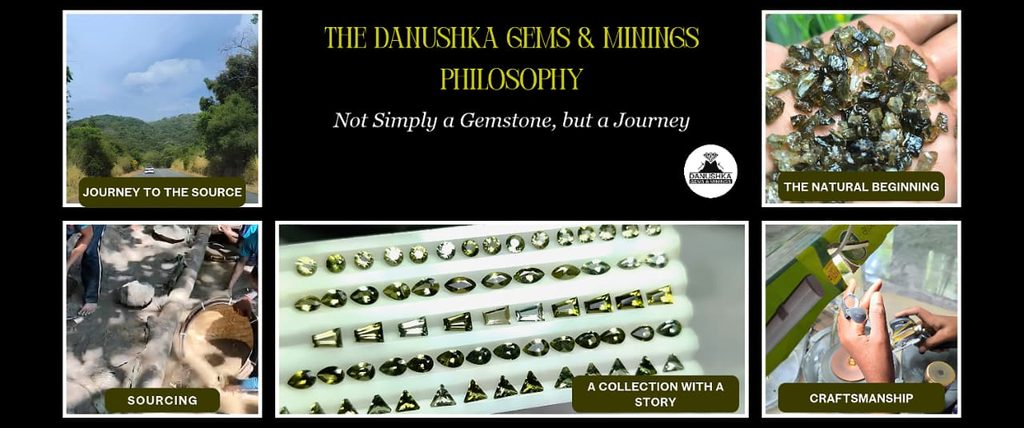
Our approach has always been about understanding gemstones from their source.
We travel through Sri Lanka’s gemstone-producing regions, establish relationships with miners and source dealers, examine rough material carefully and manage cutting and polishing according to each project’s requirements.
We believe a gemstone’s journey matters.
Traceable sourcing does not replace scientific testing, but knowing where material was obtained and how it was processed provides valuable information that cannot be understood from its finished appearance alone.
For this Elahera kornerupine collection, we know the rough’s sourcing and cutting history. Its natural unheated condition is disclosed according to the supplied project information.
We value that connection because buying gemstones should not be only about price, weight or appearance.
It is also about the people, the natural environment, the craftsmanship and the experience behind every finished stone.
Danushka Gems & Minings – From the Source to Your Hands.
Not simply a gemstone, but a journey carrying the character of its origin, the people who discovered it and the craftsmanship that revealed its hidden beauty.
FAQ – Frequently Asked Questions
Kornerupine is a silicate mineral with an orthorhombic crystal structure, approximately 6.5–7 Mohs hardness and often noticeable pleochroism. It can occur in green, yellowish and brownish colors.
Yes. The Elahera parcel is natural unheated kornerupine.
The original rough originated from Elahera village around mining in Sri Lanka, North Central Province.
The project produced 65 faceted gemstones weighing 11.83 ct in total, representing approximately 11.83% rough-to-finished weight recovery.
Yes. Properly cut and protected kornerupine can be incorporated into jewelry. This collection includes rounds, pears, cushions, triangles, tapered baguettes and marquises, with some closely matching sizes suitable for coordinated jewelry designs.