
Every natural gemstone has two stories. One is the geological story written inside the crystal over millions of years. The other begins when the rough stone reaches human hands and decisions have to be made about orientation, inclusions, color, weight, symmetry and final use. This 13.30 ct natural Ceylon blue sapphire became a good example of how those decisions can change during cutting, and why a rough-to-finished gemstone journey is rarely as simple as choosing a shape and polishing it.
The sapphire began as a 13.30 ct natural unheated alluvial blue sapphire rough, measuring 15 × 12.3 × 7.3 mm, sourced from Ratnapura village around mining in Sri Lanka. Its rounded alluvial form was immediately encouraging because material shaped naturally by river transport can sometimes offer useful proportions for planning a finished gemstone without first removing excessive rough skin or damaged crystal edges.
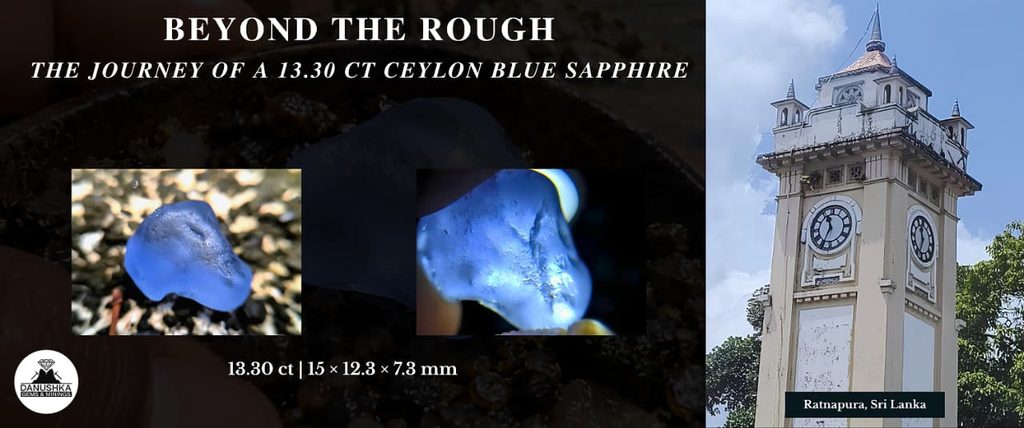
Before cutting, we photographed and examined the sapphire from different directions under ordinary light and stronger transmitted illumination. Strong transmitted light is especially useful when studying sapphire rough because internal features that seem minor in normal viewing can become much clearer when light travels through the body of the stone.
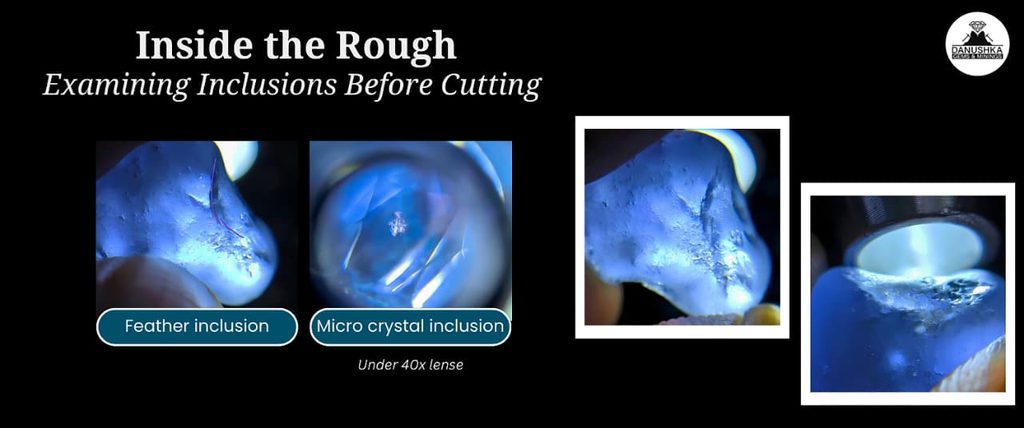
In this sapphire, the most important feature was a larger feather-type inclusion positioned near one corner. A second, much smaller micro-crystal inclusion could also be seen nearer the center. These features did not automatically make the stone unsuitable for faceting, but they had to be considered carefully because inclusion position can influence orientation, durability, weight recovery and the final appearance of a polished sapphire.
This stone had already been purchased by a customer in the Netherlands, so the cutting process was discussed as a collaborative project. The goal was not simply to chase the highest possible carat weight. We needed to balance several factors at once: remove the more significant feather, maintain attractive blue color, preserve useful depth, keep a good oval outline, obtain a clean face-up appearance and avoid unnecessary weight loss.
Choosing the Cutting Orientation
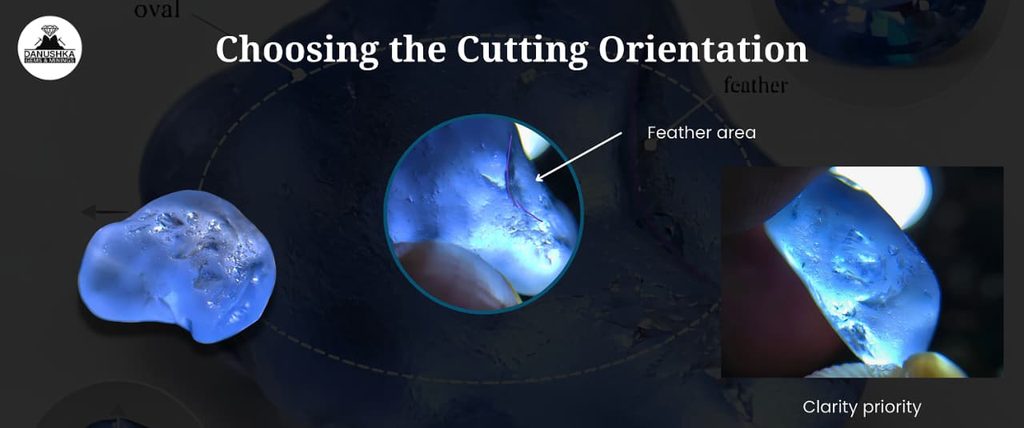
The original alluvial shape offered several possible orientations. One direction appeared capable of holding slightly stronger color, but another direction gave us a better opportunity to deal with the larger feather inclusion.
After comparing the options, the customer, Danushka Gems & Minings and the cutter agreed to prioritize removal of the main feather rather than force the stone into the direction that appeared darkest.
That decision meant accepting a slightly lighter finished blue tone in exchange for improved clarity and a safer, cleaner final gemstone.
This is an important part of practical sapphire cutting. The darkest orientation is not automatically the best orientation. Color, clarity, pavilion depth, inclusions, weight and shape must all be considered together.
Pre-forming the 13.30 ct Sapphire
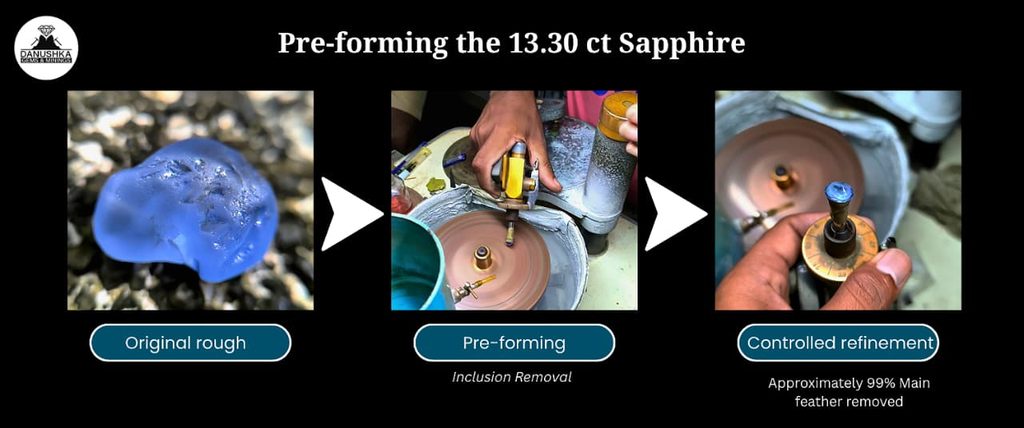
During pre-forming, the cutter carefully worked toward the planned oval profile while gradually removing the problematic corner.
Approximately 99% of the main feather was removed during this stage.
A very small remaining portion was intentionally left close to the future pavilion edge. Removing it completely during pre-forming would have required taking away additional material before we knew exactly how the pavilion facets would meet.
Instead, we decided to preserve that small amount temporarily and approach it during final faceting.
This is where gemstone cutting becomes less like manufacturing and more like controlled decision-making. Every fraction of a millimeter can influence the final carat weight.
Throughout the process, Danushka Gems & Minings followed the cutting step by step and communicated the progress with the customer. Rough orientation, inclusion removal, proportions and weight were continuously considered rather than leaving the stone at the workshop and only checking the result at the end.
A Very Promising 5.90 ct Stage
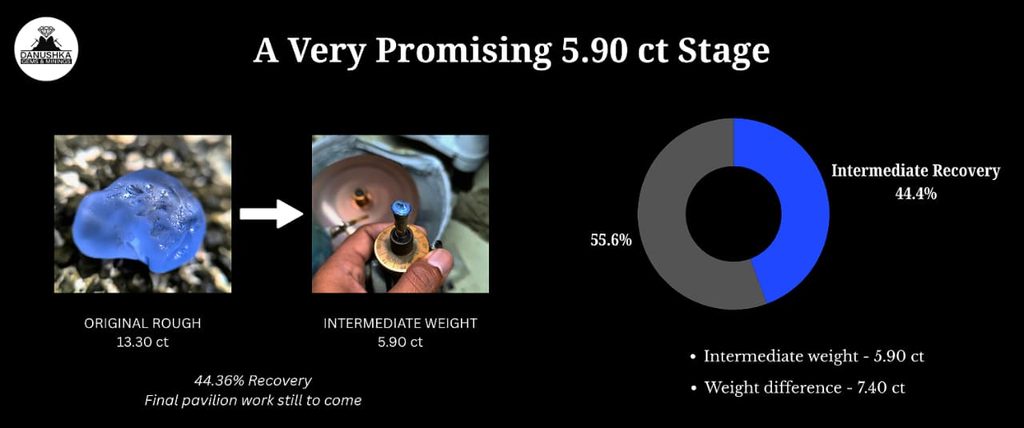
Once the crown had been completed and polished and most of the pavilion had been finished, the sapphire reached approximately 5.90 ct.
From the original 13.30 ct rough, this represented an intermediate recovery of about 44.36%.
At that stage we were extremely pleased. The sapphire had developed a good oval outline, the larger inclusion had been almost completely removed, and the overall appearance was much cleaner.
Only the final pavilion work remained.
Then came the part that every experienced rough buyer and cutter understands: even when the planning is correct, the stone can still change the plan.
The Final Pavilion Surprise
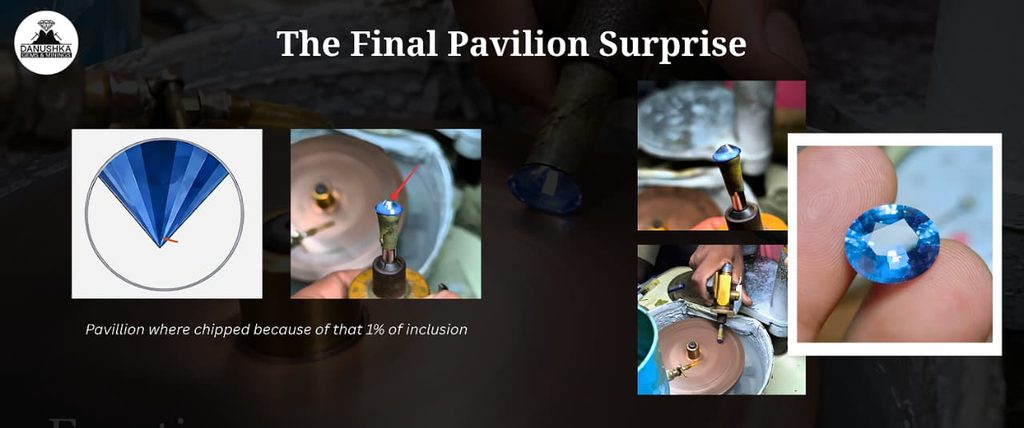
While polishing the last pavilion area, the small remaining portion of the feather reached the edge of the stone and chipped.
The damage affected the pavilion near the culet.
Instead of ending with a clean pointed pavilion termination, the bottom became slightly flat.
Technically, we could have stopped there and retained more weight, but the pavilion would not have been finished to the standard we wanted.
Correcting only the chipped facet was also not the proper solution. Changing one pavilion facet independently could disturb the relationship between the surrounding angles, potentially creating poor light return or a visible window.
The correct approach was to rebuild the pavilion geometry progressively toward the culet.
That meant cutting again.
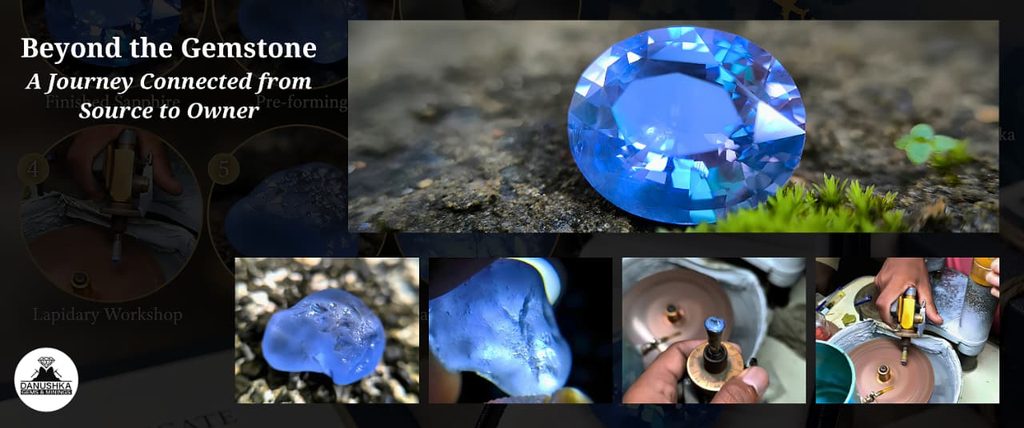
It also meant losing additional weight.
Final Result — 5.05 ct Natural Unheated Blue Sapphire
After carefully recutting and repolishing the pavilion, the gemstone was finally completed at:
Finished Weight: 5.05 ct
Measurements: 11.2 × 9.3 × 5.7 mm
Shape: Oval
Gemstone: Natural Ceylon Blue Sapphire
Treatment: Unheated
Origin: Ratnapura village around mining in Sri Lanka
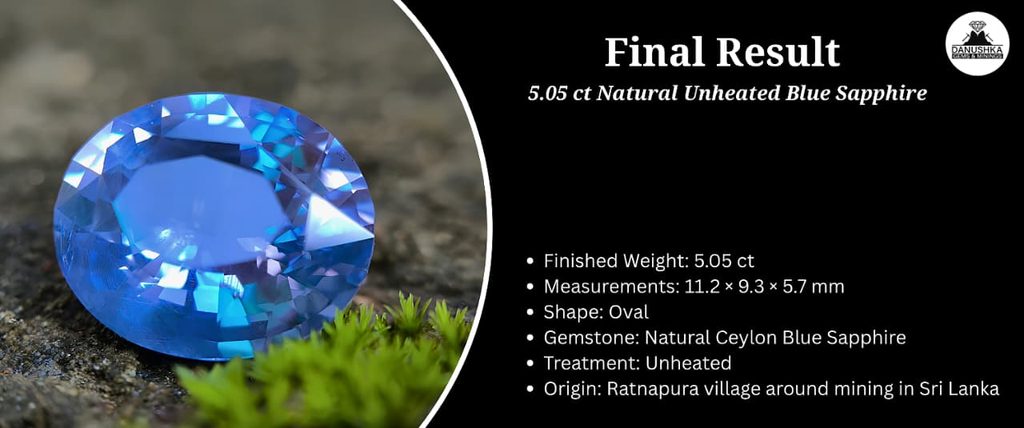
The final recovery from the original 13.30 ct rough was approximately 37.97%.
That means approximately 62.03% of the original rough weight was removed during pre-forming, inclusion management, shaping, faceting and final pavilion correction.
The last pavilion correction alone reduced the stone from approximately 5.90 ct to 5.05 ct, a difference of 0.85 ct.
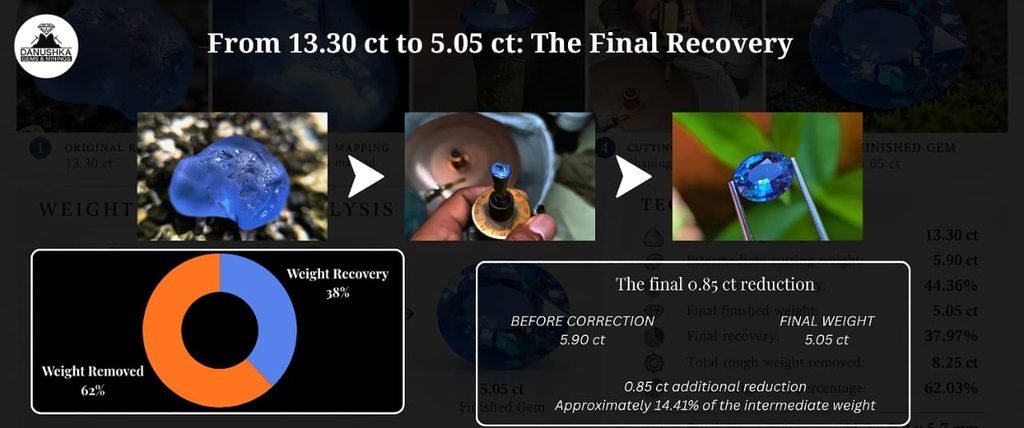
At first, losing that additional weight was disappointing. But the final result justified the decision. The finished sapphire became cleaner, the pavilion geometry improved, and the stone developed a better overall balance of clarity, proportion, color and appearance.
Sometimes in gemstone cutting, losing more weight creates the better gemstone.
Why Rough-to-Cut Sapphire Projects Are Different
When someone buys a finished sapphire, they normally see only the final polished stone.
They do not see the inspection under transmitted light, the discussions about orientation, the uncertainty around inclusions, the pre-forming, the changing weight, the accidental chip, the decision to recut the pavilion or the moment the final gemstone is removed from the dop.
With a rough-to-finished project at Danushka Gems & Minings, we want the customer to experience those stages.
The aim is not only to sell a gemstone.
It is to connect the customer with the complete journey — from Sri Lankan source areas, rough evaluation and lapidary planning to the final polished sapphire that eventually reaches their hand.
There is risk in that process. There is also excitement.
A rough stone does not guarantee a particular finished weight, clarity or appearance. But when every stage is documented and discussed honestly, the customer understands why the final gemstone looks the way it does and what decisions created it.
That is the experience we want to provide: source, stone, cutter, decision, transformation and final ownership — all connected in one real gemstone journey.
Cutting Recovery Summary
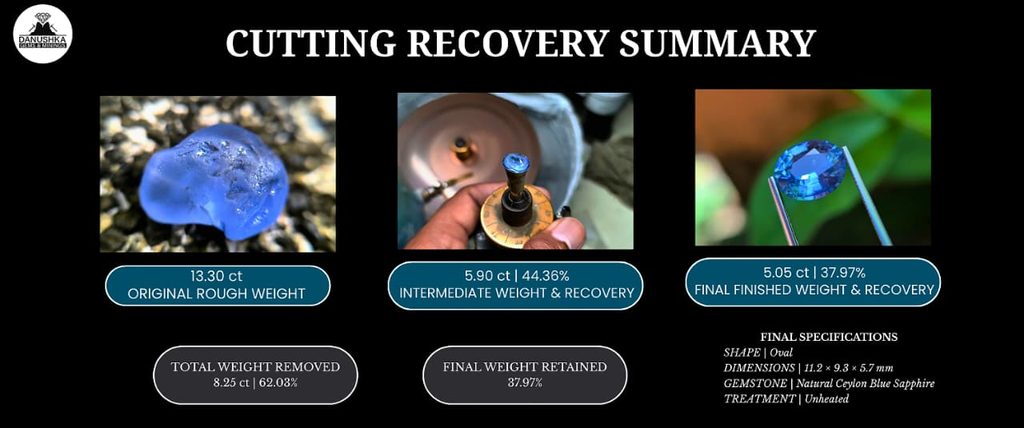
Original rough weight: 13.30 ct
Intermediate cutting weight: 5.90 ct
Intermediate recovery: 44.36%
Final finished weight: 5.05 ct
Final recovery: 37.97%
Total rough weight removed: 8.25 ct
Total weight-loss percentage: 62.03%
Final dimensions: 11.2 × 9.3 × 5.7 mm
Final treatment status: Natural, unheated
FAQ
1. Is this blue sapphire heated?
No. This sapphire remained natural and unheated throughout the cutting process.
2. Where did this Ceylon blue sapphire come from?
The rough was sourced from Ratnapura village around mining in Sri Lanka.
3. Why did a 13.30 ct rough sapphire finish at only 5.05 ct?
Natural rough cutting requires removal of irregular surfaces, unsuitable material and inclusions while creating correct crown and pavilion geometry. In this project, additional weight was also removed after a small feather reached the pavilion edge during final polishing.
4. What was the cutting recovery percentage?
The final recovery was approximately 37.97%, from 13.30 ct rough to 5.05 ct finished.
5. Why was the sapphire recut after reaching 5.90 ct?
A small remaining feather chipped near the pavilion edge during final polishing, leaving the culet area too flat. The pavilion was recut to restore better geometry and reduce the risk of poor light return.
6. Are inclusions always removed when cutting sapphire?
Not always. Their size, depth, position and effect on durability and appearance must be evaluated against potential weight loss. Sometimes retaining a minor inclusion is preferable to sacrificing unnecessary weight.
7. Can a rough sapphire’s final weight be guaranteed before cutting?
No. Experienced cutters can estimate possible recovery, but internal features and unexpected behavior during cutting can change the final result.
8. Why is orientation important in blue sapphire cutting?
Orientation affects color concentration, clarity, yield, brilliance and shape. The orientation showing the strongest color is not always the best overall choice.
9. Can customers follow the cutting process with Danushka Gems & Minings?
Yes. For suitable projects, we document the rough, discuss cutting decisions, follow the transformation and communicate important stages with the customer through the journey.