
Rare Blue-Green to Pink-Purple Alexandrite
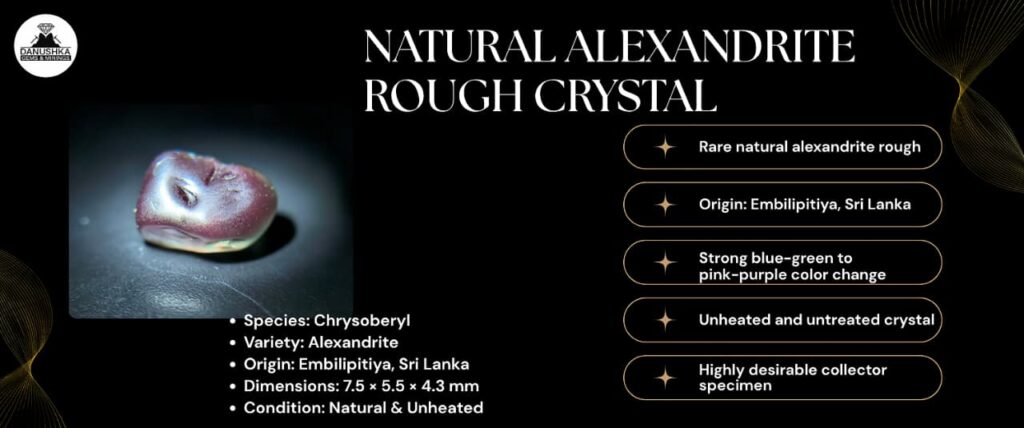
Sri Lanka has long been known as one of the world’s historic gemstone sources. Among the many gemstones found in its alluvial deposits, alexandrite remains one of the rarest and most fascinating. This particular specimen represents an exceptional example of Sri Lankan chrysoberyl with strong color change properties.
Sourced from Embilipitiya village around mining in Sri Lanka, located in Sabaragamuwa Province, this unheated alexandrite rough measures 7.5 × 5.5 × 4.3 mm and displays an extremely strong color change from blue-green in daylight to vivid pink-purple under warm light. Stones showing such dramatic transformation are extremely uncommon, even within the already rare category of alexandrite.
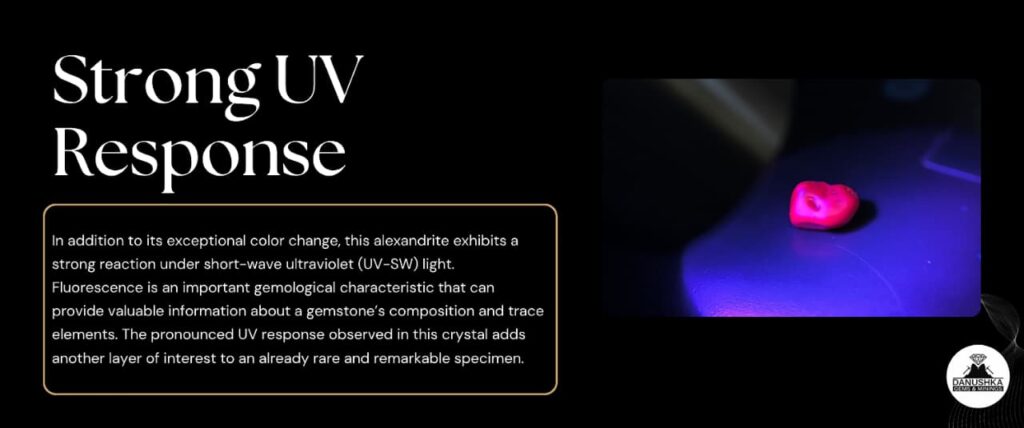
This stone also shows very strong reaction under short-wave ultraviolet light, adding another interesting gemological feature to its profile. Combined with its Embilipitiya origin, strong color shift, and natural unheated condition, this crystal represents an important example of Sri Lankan alexandrite.
Alexandrite: The Color-Changing Variety of Chrysoberyl
Alexandrite is the color-change variety of the mineral chrysoberyl, with the chemical composition BeAl₂O₄, known as beryllium aluminum oxide. The color change phenomenon occurs due to trace amounts of chromium substituting for aluminum in the crystal lattice.
According to gemological research and widely accepted gemology references, the alexandrite effect occurs because the gemstone absorbs certain yellow wavelengths while transmitting green and red portions of the spectrum. Under daylight, which contains more blue-green wavelengths, the stone appears greenish or blue-green. Under warm or incandescent light, which is richer in red wavelengths, the gemstone appears red, purple, or pinkish-purple.
The most desirable alexandrites show a dramatic shift between two clearly different colors. In the finest examples, this transformation gives the stone a unique and highly attractive visual character.
The Unique Color Range of Sri Lankan Alexandrite
Sri Lanka produces a range of alexandrite colors that can differ from the classic Russian stones historically found in the Ural Mountains. Sri Lankan alexandrites are often admired for their natural clarity, attractive tones, and individual color behavior.
Typical Sri Lankan alexandrite color changes may include green to reddish orange, yellowish green to brownish red, olive green to orangy red, and green to red. However, the stone presented here shows a much rarer color combination, shifting from blue-green to pink-purple. This hue combination is less commonly seen in Sri Lankan material and makes the stone especially interesting for collectors and professional gemstone buyers.
Because of this unique color behavior, such stones are considered highly desirable, especially when the color change is strong, the origin is clear, and the stone remains in natural unheated condition.
Alexandrite from Embilipitiya – A Rare Gemstone Discovery Area
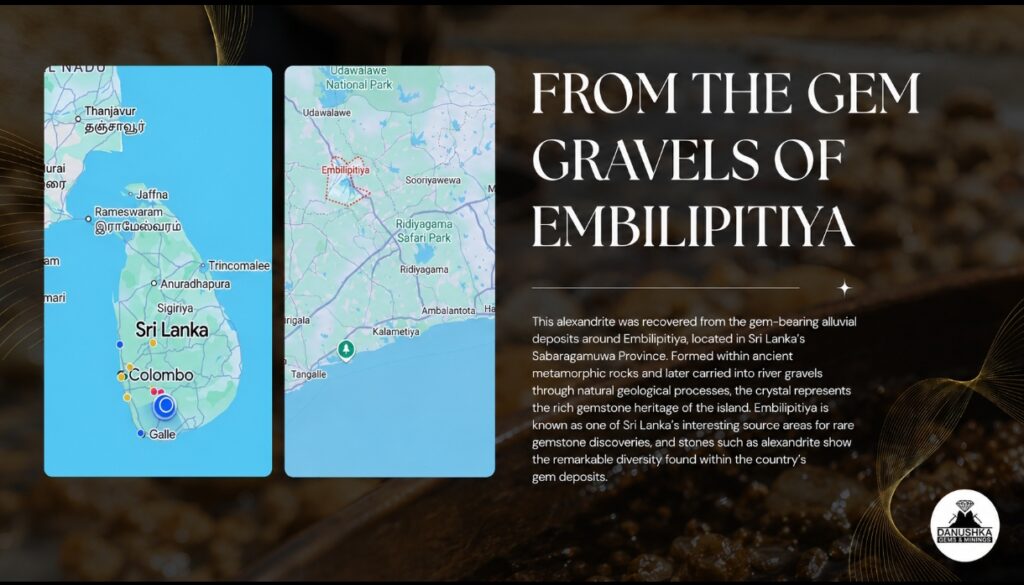
While alexandrite has been reported in several Sri Lankan mining regions, including areas around Ratnapura, Rakwana, Nivithigala, Kolonna, Galpaya, Kalawana, Elahera, Deniyaya, Matale, and Balangoda, Embilipitiya is also known as an interesting source area where rare gemstone discoveries can appear within alluvial gem gravels.
Located in Sri Lanka’s Sabaragamuwa Province, Embilipitiya is connected to the wider gem-bearing geological environment of the island. These deposits are related to Sri Lanka’s ancient metamorphic rock formations. Over long geological periods, erosion released gemstone crystals from their host rocks and transported them into river gravels, where many gems are found today.
Embilipitiya is appreciated among local gem circles as one of the areas where unusual and rare stones can occasionally be discovered. Alexandrite from this region is especially interesting because it reflects the diversity of Sri Lanka’s gem deposits and the unpredictable nature of rare gemstone formation.
Gemological Characteristics of This Alexandrite
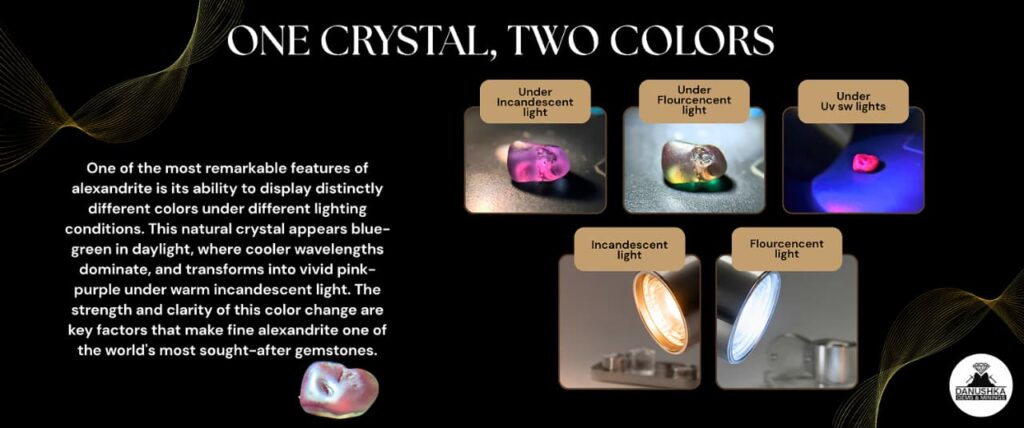
The gemological features of this crystal support its identification as a high-quality color-change chrysoberyl.
Species: Chrysoberyl
Variety: Alexandrite
Treatment: Natural / Unheated
Origin: Embilipitiya village around mining in Sri Lanka, Sabaragamuwa Province
Measurements: 7.5 × 5.5 × 4.3 mm
Color Change: Blue-green in daylight to pink-purple under warm light
Fluorescence: Strong reaction under short-wave ultraviolet light
Crystal Structure: Natural alluvial shaping typical of Sri Lankan gem gravels
Why Strong Color Change Alexandrite Is So Rare
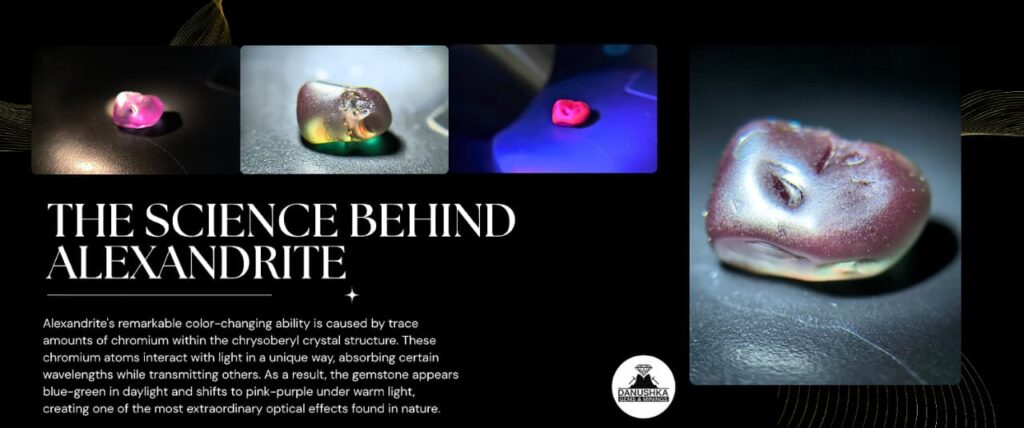
Alexandrite requires very specific geological conditions to form. Three major factors must occur together: a beryllium-rich geological environment, the presence of chromium to create the color-change effect, and stable metamorphic conditions suitable for chrysoberyl formation.
Beryllium and chromium rarely occur together in the same geological environment. This is one of the main reasons alexandrite deposits are limited worldwide and why strong color change stones are considered rare.
Major alexandrite sources historically include Russia, Brazil, Sri Lanka, Tanzania, Madagascar, and India. Among these locations, Sri Lankan stones are especially valued for their natural beauty, clarity potential, and attractive color tones.
Collector and Cutting Potential
When evaluating alexandrite rough, professional gem cutters consider several important factors, including orientation of color zones, crystal depth and shape, internal fractures or inclusions, and potential yield after cutting.
Because alexandrite rough is valuable and rare, cutters must plan the orientation carefully to preserve the strongest color-change effect. A small change in direction can affect the final face-up color, brightness, and overall appearance of the finished gemstone.
In some cases, specimens with unique structures, strong UV reaction, or especially dramatic color change may also be kept as mineral collector pieces rather than being cut immediately. This depends on the buyer’s purpose, the stone’s structure, and the best way to preserve its value.
A Rare Example of Sri Lankan Alexandrite
The gemstone trade may occasionally see green-to-orangish Sri Lankan alexandrites, but stones displaying blue-green to pink-purple color change remain highly unusual. Combined with its Embilipitiya origin, strong UV reaction, natural unheated condition, and rare color behavior, this crystal represents a special example of Sri Lankan chrysoberyl formation.
For gemologists, collectors, and professional gemstone buyers, stones like this are not just gemstones. They are geological stories captured within a crystal, showing the natural complexity of Sri Lanka’s gem-bearing deposits.
Danushka Gems & Minings — where stones become stories.
FAQ – Alexandrite from Sri Lanka
1. What is alexandrite?
Alexandrite is the color-changing variety of the mineral chrysoberyl. It changes color depending on the type of light.
2. Why does alexandrite change color?
The color change occurs mainly due to chromium in the crystal structure interacting with different light wavelengths.
3. Is alexandrite found in Sri Lanka?
Yes. Sri Lanka is one of the world’s important sources of natural alexandrite found in alluvial gem deposits.
4. Where is Embilipitiya located?
Embilipitiya is located in Sri Lanka’s Sabaragamuwa Province and is connected to the island’s gem-bearing alluvial deposits.
5. What colors do Sri Lankan alexandrites show?
Sri Lankan alexandrites may show green to reddish orange, yellowish green to brownish red, olive green to orangy red, green to red, and in rare cases, blue-green to pink-purple.
6. Why is alexandrite expensive?
Alexandrite is expensive because it requires rare geological conditions to form, and stones with strong color change are very limited in supply.
7. What makes this Embilipitiya alexandrite special?
This stone shows an extreme blue-green to pink-purple color change, strong short-wave UV reaction, natural unheated condition, and origin from Embilipitiya village around mining in Sri Lanka.