
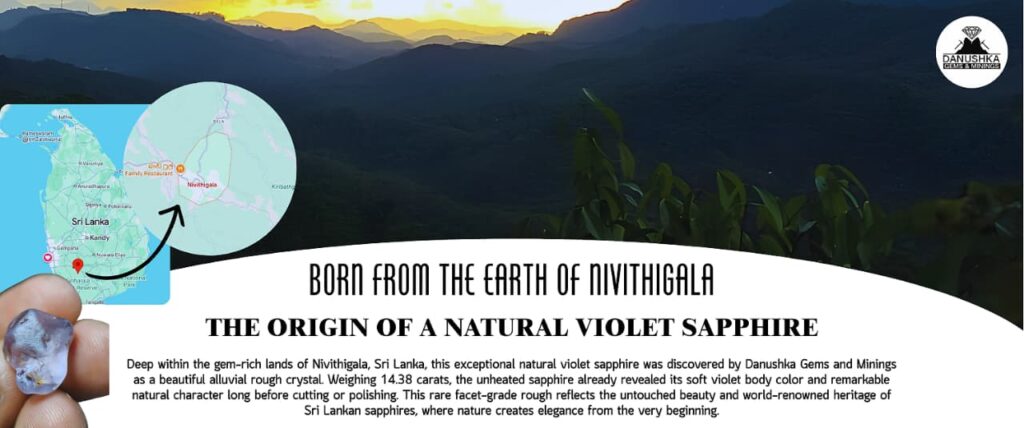
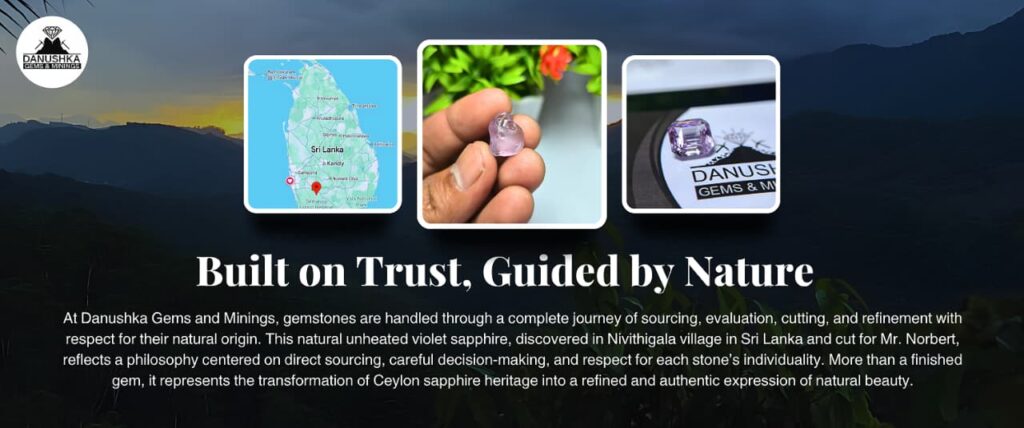
In the world of fine colored gemstone, some stones are admired only after they are polished, while others carry beauty from the very first moment they are found. This facet grade natural violet sapphire rough belongs to the second category. Found by Danushka Gems and Minings in Nivithigala village around mining in Sri Lanka, this natural unheated sapphire began as a beautiful alluvial rough weighing 14.38 carats, measuring 15.2 x 12.1 x 8.2 mm. Even in rough form, it already showed a soft violet body color, strong cutting promise, and the kind of natural character that makes Sri Lankan sapphires respected throughout the gemstone world.
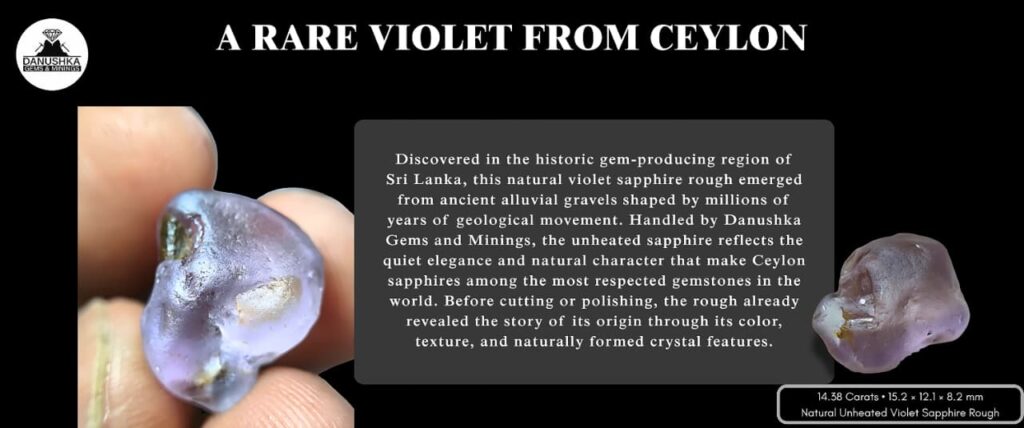
Sri Lanka, historically known as Ceylon, remains one of the most important origins for natural sapphires. While blue sapphire is the most internationally recognized variety, the island is also known for producing rare fancy sapphire colors such as violet, lavender, pink, yellow, purple, and padparadscha tones. Among these, violet and lavender sapphires hold a special place because of their quieter elegance. They do not rely on the strong dominance of royal blue or vivid pink. Instead, they offer a softer and more refined presence, making them especially attractive to collectors, designers, and buyers who appreciate unique sapphire colors with understated luxury.
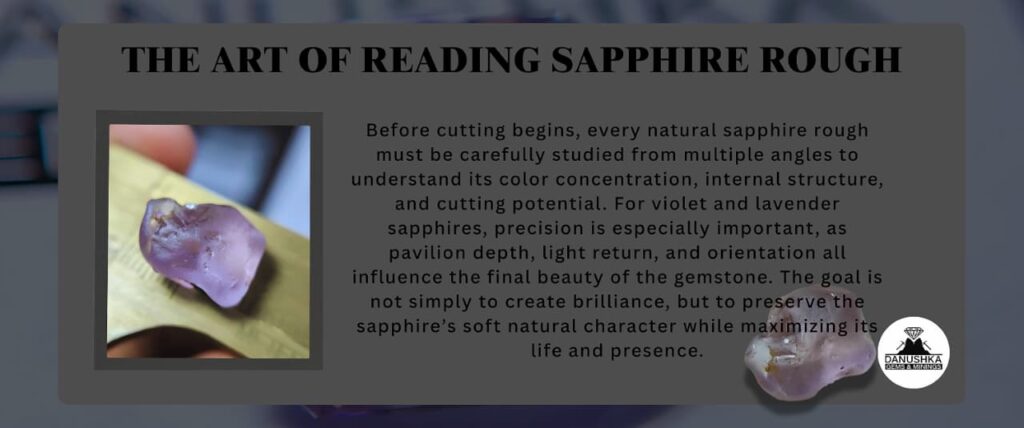
This gemstone was found and handled by Danushka Gems and Minings, directly connected to source-level sapphire buying and rough evaluation in Sri Lanka. The stone came fresh from mining as a large, attractive alluvial sapphire rough. Alluvial sapphires are shaped naturally through long geological movement in water-bearing gravels, often carrying rounded surfaces, natural skin, minor pressure marks, and growth-related external features. For experienced gemstone professionals, these details are not flaws to be ignored, but part of the language of the rough itself. They help reveal how the stone formed, how it moved, and how it should be approached before cutting.
At the rough stage, this sapphire required careful study rather than quick cutting. A 14.38 carat rough sapphire of this size must be observed from multiple directions before the cutting process begins. The color concentration, internal openness, surface condition, depth, and possible orientation all influence the final result. Violet and lavender sapphires are especially sensitive in cutting because their final face-up appearance depends greatly on pavilion depth, light return, angle balance, and the handling of any internal zoning. A shallow cut can weaken the body color and create a washed appearance. A cut that is too deep can make the stone look darker or less lively than intended. The challenge is to preserve the soft lavender-violet personality while still producing a stone with strong beauty and presence.
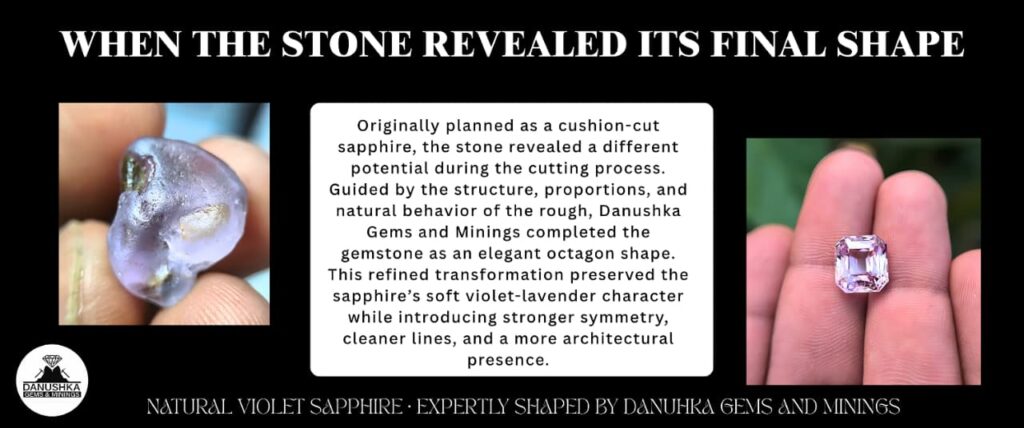
This sapphire was cut upon the request of Mr. Norbert, and the entire process was handled by Danushka Gems and Minings. From rough selection to shaping direction and final decision-making, the stone remained part of a carefully guided transformation. The original plan was to produce a cushion shape, which is often chosen for colored sapphires because it can preserve weight while offering a graceful and commercially attractive outline. However, in gemstone cutting, the first plan is not always the final answer. As the stone was examined more closely during the cutting stage, the structure and proportions suggested that another direction would create a more balanced and visually satisfying result.
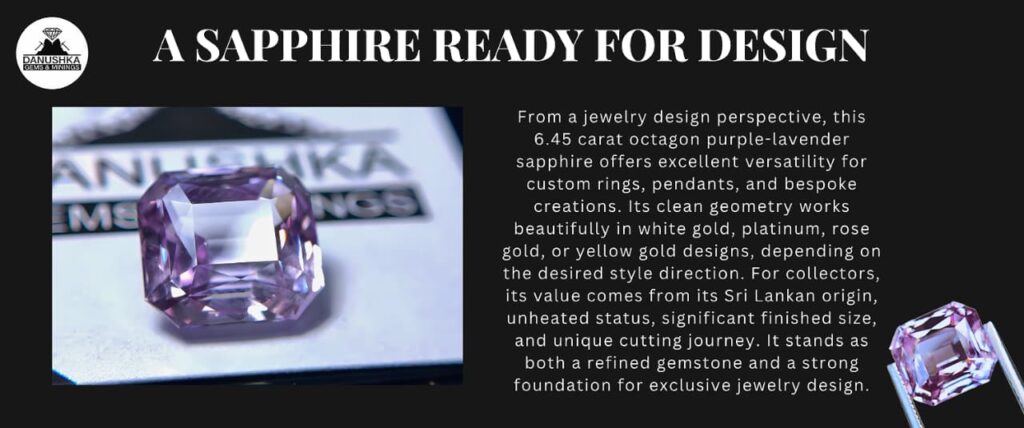
For that reason, the stone was finally completed as an octagon shape. This change was not random. It was based on how the rough behaved during cutting and how the final gemstone could best retain its soft violet-lavender beauty while gaining strong symmetry and refined character. The octagon shape gave the stone a more structured and elegant personality, offering clean lines and a more architectural finish without losing the softness of its color.
One of the most distinctive features of this sapphire is the pavilion treatment. There was a special request from Mr. Norbert not to keep a sharp edge at the pavilion end. Instead, the pavilion was finished with a softened broken-end style inspired by the feeling of old mine cuts. This detail is important because it gives the stone a more individual identity. Many modern sapphires are cut with predictable and highly standardized pavilion arrangements, but this stone was approached with a more personal and creative cutting idea. By softening the pavilion end rather than leaving a sharp point, the final gemstone gained a more unusual internal reflection character and a more artistic cutting personality.
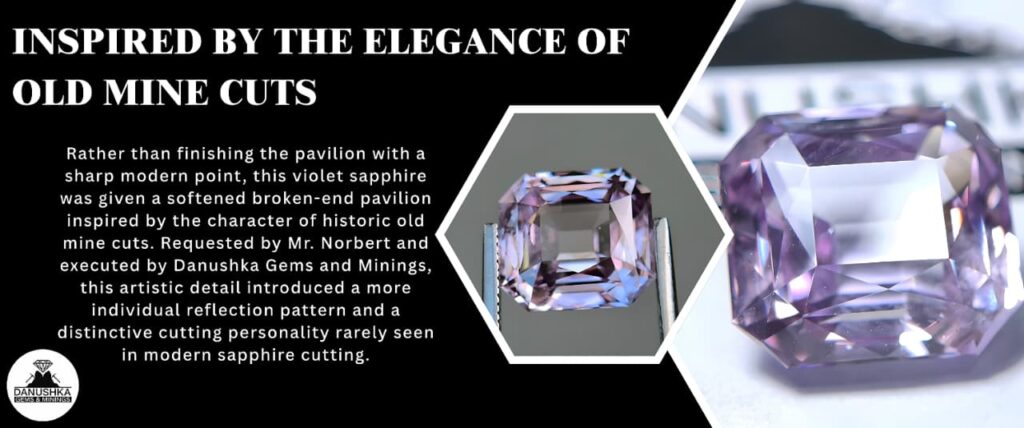
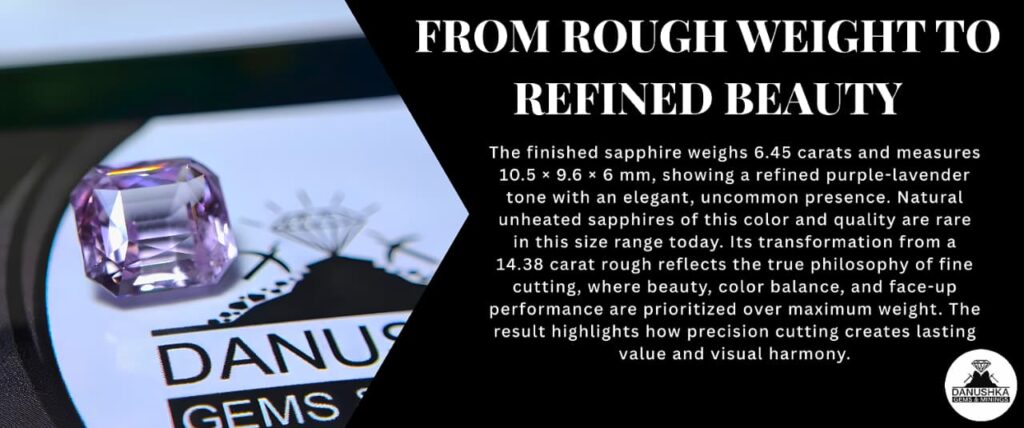
The finished sapphire weighs 6.45 carats and measures 10.5 x 9.6 x 6 mm. Its final appearance can be described as a beautiful purple-lavender sapphire, with a calm, elegant tone that feels both refined and uncommon. In today’s market, a natural unheated sapphire in this color range and size is not a common everyday stone. The finished gem carries enough size to be highly noticeable, while its color gives it a softer luxury appeal compared with more saturated sapphire varieties.
The transformation from 14.38 carats rough to 6.45 carats finished also shows the real balance involved in fine gemstone cutting. In colored stones, value is not always created by retaining the maximum possible weight. A heavier finished stone is not automatically a better one. The more important goal is to achieve the best face-up beauty, balanced proportions, stable color presentation, and overall identity. In this sapphire, the final cut was chosen to protect those qualities rather than to chase weight alone.
Another major value point of this stone is its treatment status. This sapphire is described as natural and unheated, meaning its violet-lavender color was not created or improved through heat treatment. In the sapphire trade, heating is common and widely accepted, but unheated sapphires hold a different level of appeal because they preserve their natural geological identity. When an unheated sapphire also displays an attractive fancy color such as violet or lavender, it becomes even more interesting to collectors and buyers who place importance on authenticity and rarity.
From a jewelry perspective, this 6.45 carat purple-lavender sapphire offers strong design potential. The octagon shape gives it a clean and elegant outline suitable for sophisticated rings, pendants, or custom one-of-a-kind jewelry. Its color can work beautifully in white gold, platinum, rose gold, or even yellow gold, depending on whether the design aims for contrast or harmony. For collectors, the value lies in the combination of Sri Lankan origin, unheated status, large finished size, and a distinct cutting story tied to a customer request. For gemstone lovers, it represents the full emotional journey from rough origin to polished presence.
At Danushka Gems and Minings, gemstones are not treated as simple products passing from one hand to another. Each stone carries a real process of finding, evaluating, planning, cutting, and respecting what the material naturally offers. This sapphire was found in Nivithigala village around mining in Sri Lanka, handled throughout by Danushka Gems and Minings, and cut upon the request of Mr. Norbert into a finished stone with its own identity. That process reflects the values behind the business: direct handling, honest rough evaluation, careful cutting judgment, and respect for the natural nature of the gemstone.
This Natural Unheated Violet Sapphire is more than a finished gem. It is a transformation story from rough alluvial beauty to polished lavender brilliance. It reflects the heritage of Ceylon sapphires, the skill involved in Sri Lankan gemstone cutting, and the commitment of Danushka Gems and Minings to creating gemstones with authenticity, individuality, and lasting appeal.
FAQ
1.Who found and handled this sapphire?
The sapphire was found and fully handled by Danushka Gems and Minings.
2. Was this sapphire cut for a specific request?
Yes. This stone was cut upon the request of Mr. Norbert, with the process guided according to the best visual and structural outcome for the rough.
3. Is this violet sapphire heated or treated?
No. This gemstone is described as natural and unheated, meaning its color remains in natural condition without heat treatment.
4. What was the original rough weight before cutting?
The original rough weighed 14.38 carats and measured 15.2 x 12.1 x 8.2 mm.
5. What is the final weight and size after cutting?
The finished sapphire weighs 6.45 carats and measures 10.5 x 9.6 x 6 mm.
6. What shape is the finished gemstone?
The final gemstone is an octagon shape. A cushion was first considered, but the final direction changed during cutting based on the structure and best outcome of the stone.
7. What makes the pavilion style special?
The pavilion was finished without a sharp edge at the end, following a special request from Mr. Norbert for a softer old-mine-inspired effect. This gives the stone a more individual and artistic cutting identity.
8. Why is a natural unheated violet sapphire valuable?
Natural unheated violet and lavender sapphires are appreciated because their color is naturally formed without heat enhancement. Combined with Sri Lankan origin, large size, and distinct cutting character, they are especially attractive to collectors and designers.
9. Why is this stone important for Danushka Gems and Minings?
Because it represents the full gemstone journey handled directly by Danushka Gems and Minings — from finding the rough in Sri Lanka to planning, cutting, and finishing a custom-request sapphire with real individuality.