
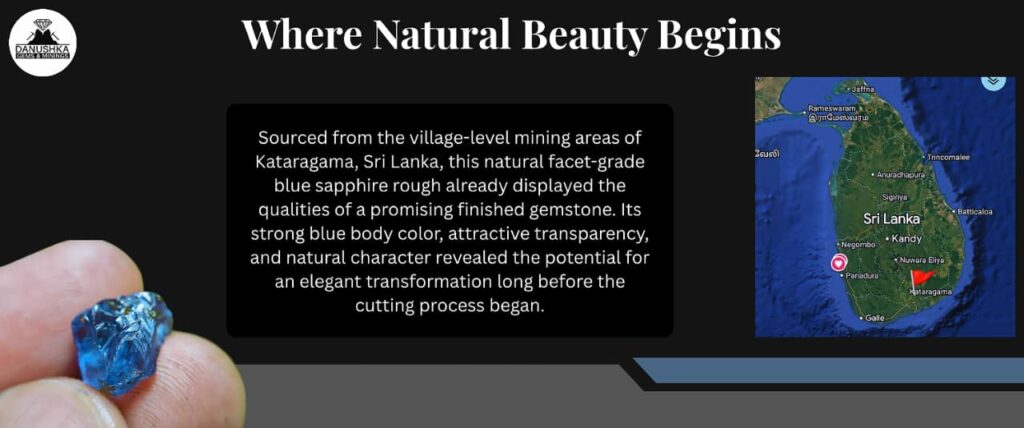
At Danushka Gems, some stones become memorable not only because of their final beauty, but because of the journey required to bring that beauty forward with precision. This natural Ceylon blue sapphire is one of those stones. It began as a 5.01 carat facet grade rough measuring 10.8 × 9.1 × 6.5 mm, sourced from Kataragama village around mining in Sri Lanka. In rough form, the stone already showed the qualities that make a cutter stop and study more carefully: a strong intense blue body color, clean-looking material, and the kind of shape that suggested genuine potential for a fine finished gem.
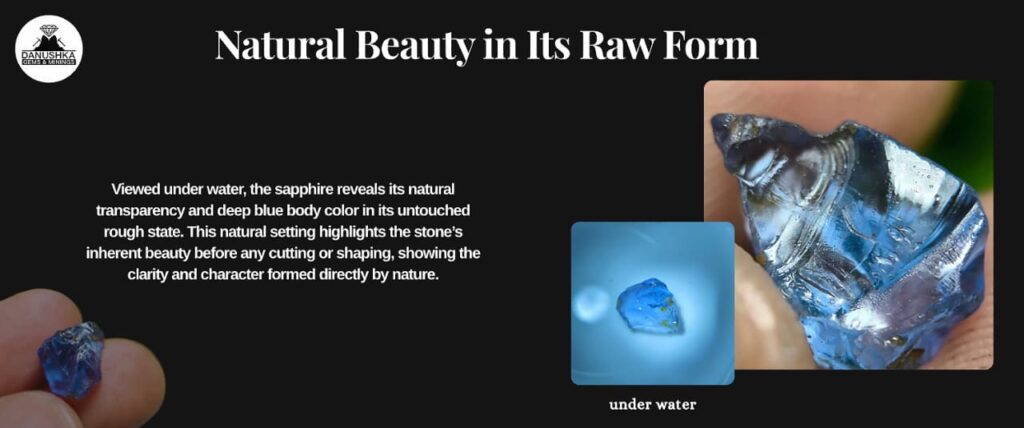
Sri Lanka has long been respected in the gemstone world for producing sapphires with distinctive life, color, and cutting character. Within that broader story, stones sourced from village-level mining areas often carry a more direct sense of origin and individuality. This sapphire from Kataragama village around mining in Sri Lanka had that feeling from the beginning. Even before cutting, the material showed attractive transparency and a blue tone that was not weak or washed out. It had the kind of rough presence that suggested it could become a refined finished gemstone if the cutting direction was handled correctly.
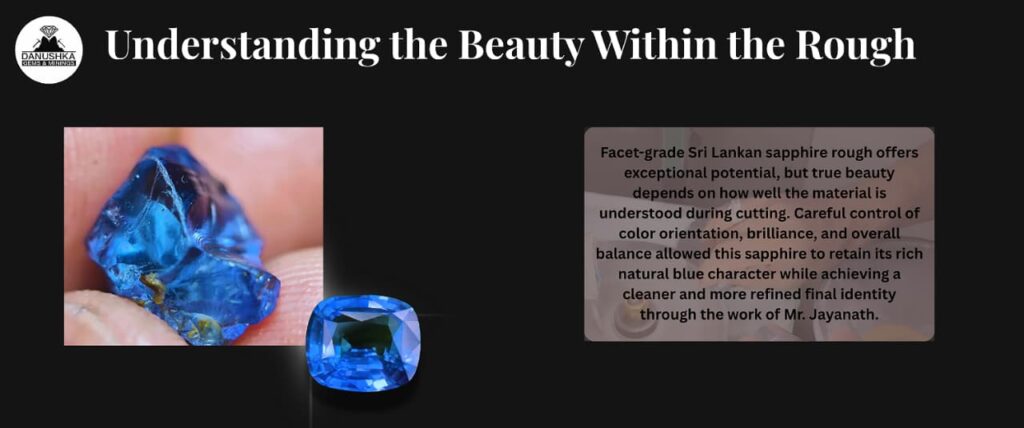
In gemstone work, however, good rough alone is never enough. A rough sapphire can show color and still fail in the final gem if the cutting plan is wrong. Orientation, depth, internal distribution of color, and the balance between brilliance and shape all matter. This is especially true in unheated sapphires, where the cutter is working with the stone exactly as nature formed it. There is no artificial correction of color or clarity to rely on later. The success of the finished stone depends on understanding the material honestly from the beginning.
This particular sapphire was handled as a customer request from Israel by Mr. Deutch. That added another layer of importance to the project. When a stone is being cut for a specific request, the task is not simply to make a gemstone from rough. The task is to produce the right gemstone from that rough. In this case, the goal was a clean, natural, unheated blue sapphire that would preserve the rich Ceylon character of the original material while becoming a balanced and elegant finished stone.
At the sourcing stage, Danushka Gems selected the rough because it offered the right starting combination of body color, structure, and possibility. The intense blue appearance already visible in rough form made it interesting, but what mattered even more was whether that blue could survive the cutting process in a stable and attractive way. In sapphire cutting, the wrong orientation can lighten the face-up look too much, darken the center, weaken the brilliance, or reduce the stone’s overall balance. So even with a promising rough, the real work begins in planning.
The cutting was completed by Mr. Jayanath, whose role in this transformation was critical. A sapphire like this requires controlled judgment, not aggressive removal of material. The challenge is to preserve color, maintain openness, and shape the stone into something refined without losing the character that made the rough valuable in the first place. In this case, the final decision led to a cushion step cut, a shape that carries both softness and structure. Cushion outlines are often appreciated because they give the gem a balanced face-up presence, while step-style influence can help organize the body color and create a calmer, more architectural elegance.
After cutting, the sapphire finished at 2.15 carats with final dimensions of 8 × 6.8 × 4 mm. The transformation from 5.01 carats to 2.15 carats reflects the reality of serious gemstone cutting. Weight loss in sapphire is not unusual, especially when the goal is a properly proportioned finished gem rather than a heavier but compromised stone. In rough form, a sapphire may carry extra body in places that do not support the final beauty of the gem. Corners may need refinement, depth may need adjustment, and the internal direction of color may require sacrifice in order to achieve a cleaner and more attractive result. What matters is not the amount removed, but whether the final stone justifies those decisions. In this case, it clearly does.
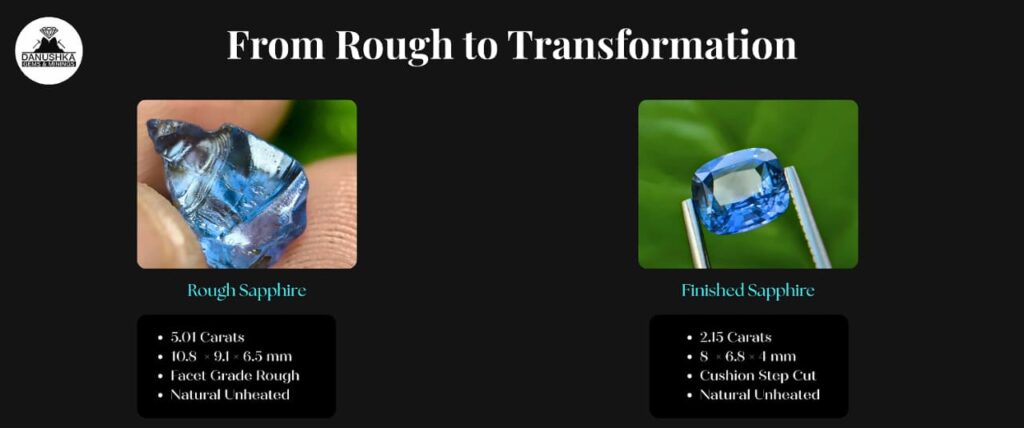
The finished sapphire presents as a clean, unheated blue stone with a refined cushion step cut and an elegant proportion. The final dimensions give it a pleasing outline without making it appear too deep or too flat. The face-up look is balanced, and the blue color remains the central strength of the gem. This is one of the most satisfying results in sapphire cutting: when the final stone still feels true to the original rough, but with greater discipline, polish, and purpose.
Another important part of this story is the fact that the sapphire remained unheated. In today’s gemstone market, treatment status matters greatly to collectors, buyers, dealers, and anyone seeking transparency. A natural unheated sapphire preserves its original geological identity. It carries its color and character from the earth rather than from post-mining enhancement. For many buyers, especially those requesting carefully selected Sri Lankan sapphires, that authenticity is a major part of the stone’s appeal. It is not only about beauty. It is about trust, rarity, and natural origin.
This transformation also highlights the practical role of source-based gemstone work. Danushka Gems was responsible for sourcing the rough and guiding the stone through the journey from origin to finished gem. That kind of involvement matters. A sapphire is not just a product that appears at the end of a supply chain. It is the result of choices made at the source, in the selection process, and at the cutting stage. When those steps are connected properly, the final gemstone carries more than appearance. It carries a story of material knowledge and craftsmanship.
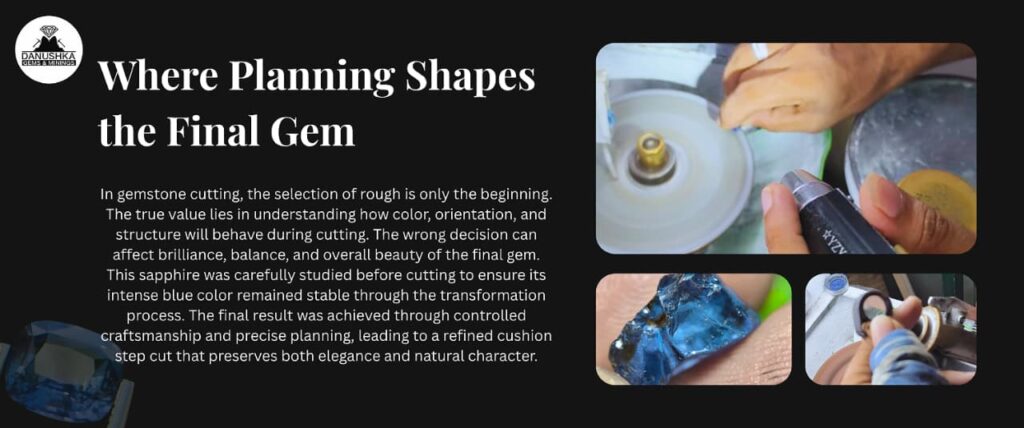
From a gemological point of view, the finished result shows why facet grade Sri Lankan blue sapphire rough continues to attract serious interest. Good rough offers possibility, but possibility alone does not create beauty. The cutter has to understand where the color sits, how the stone will face up, and what form will best express the material. Mr. Jayanath’s cutting gave this sapphire a cleaner identity while preserving the intense blue character that made the original rough attractive. That is what turns a promising rough into a finished gemstone with real presence.
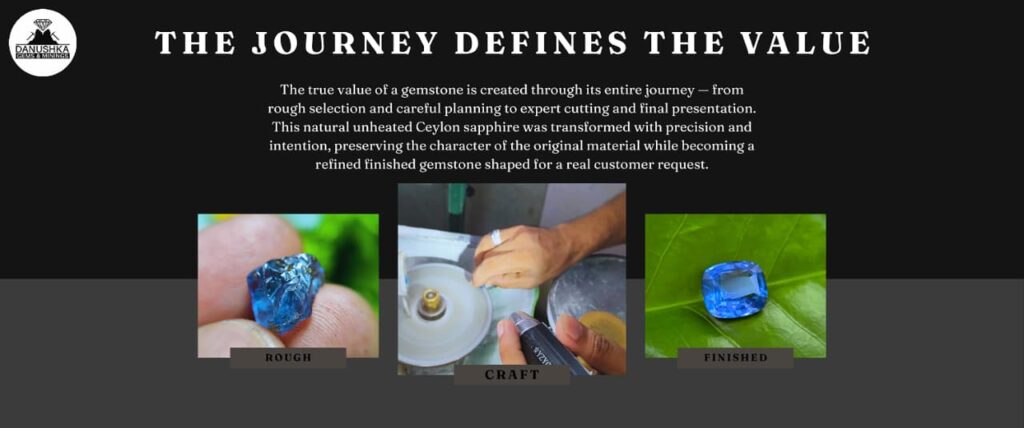
For customers looking for natural Ceylon sapphire, journeys like this are especially meaningful. They show that fine gemstones are not always found ready-made in exactly the right form. Sometimes the right stone begins as rough, and the final beauty only appears through careful planning and experienced cutting. In this case, a 5.01 carat rough sapphire from Kataragama village around mining in Sri Lanka became a 2.15 carat cushion step cut blue sapphire that reflects not only the strength of the original material, but also the success of the decisions made around it.
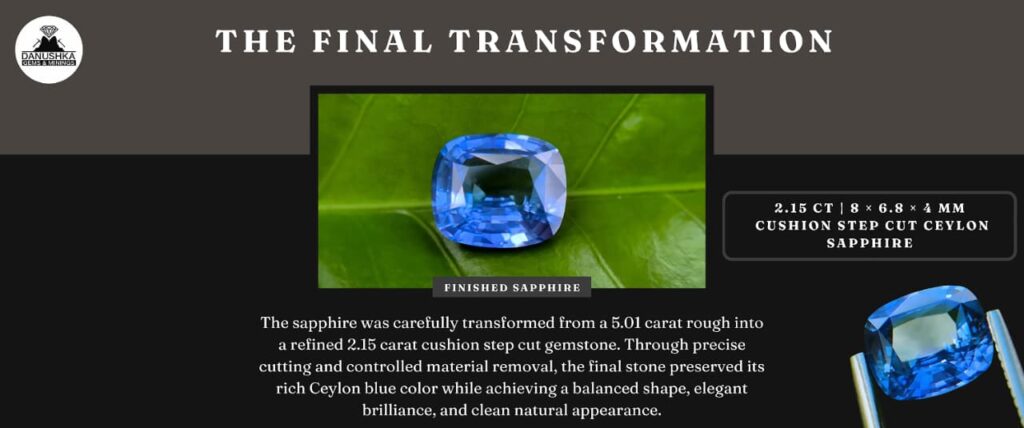
At Danushka Gems, this is what gives a stone long-term value. It is not only the final carat weight, or even the final color. It is the full journey from source to finished gem, handled with clarity and intention. This sapphire began as a natural rough with strong promise. It ended as a clean, unheated, well-cut Ceylon blue sapphire shaped for a real customer request and brought to completion through careful work. That is the kind of gemstone story worth documenting, because it shows what true transformation looks like when source, cutting, and purpose all come together.
FAQ
1.What was the original rough weight of this sapphire?
The original rough weighed 5.01 carats and measured 10.8 × 9.1 × 6.5 mm before cutting.
2. Where was this blue sapphire sourced?
This sapphire was sourced from Kataragama village around mining in Sri Lanka through Danushka Gems.
3. Is this sapphire natural and unheated?
Yes. Both the rough and the finished gemstone are natural and unheated.
4. What is the final weight and size after cutting?
After cutting, the sapphire finished at 2.15 carats with dimensions of 8 × 6.8 × 4 mm.
5. What cut was chosen for the finished gemstone?
The final gemstone was cut into a cushion step cut, giving it a balanced outline and a more refined face-up appearance.
6. Who cut the sapphire?
The cutting was completed by Mr. Jayanath.
7. Who requested this finished sapphire?
This gemstone was prepared based on a customer request from Israel by Mr. Deutch.
8. Why is unheated status important in a sapphire like this?
Unheated status means the sapphire preserves its original natural character, which is important for authenticity, rarity, and buyer confidence.
9. What makes this sapphire journey special?
Its value comes not only from the final blue color and clean finish, but from the full transformation: source selection by Danushka Gems, careful planning, and the successful cutting of a natural Sri Lankan rough into a refined finished gemstone.