
In the gemstone world, larger size often receives more attention. Bigger stones attract quicker interest, stronger market reactions, and easier visibility. But true rarity is not always defined by size. Sometimes the most demanding journey begins with a very small finished gemstone — especially when that stone must satisfy an unusually precise set of requirements.
This blue sapphire belongs to that category.
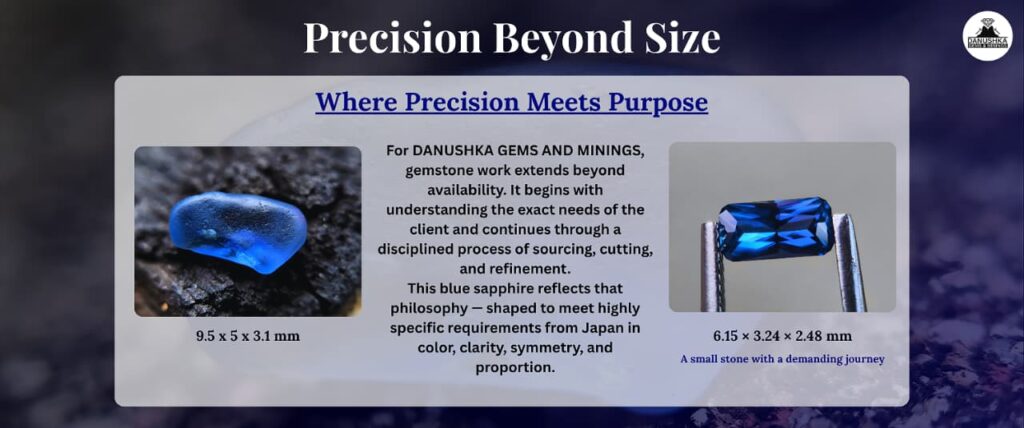
At first glance, a finished sapphire 6.15 x 3.24 x 2.48 mm may seem modest in scale. Yet behind this final result was a long and careful process of searching, selecting, evaluating, cutting, adjusting, and certifying. This was not a stone chosen casually from existing stock. It was created to meet a custom requirement from Japan, where the expectations were extremely specific, not only in color, but also in shape, cutting precision, symmetry, openness, clarity, and final face-up dimensions.
For DANUSHKA GEMS AND MININGS, this kind of project represents the deeper meaning of gemstone work. It is not simply about selling what is available. It is about understanding what the client truly needs, then going back to the source and guiding the material until it becomes exactly what the request demands.
A Small Stone with Desired Requirements
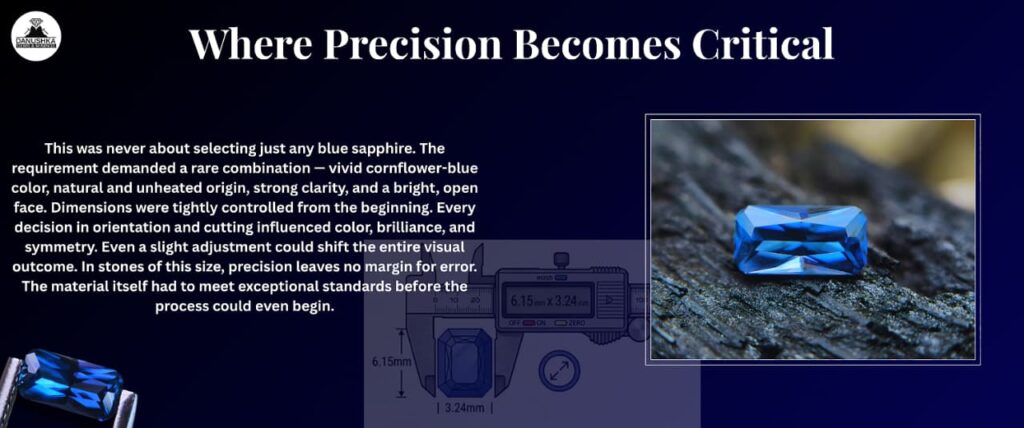
The challenge in this project was never about finding just any blue sapphire. The requirement was highly refined.
The finished stone needed to be small, but not ordinary. It needed to show a vivid and open cornflower-blue color, remain natural and unheated, display strong clarity, avoid a dark appearance, and support a very precise cutting result. The customer also emphasized the importance of symmetry, clean facet alignment, and a balanced overall shape. Originally, a step cut had been considered, but later the direction changed toward a more refined mixed style based on a previously shown finished stone.
Even the dimensions were carefully defined. The preferred target for the finished stone was around 5.5 x 2.7 x 2.5 mm, while a slightly larger result around 6.0 x 3.0 x 2.5 mm was also acceptable — but only if the color and quality remained strong. That final point was critical. Size was not allowed to come at the expense of color, brilliance, or overall beauty.
This is where many gemstone projects become difficult. In sapphire cutting, especially with small stones, every decision becomes more sensitive. A small change in orientation can alter the color. A small change in proportion can affect brightness. A small push for size can weaken the face-up appearance. To satisfy all these conditions in one stone, the rough material itself must already possess uncommon quality.
That is why this search took time.
The Search for the Right Rough
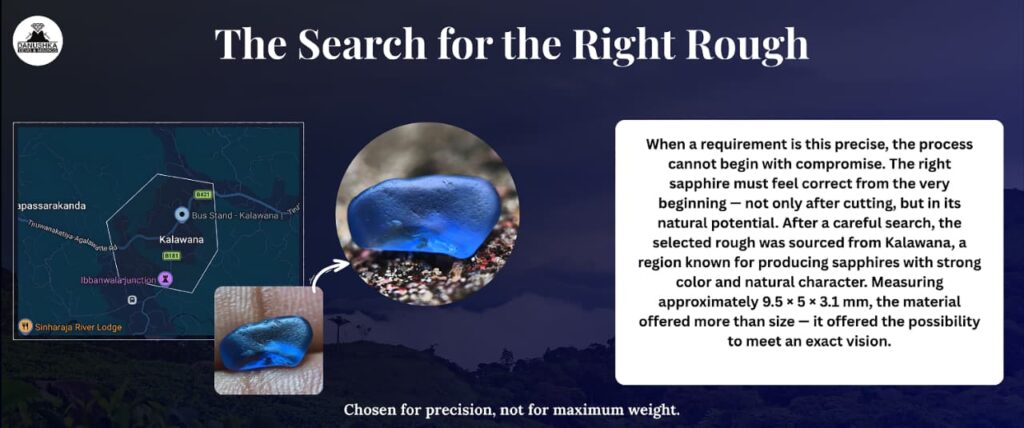
When a customer’s requirement is this specific, there is no practical value in rushing. In many cases, the market may offer stones that are “close enough,” but this project was not about compromise. The sapphire needed to feel correct from the beginning — not only after cutting, but already in its internal promise.
After a careful search, the right rough stone was finally sourced from Kalawana village around mining in Sri Lanka.
Kalawana is widely respected among serious sapphire buyers and cutters as one of the important alluvial sapphire source regions in Sri Lanka. Material from this area is known for producing fine-quality sapphires with strong natural color and attractive internal character. For those who work close to the source, Kalawana is a place that repeatedly proves its value, especially when the requirement involves rich but elegant blue material.
The selected rough measured approximately 9.5 x 5 x 3.1 mm before cutting. At that stage, the face-up spread was significantly larger than the final result would become. From a purely weight-preservation standpoint, it would have been possible to keep more size and more carat weight. But the project was never about keeping maximum weight. The project was about meeting the customer’s exact direction.
That difference shaped every next decision.
Why the Rough Was Special
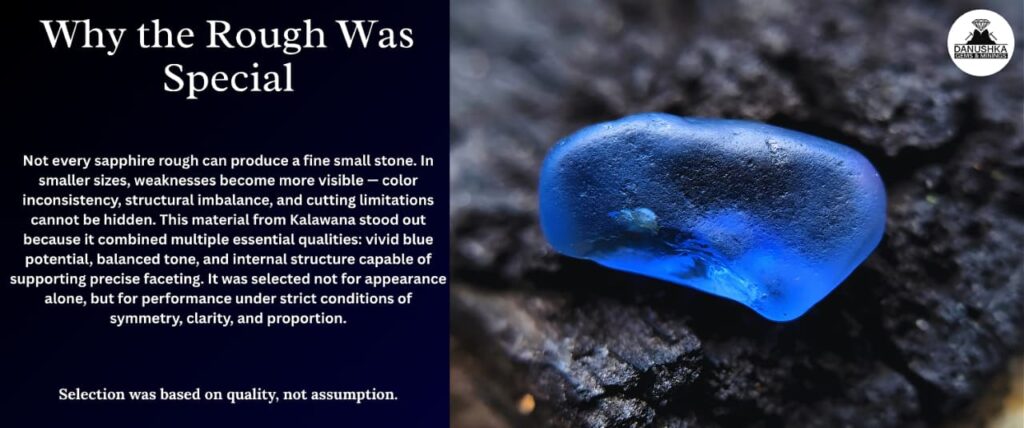
Not every blue sapphire rough can produce a fine small finished stone. In fact, small stones often expose problems more clearly than large ones. When the finished result is compact, there is less room to hide weak color, uneven structure, or poor cutting decisions. The rough has to be strong enough to still perform in a refined cut.
This Kalawana sapphire stood out because it offered several essential properties at once. It showed the potential for a rich, vivid blue hue without closing up too much in tone. It had the openness needed for a bright face-up result. It also had the right internal promise for achieving clean, sharp faceting in a small size.
This was important because the customer did not want just any blue stone. The request was for a stone that could remain beautiful even if judged by strict standards of precision. In other words, it had to be the kind of rough that could support quality first — not the kind that relied only on color from one angle or size on paper.
That is exactly why this material was selected.
From Step Cut Idea to a More Refined Direction
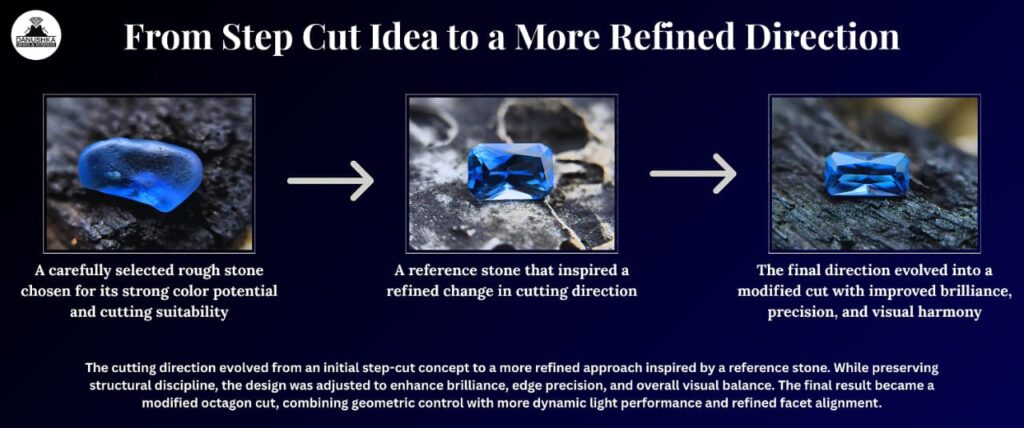
Originally, the customer had been considering a step-cut style. Step cuts can be elegant and clean, but they are also demanding. They reveal structure very honestly. A stone cut in that direction must have enough quality, balance, and color strength to remain attractive without relying on excessive brilliance.
Later, after reviewing another finished stone, the customer adjusted the request. Rather than a standard step cut, the preference shifted toward the more refined cutting style seen in the reference piece. The goal became clear: preserve the disciplined look of a structured cut, but add more life, more edge precision, and a better overall visual presence.
This is the direction that was followed.
The final style became a modified octagon, a cut that carries some of the discipline associated with step-cut thinking while introducing a more dynamic arrangement of facets. In certain contexts, this style can also feel closer to advanced diamond-inspired cutting logic, where geometry, alignment, and light placement all work together more actively.
For this sapphire, that decision proved to be the correct one.
Precision Over Weight
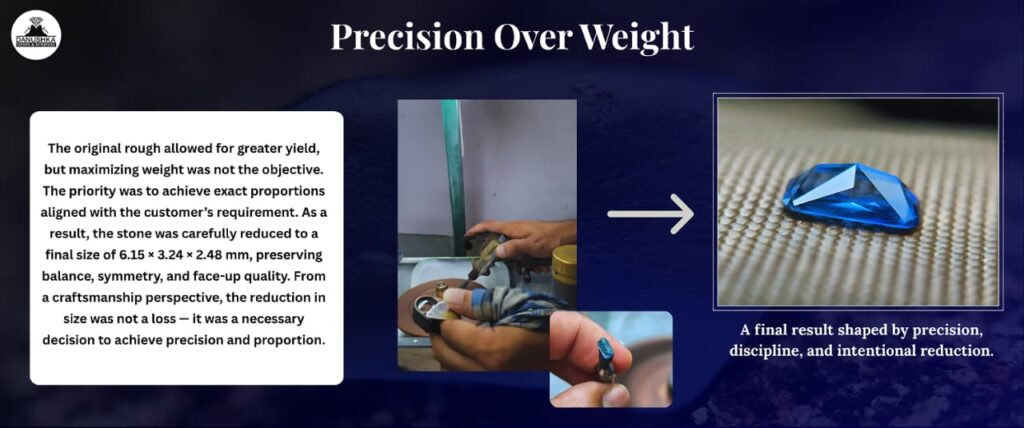
One of the most important aspects of this journey was the decision to prioritize the customer’s dimensional request instead of preserving the maximum possible yield.
The original rough had a larger face-up spread, and keeping more weight would have been easier. However, the target was not simply to produce the largest stone possible. The target was to create a finished sapphire that fit the intended use properly and reflected the exact proportions the customer had in mind.
As a result, the stone was cut down to a final size of 6.15 x 3.24 x 2.48 mm.
From a commercial perspective, some might look first at the weight difference. But from a craftsmanship perspective, this is exactly the point: the loss in size and weight was not waste. It was the cost of precision. The stone could have been left broader and heavier, but it would not have fulfilled the same requirement. Instead, the final result stayed close to the requested 6 x 3 mm direction while preserving strong face-up beauty and a balanced profile.
The smaller alternative request of 5.5 x 2.7 x 2.5 mm was also considered, but going that far would have required sacrificing too much additional weight. In the end, the first dimensional direction was prioritized as the best balance between the customer’s requirement and the stone’s natural potential.
That is how serious cutting decisions are made — not by forcing the material, but by balancing intention and reality.
The Final Color: Open, Intense, and Alive
Perhaps the most satisfying result of the entire process was the final color.
The finished sapphire displayed a vivid cornflower-blue hue with strong intensity, but without becoming dark or more lighter. This balance is very difficult to achieve, especially in a smaller finished stone. Many sapphires can show blue, but fewer can show a rich and lively blue while still remaining open and attractive face-up.
This stone did.
In person, the sapphire presents a bright, confident blue character that feels refined rather than heavy. It carries the richness expected from fine sapphire material, yet it still remains open enough for the cut to speak clearly. That is what made the finished result so rewarding. It was not only close to the customer’s hope — it was visually convincing in its own right.
Certification and Transparency
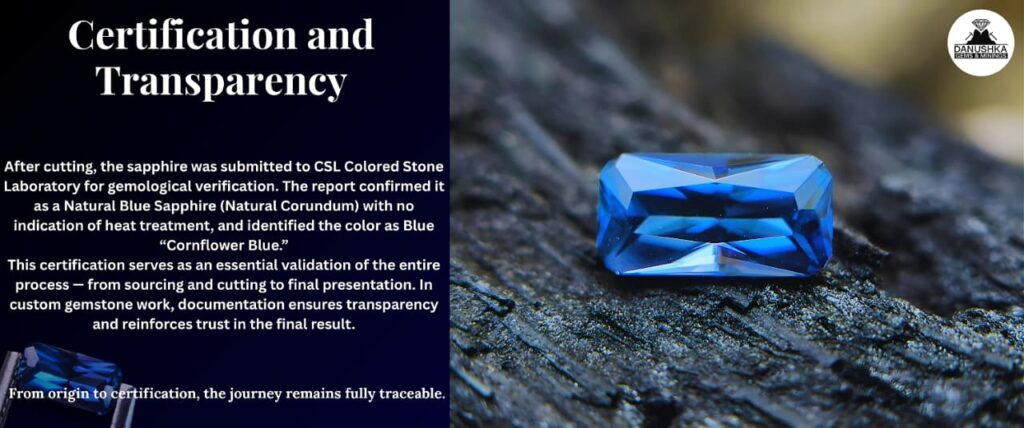
After cutting, the sapphire was submitted to CSL Colored Stone Laboratory for gemological verification. The certification confirmed the finished gemstone as Natural Blue Sapphire, species Natural Corundum, with no indication of heat treatment. The report also identified the color as Blue “Cornflower Blue.”
This laboratory verification was an important final step. In custom work, especially when the finished stone has passed through such a deliberate sourcing and cutting journey, documentation reinforces trust and transparency. It ensures that the final result is not only beautiful, but also properly represented.
For DANUSHKA GEMS AND MININGS, this is an essential part of the process. The story of the stone must remain clear from source to certification.
More Than a Small Stone
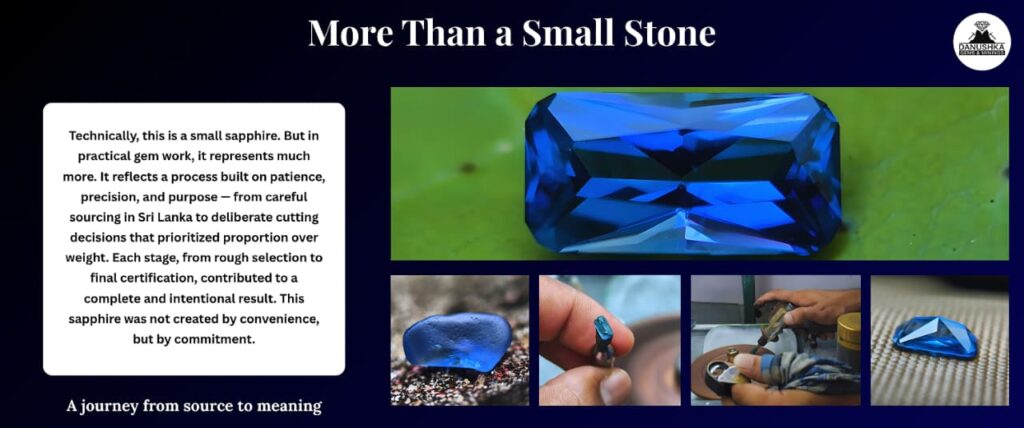
Technically, this is a small sapphire. But in practical gem work, it is much more than that.
It represents what happens when a customer’s request is treated seriously. It represents the value of searching patiently instead of settling too early. It represents the importance of Sri Lankan source knowledge, especially from places like Kalawana village around mining in Sri Lanka, where fine alluvial sapphire material can still be found by those who work close to the ground. And it represents the difference between simply cutting a stone and truly creating a gemstone for a purpose.
This sapphire did not come from convenience. It came from a journey.
A long search.
A precise requirement.
A carefully chosen rough.
A deliberate cutting strategy.
A decision to prioritize proportions over weight.
A final result that delivered color, style, balance, and certification in one complete story.
That is what makes it valuable.
At DANUSHKA GEMS AND MININGS, we believe the most meaningful stones are not always the biggest ones. Sometimes they are the stones that had to become exactly what they were meant to be.
DANUSHKA GEMS AND MININGS — directly from the source.
Acknowledgment
This journey was made possible through the combined effort of trusted professionals working closely from source to finished gemstone. Special thanks to Mr. Channa, who handled the cutting work with care and precision; Mr. Nileesha (GIA, AIGS), who supported the gemological side with professional knowledge; and Mr. Jayasinghe, the source miner who helped bring the right rough material into this journey. Their contribution was an important part of turning a special requirement into a finished sapphire with purpose, quality, and authenticity.
FAQ
1. Is this sapphire natural and unheated?
Yes. The finished stone was certified by CSL Colored Stone Laboratory as a natural blue sapphire with no indication of heat treatment.
2. Where was the rough sourced from?
The rough sapphire was sourced from Kalawana village around mining in Sri Lanka, a respected alluvial sapphire source area known for fine-quality material.
3. Why did the search take so long if the finished stone is small?
Because the requirement was extremely specific. The stone needed to match strict standards for color, openness, clarity, symmetry, cutting style, and final dimensions. Small size does not make sourcing easier when quality requirements are high.
4. What were the rough and finished dimensions?
Before cutting, the rough measured approximately 9.5 x 5 x 3.1 mm. After cutting, the finished sapphire measured 6.15 x 3.24 x 2.48 mm
5. Why was more weight not preserved?
Because the project prioritized the customer’s requested proportions and face-up dimensions. Keeping more weight would have been possible, but it would have moved the stone away from the intended design direction.
6. What cutting style was used?
The final stone was cut in a modified octagon style, chosen after the customer preferred this direction over a standard step cut. This style provided a more refined and visually dynamic result for the material.
7. What color does the final sapphire show?
The sapphire shows a vivid, rich cornflower-blue hue with strong intensity while still remaining open and not dark face-up.
8. Why is certification important in a custom project like this?
Certification confirms the identity and treatment status of the finished gemstone, helping maintain transparency and confidence throughout the custom process.
9.What makes this sapphire journey special?
It was not simply a stone taken from stock. It was a custom-created result based on a long search, careful source selection, precise cutting decisions, and final laboratory confirmation — all to satisfy a very specific requirement from Japan.
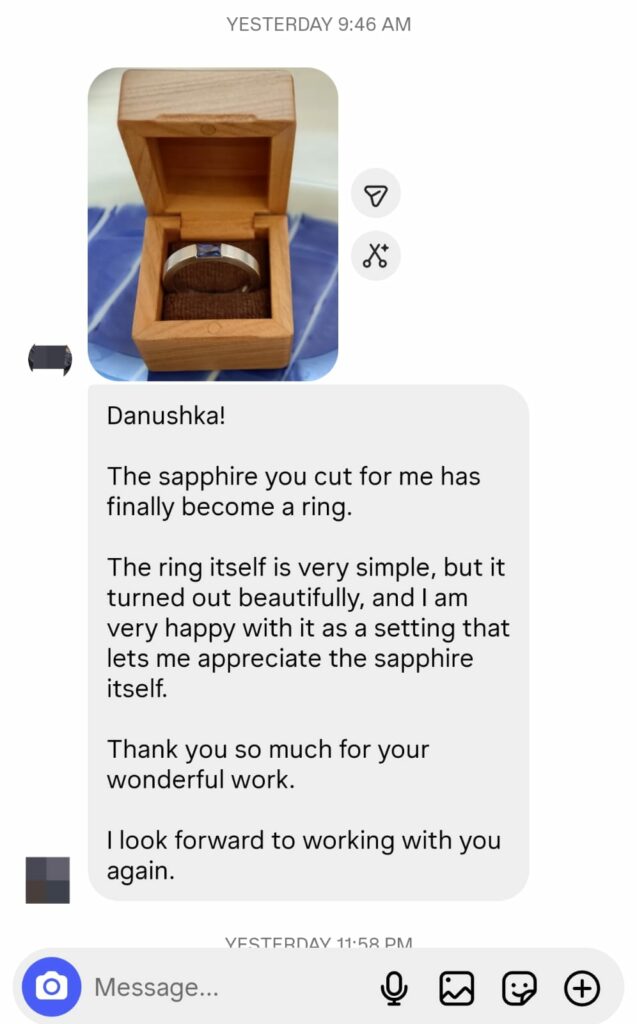
Final Customer Update
Many days after the cutting work was completed, the customer shared this beautiful update with us. The sapphire has now become a ring, set in a simple design that allows the gemstone itself to be appreciated clearly.
For Danushka Gems & Minings, this is the most meaningful part of a gemstone journey. From rough selection to cutting, and finally into a personal jewelry piece, every step carries trust, patience, and careful work. We are thankful to see the final result and happy that the customer is pleased with the finished sapphire.