
At Danushka Gems and Minings, every gemstone has its own journey, and some stones become memorable not only because of their final beauty, but because of the decisions made along the way. This natural grossular garnet rough from Rakwana village around mining in Sri Lanka is one of those special examples. It began as a vivid reddish-orange facet grade rough weighing 41.67 carats and measuring approximately 20 x 18.5 x 13.5 mm. Completely natural and unheated, the stone showed a fiery body color and strong cutting potential from the beginning.
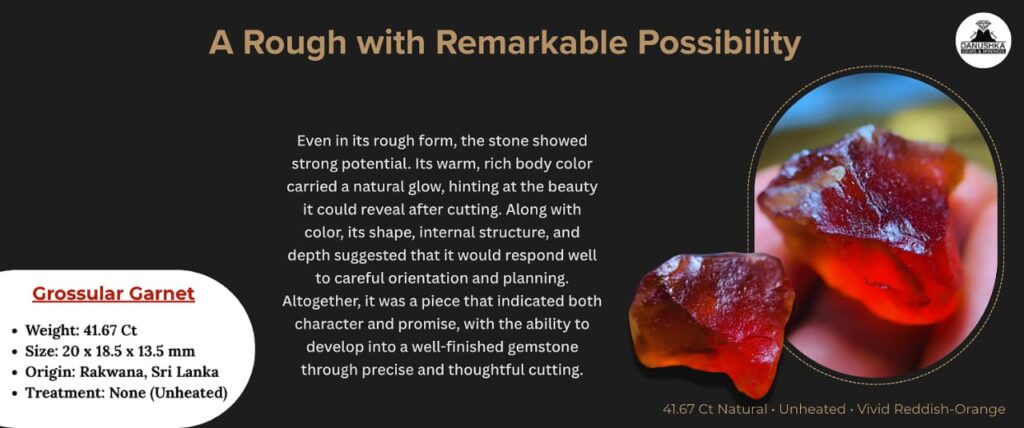
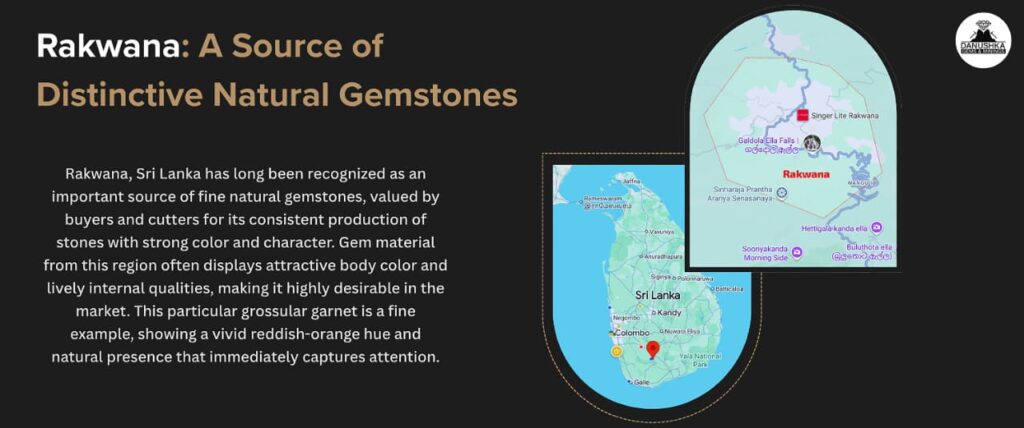
Rakwana village around mining in Sri Lanka is known among gem buyers and cutters as one of the important source areas for a range of natural gemstones. When a stone comes from such an origin, especially with attractive color and good internal life, it immediately draws attention. This particular garnet showed the kind of vivid reddish-orange appearance that makes grossular garnet, especially the hessonite variety, highly interesting to cutters, collectors, and buyers who appreciate natural gemstones with strong personality.
In rough form, the stone already showed promise. The body color carried a warm, rich glow, and even before cutting, it had the kind of material quality that allows a cutter to think beyond a simple polished result. Stones like this are not only judged by their color. Their shape, internal structure, depth, and the way they may respond to orientation all matter. In the rough, this gem had the kind of presence that suggested it could become a strong finished stone if handled with care.
The first stage of the cutting journey was pre-forming. This step is one of the most important parts of gemstone cutting because it begins the process of turning a natural crystal or rough alluvial piece into a more intentional shape that can later be faceted. In this case, the rough was first pre-formed by Mr. Wije. After that stage, the stone was brought down to around 27 carats in a cushion-oriented pre-form. That initial plan made practical sense, because a cushion cut often helps preserve weight while still producing a balanced and attractive gemstone.
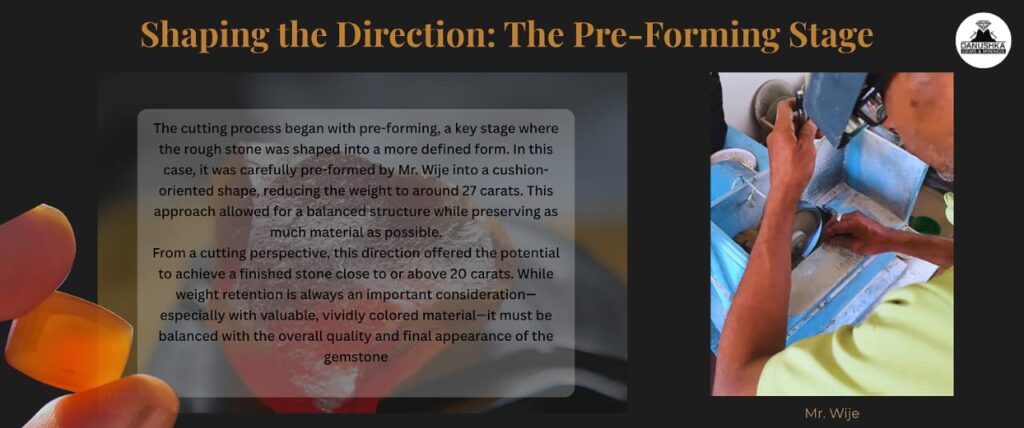
From a cutter’s perspective, that early cushion direction had real advantages. There was a possibility to achieve a finished stone above 20 carats, or at least stay closer to that target while preserving the strength of the material. There was even room to consider another shape that might have kept more weight compared to a more angular design. In gemstone cutting, weight retention is always part of the conversation, especially when the rough is valuable and the material shows strong color. However, weight alone is never the only priority.
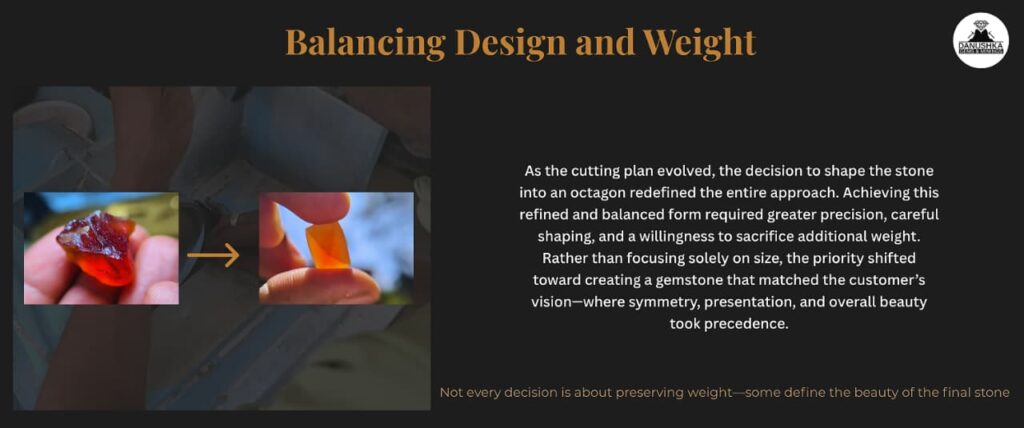
As the project developed, the customer decided that the final stone should be cut as an octagon rather than remain in a cushion-style direction. That decision changed the entire cutting strategy. An octagon cut can create a refined and elegant look, with stronger geometric balance and beautiful face-up appearance, but it often requires more sacrifice from the rough. Corners must be shaped more carefully, the outline must be made more precise, and the stone may need to be reduced further in order to achieve the desired symmetry and proportion.
This is where gemstone cutting becomes a balance between beauty, design, and recovery. If the only goal had been to preserve as much weight as possible, the cutting plan could have followed a different path. But in this case, the customer’s vision mattered more. The priority was not simply to keep the finished stone heavier. The priority was to produce an octagon shape that matched the customer’s idea of how the gem should look in its final polished form. That choice meant accepting additional weight loss in exchange for shape, presentation, and style.
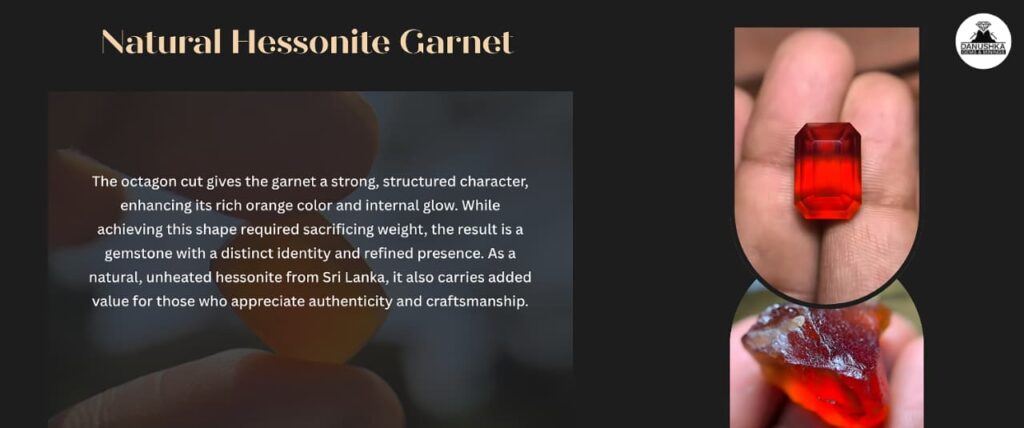
The final gemstone was cut and polished by Mr. Jayanath, whose work brought the stone into its completed form. The finished result weighs 15.67 carats and measures 15.42 × 10.67 × 10.22 mm. It is an octagon-cut natural unheated orange hessonite garnet, belonging to the grossular garnet family. The finished gem shows a rich orange appearance with reddish warmth, creating the glowing visual character that many buyers appreciate in fine hessonite material.
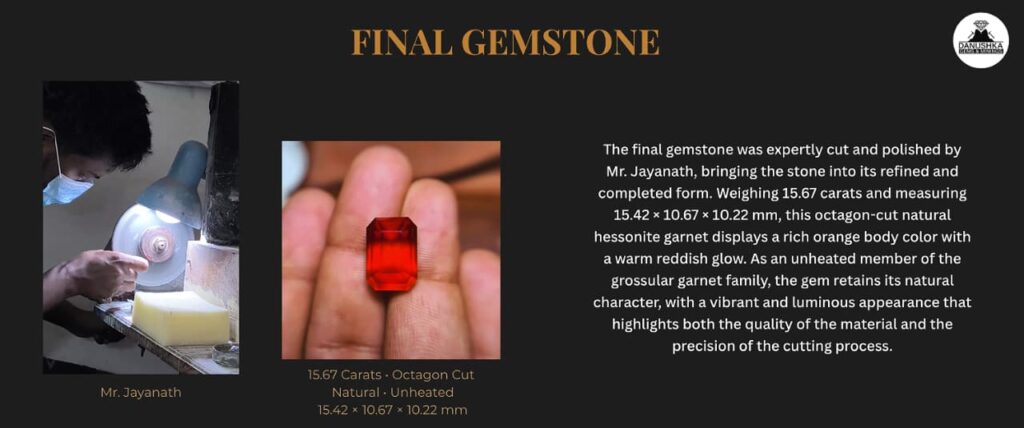
What makes this transformation especially meaningful is that the final gem reflects not only the natural quality of the original rough, but also the human decisions behind it. From the source area in Rakwana village around mining in Sri Lanka, to the first pre-forming stage by Mr. Wije, to the final faceting and polish by Mr. Jayanath, the stone passed through multiple stages of skill and judgment. The result is not just a polished garnet. It is a gemstone shaped by source, material, craftsmanship, and customer preference.
The octagon cut gives this hessonite garnet a more structured personality. Compared with softer rounded shapes, the octagon presents stronger lines and a cleaner outline. It gives the stone a more intentional and architectural appearance. In a gem like this, with vivid orange body color and excellent internal glow, the cut helps organize the light across the face of the stone while maintaining a rich and attractive visual depth. Even though more weight was lost to achieve this design, the final result carries a strong identity that would not have been the same in another shape.
This cutting journey also shows something important about natural gemstones: the best result is not always measured only by carat retention. In real cutting decisions, many factors must be weighed together. Color concentration, shape preference, durability of the outline, customer taste, and face-up appearance all matter. Sometimes the most commercially efficient option is not the one chosen. Instead, the final design is selected because it better suits the stone’s character or the customer’s vision. That is exactly what happened here.
As a natural and unheated hessonite grossular garnet, this stone also carries appeal for buyers who value untreated gems. In today’s gemstone market, transparency about treatment status matters. A stone that remains natural and unheated preserves its original geological identity. For many gemstone enthusiasts, that authenticity adds meaning to the final gem. When such material is combined with a strong cutting story and a traceable Sri Lankan origin, it becomes even more interesting.
For Danushka Gems and Minings, stones like this represent more than inventory. They reflect the practical reality of gemstone work in Sri Lanka, where buying rough, studying it carefully, planning its best use, and respecting the customer’s final choice are all part of the business. A gemstone journey is rarely a straight line. It involves technical decisions, compromises, and experience. In this case, the final 15.67 ct octagon became the right result not because it preserved the most weight, but because it fulfilled the purpose behind the cut.
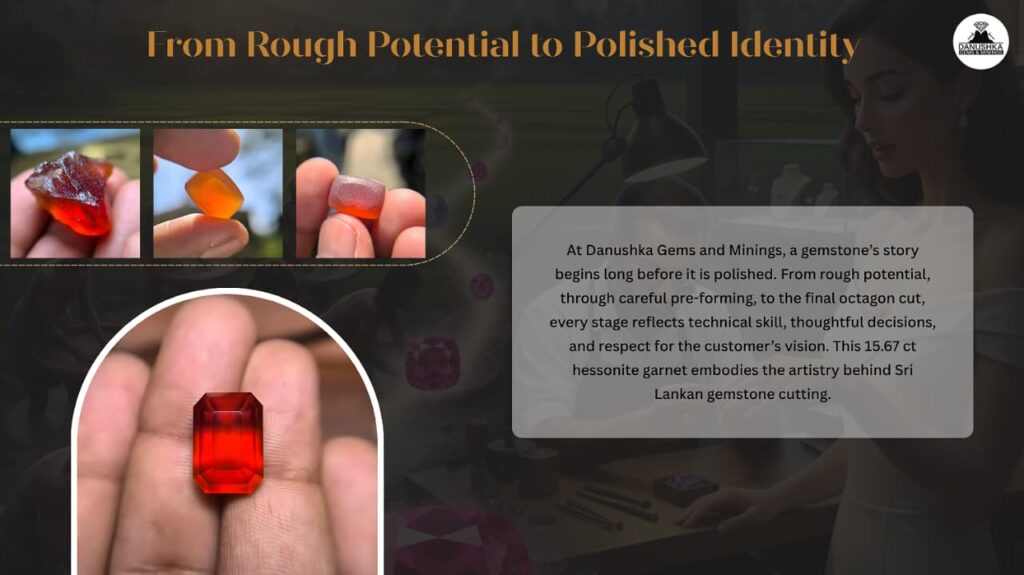
The transformation from rough to polished form is what gives many natural gems their strongest story. In the rough stage, the stone carried raw potential. In the pre-form stage, that potential was narrowed into direction. In the final octagon stage, it became a finished gemstone with its own distinct identity. That process is what makes gemstone cutting so important. A beautiful finished gem is not created by chance. It is created by reading the material correctly, understanding the trade-offs, and executing the final plan with care.
This natural grossular garnet from Rakwana village around mining in Sri Lanka is a strong example of that process. Its fiery reddish-orange rough body, its reduction through pre-forming, its shift from cushion planning to octagon cutting, and its final polished appearance all show how a natural gemstone evolves through expertise and decision-making. The result is a vivid 15.67 ct unheated hessonite garnet with a clean octagon form, strong color presence, and a journey worth documenting.
For those who appreciate gemstone cutting, this stone offers something valuable beyond appearance alone. It shows how real gem work happens. Rough stones do not always follow the most weight-saving route. Sometimes they follow the right route for the final purpose. And when the source material is good, the craftsmanship is skilled, and the final design is chosen with intention, the result speaks for itself.
FAQ Section
1. What is the original rough weight of this grossular garnet?
The original rough weighed 41.67 carats and measured approximately 20 x 18.5 x 13.5 mm.
2. Where did this garnet come from?
This natural grossular garnet was sourced from Rakwana village around mining in Sri Lanka.
3. What variety of garnet is the finished stone?
The finished gemstone is a natural hessonite garnet, which belongs to the grossular garnet family.
4. Is this gemstone natural and unheated?
Yes. Both the rough and the finished stone are natural and unheated.
5. What was the first cutting plan for this stone?
The stone was first pre-formed toward a cushion-style shape, reaching around 20 carats during the pre-form stage.
6. Who completed the pre-forming stage?
The first pre-forming work was done by Mr. Wije.
7. Why was the final cut changed to an octagon?
The customer preferred an octagon shape, so the cutting plan was adjusted to match that design choice.
8. Did the octagon cut cause more weight loss?
Yes. Compared with some other possible shapes, the octagon required more material loss in order to achieve proper symmetry and outline.
9. Could the stone have finished in a heavier size?
There was potential to retain more weight with a different shape, but the final priority was to follow the customer’s idea and produce an octagon cut.
10. Who cut and polished the finished gemstone?
The final cutting and polishing were completed by Mr. Jayanath.
11. What is the final weight and size of the polished stone?
The finished gem weighs 15.67 carats and measures 15.42 × 10.67 × 10.22 mm.
12. Why is this gemstone special?
This gemstone is special because of its vivid reddish-orange to orange body color, natural unheated status, Sri Lankan origin, strong cutting potential, and the detailed transformation journey from rough to finished octagon.