
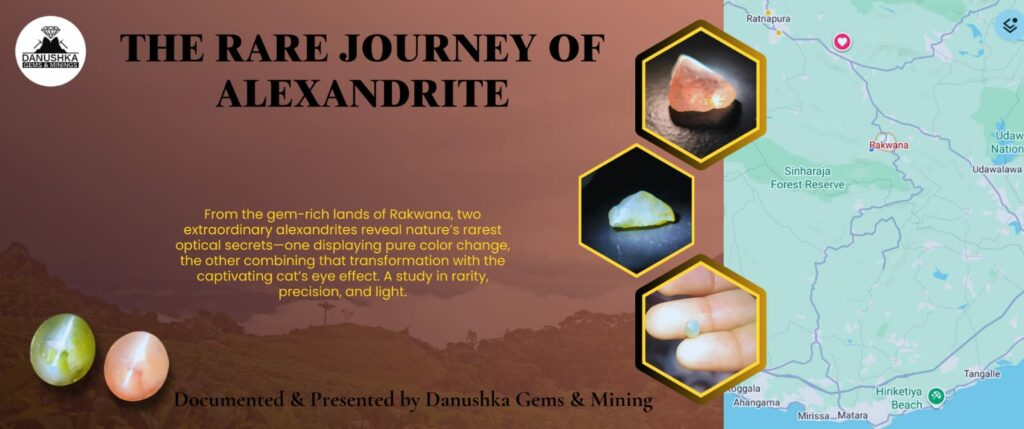
In the world of fine gemstones, few materials command the same respect and fascination as Alexandrite, the color-changing variety of chrysoberyl. Celebrated for its dramatic shift from greenish hues in daylight to reddish tones under incandescent light, alexandrite is already rare by nature. Yet within this rare category exists an even more exceptional phenomenon: alexandrite that displays both color change and a natural cat’s eye effect.
This article documents the journey of two alexandrite stones sourced from Rakwana village around mining in Sri Lanka, carefully studied, cut, and polished to reveal their full optical behavior. One stone exhibits both alexandrite color change and chatoyancy, while the other displays pure color change without a cat’s eye—allowing a direct comparison between these uncommon gemological outcomes.
Understanding Alexandrite and Its Optical Phenomena
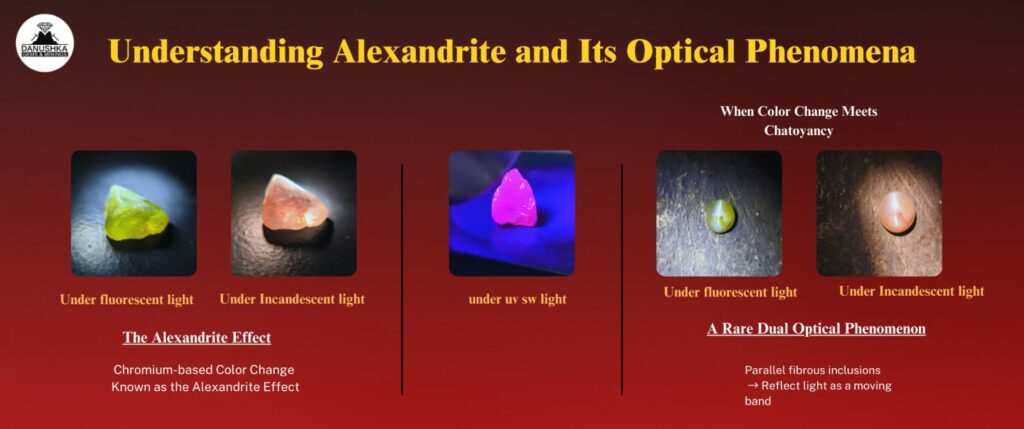
Alexandrite belongs to the chrysoberyl family and is defined by its chromium-based color change, shifting between greenish tones in daylight and reddish-orange tones under incandescent or warm light. This phenomenon is often referred to as the alexandrite effect.
Separately, some chrysoberyls may show chatoyancy, commonly known as the cat’s eye effect, caused by parallel fibrous inclusions that reflect light as a sharp, moving band across the surface when cut en cabochon.
What makes certain stones extraordinary is when both effects occur together—a genuine alexandrite color change combined with a well-defined cat’s eye. This combination is rare, highly specialized, and dependent on precise internal structure and cutting orientation.
Set 1: Alexandrite with Cat’s Eye and Color Change (Rare Combination)
Rough Stone Characteristics
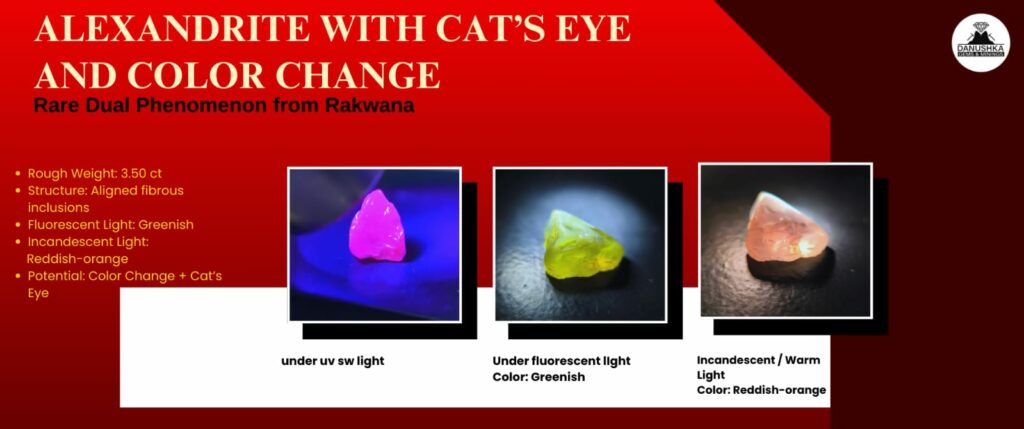
The first stone began as a 3.50 ct translucent alexandrite rough, showing a fibrous internal structure—a critical indicator for potential chatoyancy.
Rough Weight: 3.50 ct
Appearance: Translucent with aligned fibrous inclusions
Fluorescent lIght Color: Greenish
Incandescent / Warm Light Color: Reddish-orange
Special Potential: Combined alexandrite effect + cat’s eye
This rough clearly signaled the possibility of producing one of the most elusive chrysoberyl varieties: alexandrite with cat’s eye.
After Cutting
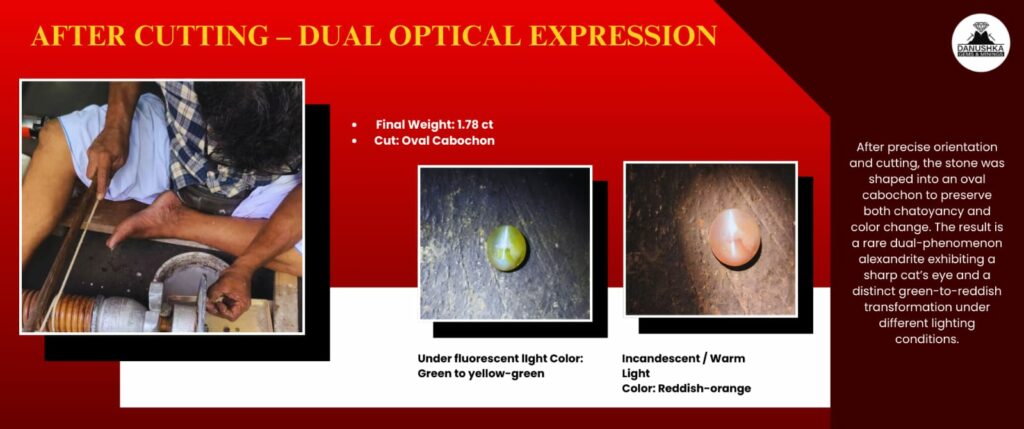
After careful orientation and cutting, the stone was fashioned into an oval cabochon, optimized to preserve both optical effects.
Final Weight: 1.78 ct
Cut: Oval cabochon
Optical Effects:
Distinct cat’s eye (chatoyancy)
Alexandrite-type color change
Color Behavior:
Fluorescent Light: Green to yellow-green
Incandescent Light: Reddish-orange
This stone represents a rare dual-phenomenon alexandrite, where light direction, wavelength, and internal structure work in harmony.
Set 2: Alexandrite with Color Change Only (No Cat’s Eye)
Rough Stone Characteristics
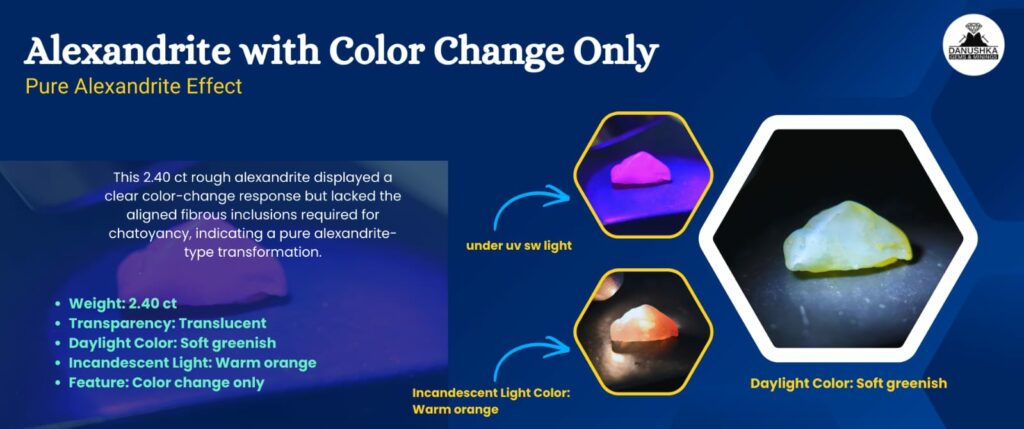
The second stone, while still rare, lacked the fibrous structure necessary for chatoyancy but showed color-change behavior.
Rough Weight: 2.40 ct
Appearance: Translucent rough
Daylight Color: Soft greenish
Incandescent Light Color: Warm orange
Feature: Alexandrite color change only
After Cutting
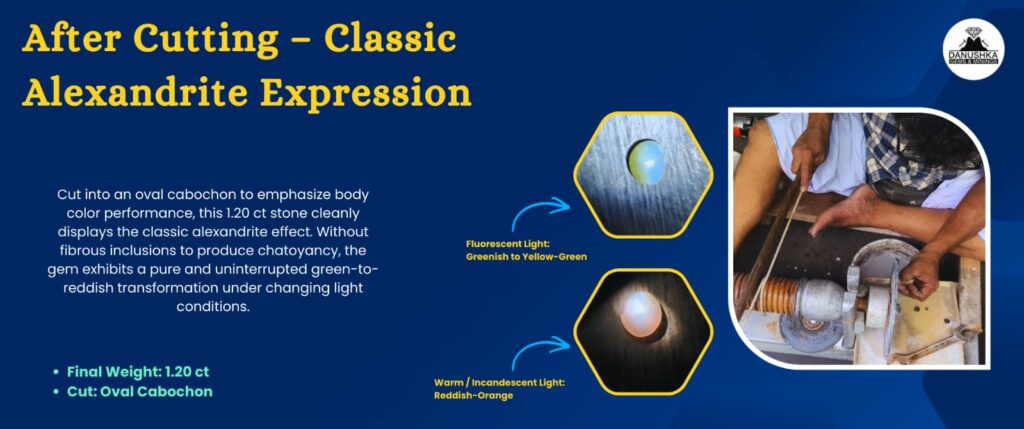
This stone was also cut as an oval cabochon, focusing purely on color performance rather than chatoyancy.
Final Weight: 1.20 ct
Cut: Oval cabochon
Optical Effect:
Alexandrite color change present
No cat’s eye
Color Behavior:
Fluorescent light: Greenish to yellow-green
Warm / incandescent light : reddish-orange
This stone is an excellent example of classic alexandrite behavior, cleanly displaying the color shift without additional optical phenomena.
Weight Retention and Cutting Insight
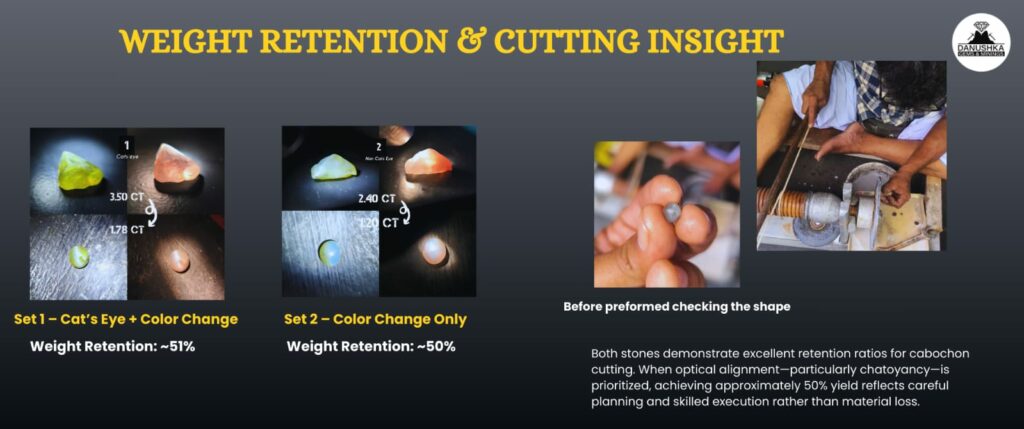
Cutting alexandrite—especially when preserving optical effects—is a process that demands precision and restraint.
Set 1 (Cat’s Eye + Color Change): ~51% weight retention
Set 2 (Color Change Only): ~50% weight retention
Such retention ratios are considered excellent for cabochon cutting, especially when optical alignment is prioritized over maximum yield.
Why Alexandrite with Both Effects Is So Rare
A chrysoberyl stone can show:
Color change only ✅
Cat’s eye only ✅
Both together ✅ (rare)
For both phenomena to coexist:
Chromium concentration must be ideal for color change
Fibrous inclusions must be perfectly aligned
Transparency must be sufficient to allow light transmission
Cutting orientation must be exact
Failure in any one of these conditions eliminates the dual effect. This is why alexandrite cat’s eye stones are rarely encountered and highly prized among collectors and connoisseurs.
Craftsmanship and Origin
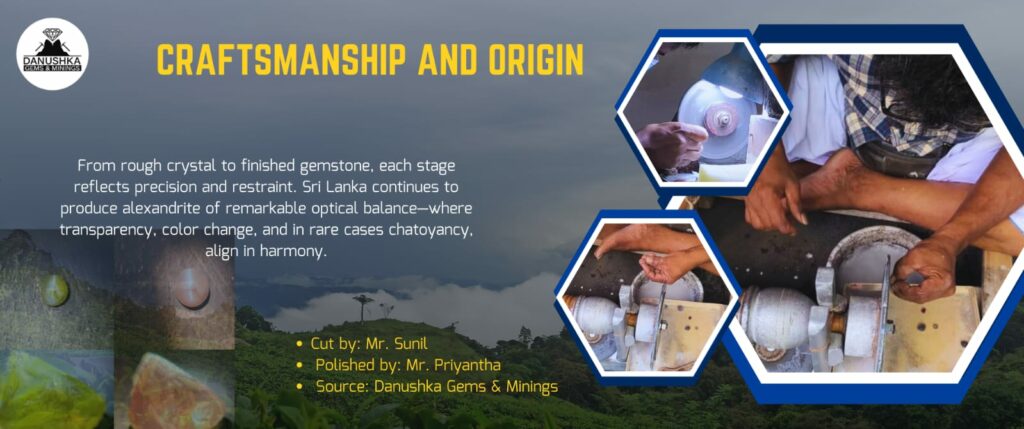
Origin: Rakwana village around mining in Sri Lanka
Cut by: Mr. Sunil
Polished by: Mr. Priyantha
Source: Danushka Gems & Minings
Sri Lanka remains one of the few sources capable of producing natural alexandrite with consistent optical quality, particularly in stones that balance transparency, color change, and chatoyancy.
Final Thoughts: More Than a Stone
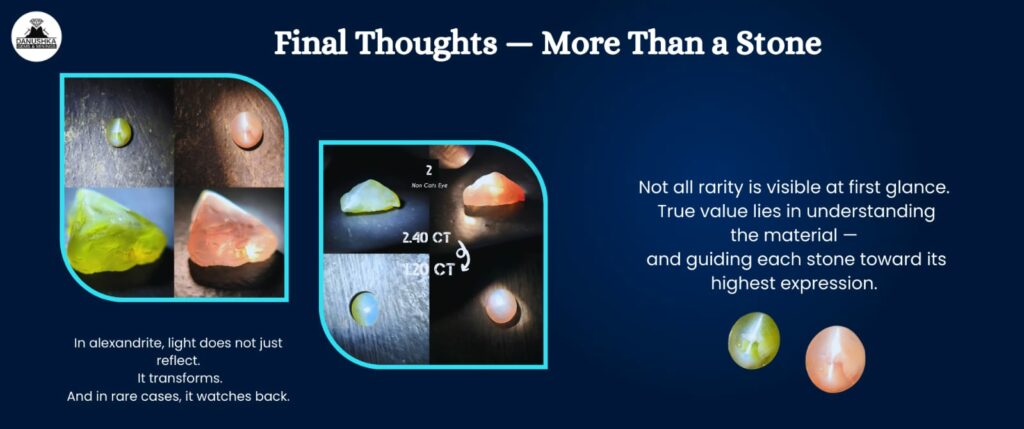
These two alexandrite sets illustrate something essential in the gemstone world: not all rarity is visible at first glance. True value lies in understanding material behavior, respecting natural structure, and guiding each stone toward its highest expression.
This is not simply about cutting gemstones—it is about revealing light, color, and motion locked inside the earth for millions of years.
In alexandrite, light does not just reflect.
It transforms.
And in rare cases, it watches back.
FAQ – Alexandrite from Rakwana
1.What is alexandrite color change?
Alexandrite is a chromium-rich chrysoberyl that shifts from greenish tones in daylight to reddish tones under warm or incandescent light. This natural optical shift is known as the alexandrite effect.
2. What causes the cat’s eye effect in alexandrite?
The cat’s eye (chatoyancy) is caused by aligned fibrous inclusions inside the stone. When cut en cabochon, these inclusions reflect light as a sharp moving band.
3. Is alexandrite with both color change and cat’s eye rare?
Yes. For both effects to occur in one stone, the crystal must contain ideal chromium levels and perfectly aligned inclusions. This combination is uncommon and highly collectible.
4. Why are these stones cut as cabochons?
Cabochon cutting preserves chatoyancy and enhances color concentration. Proper orientation is essential to maintain both optical effects.
5. Where were these stones sourced?
Both stones were sourced from Rakwana village around mining in Sri Lanka, a region known for producing high-quality chrysoberyl and alexandrite